Is this police force professional and capable of handling violen...
/ 2026-10-16 18:54:07Focus


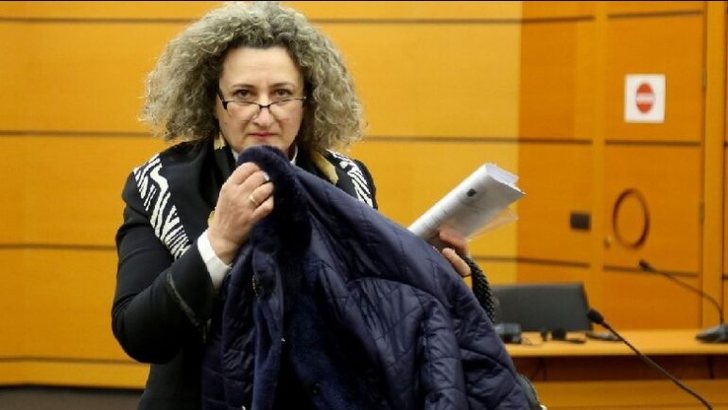
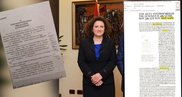
The High Judicial Council has submitted to the General Prosecutor's Office the complete file of the special judge, Irena Gjoka. The prosecution body, which has the competence to verify the self-declaration forms within the framework of the decriminalization law, has started the in-depth verification of the judge, after the publication of two decisions of the Greek authorities, which show her deportation in December 2002 for forging visa.
The first decision was taken on December 24, 2002 by the Greek border authorities, who denied her entry after the judge tried to enter Greece with a forged minority visa with the surname Shpata. In addition to the deportation, the Greek authorities imposed a 10-year ban on entering the Schengen area. The second decision was taken in 2004 by the administrative court of Ioannina, which overturned the appeal of judge Irena Gjoka for the annulment of the deportation and declaration of 'non grata' in Schengen.
Sources of Voxnews.al claim that the in-depth verification of the general prosecutor's office will focus on two directions. The first will be the self-declaration form completed by judge Irena Gjoka. The form will be administered and the judge's statements in it will be verified.
At the same time, the general prosecution will send a letter to the Greek authorities to officially withdraw the decision of the Ioannina court on the detention of judge Irena Gjoka, who at that time bore the surname Maneku.

In the event that the General Prosecutor's Office officially confirms the decision to expel Irena Gjoka, she not only endangers her job, but may also face court proceedings for the criminal offense of "falsification of forms", which is punishable by 1 to 4 years of imprisonment .
The highlights of the vetting and career of judge Irena Gjoka
Irena Gjoka was appointed a judge in the first instance of the Special Court in 2019, when she had not yet passed the vetting filters, neither in the Independent Qualification Commission nor in the Special Appeals College.
A year later, the Independent Qualifications Commission confirmed her in office, despite concerns raised by the international monitoring operation and the Public Commissioner about her assets. At that time, Commissioner Dariel Sina asked the KPA to overturn the decision of the KPK and dismiss Gjoka.
The review at the KPA took several months. Dariel Sina ran away from the position of public commissioner and his appeal to the Special Appeals College was handled by commissioner Irena Nino. Nino withdrew from the request for the dismissal of judge Gjoka and in June 2022, Irena Gjoka was confirmed in office.
According to the decision taken by the body composed of Sokol Çomo, chairman, Natasha Mulaj relator, with members Mimoza Tasi, Rezarta Schuetz and Albana Shtylla, Irena Gjoka had a reliable level in the wealth criterion, a reliable level for the figure and a good qualifying level .
In the two decisions on the confirmation in office of Judge Irena Gjoka, the two levels of vetting were based on the documentation submitted by the judge herself, as well as on the files deposited by other institutions charged by the law for the transitional reassessment of judges and prosecutors, such as the Directorate of Securing Classified Information and the High Inspectorate of Property Declaration and Control.

The vetting law charges DSIK to verify whether among Judge Gjoka's family or social contacts there are persons convicted, prosecuted, investigated, or accused as members of, or connected to, organized crime. The law requires the ILDKPI to file the annual declarations of the assets of the judge from the time she was included as the subject of the declaration of assets.
As for punishments inside and outside the country, the vetting law charges the subject of the reassessment itself, in this case judge Irena Gjoka, to declare in the form completed by her. But, according to the form filed by the judge in the KPK, at the point when it is asked if there is any decision against her from Albanian or foreign courts, the answer is no.
What would happen in the KPK if Irena Gjoka declared the sentence of the Greek court? The final assessment would again be in the hands of the vetting bodies and the interpretation they could make of this decision. But the example of the former member of the KPA, Luan Daci, who was fired and prosecuted because he hid a disciplinary measure in his career, suggests that even in the case of Irena Gjoka, the dismissal would be inevitable.
©CopyrightVoxNews
This article is exclusive to VoxNews, it is copyrighted according to Law No. 35/2016, "On copyright and related rights". The article can be republished by other media only by citing VoxNews and placing the source link at the end, otherwise any violator will be held responsible according to Article 178 of Law No. 35/2016.