Protests, violence, curfews: From France to Albania, why Europe'...
/ 2026-10-20 23:47:20Focus


The Strait of Hormuz had never been closed before, not for such a long period of time, nor to such a close to total blockade of maritime traffic. Such a situation did not occur during the two great oil crises of the last century, including the one associated with the Iranian Revolution of 1979. Nor did it occur in the final years of the long conflict between Baghdad and Tehran, when both sides were involved in what history knows as the “tanker war.”
Hundreds of ships were targeted during that period: Iraq attacked Iranian tankers, while Iran hit ships belonging to Saddam Hussein's regime, but also those of Kuwait and Saudi Arabia. In 1987, the United States, under the administration of President Ronald Reagan, intervened to protect the ships and guarantee maritime traffic.
Even during the most recent tensions in the region, when the Iranian leadership has frequently threatened to close the Strait, Hormuz was not blocked. Not even during the twelve-day war last June, when American aircraft bombed Iranian nuclear program facilities for the first time.
Now the situation has changed. The strait is practically closed to about 90% of its traffic. According to the average of usual passages, during the last six days about 500 ships - gas tankers, oil tankers, cargo ships or vehicle carriers - should have passed through this maritime corridor.
Satellite images show hundreds of ships clustered near ports in Oman, the United Arab Emirates, Saudi Arabia, Kuwait and Qatar, as well as several near Bandar Abbas in Iran. About two-thirds of them would be transporting energy to world markets: gas from Doha to China or refined products from Saudi refineries to Rotterdam.
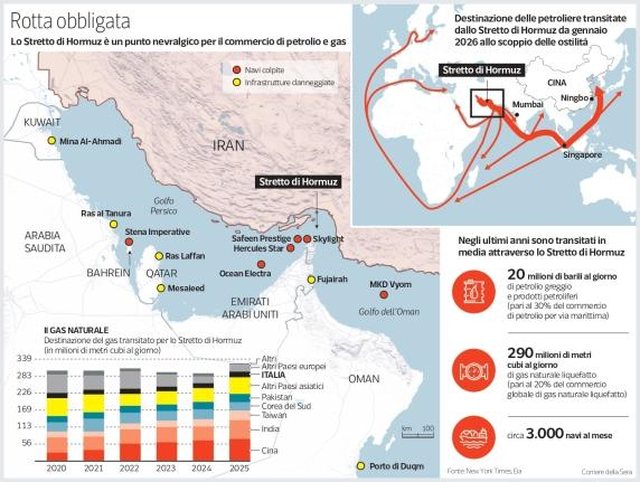
The Strait of Hormuz is one of the world's most important energy transport hubs. About a fifth of the oil and liquefied natural gas traded globally passes through it.
According to the International Monetary Fund, in 2025, about 34,000 ship crossings were recorded in this strait, ranking it eighth in the world in terms of the number of transits. However, it is considered the most sensitive point for the effects that could spread to the international economy from any crisis in its waters.
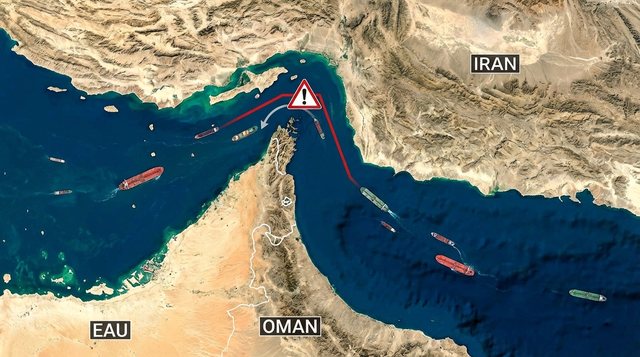
The strait takes its name from a small island opposite the Iranian port of Bandar Abbas. At its narrowest point, it is about 33 kilometers wide, between the Arabian Peninsula to the south (Oman territory) and the Iranian coast to the north.
However, navigable areas are even more limited due to the shallow waters and very strict navigation rules. Traffic takes place in two separate corridors: one for entering the Persian Gulf and one for leaving it, each about 3.7 kilometers wide and separated by a central free zone to avoid collisions between tankers.
The development that led to the current blockade also shows the fragility of the international economic system. In fact, the shutdown was not directly caused by Tehran.
Although the Iranian Revolutionary Guard warned on Monday that no one should pass through those waters, threatening attacks on ships, and even hit about ten vessels with drones or missiles, including the Palau-flagged tanker "Skylight" and the Honduran-flagged "Athe Nova," traffic had practically stopped earlier for economic reasons.
Since the launch of the Israeli-American operation on Saturday, the risk of incidents in the strait has increased so much that tanker rentals and insurance have become almost unaffordable.
According to Arctic Securities Research, the daily cost of chartering a large tanker carrying about 300,000 tons of oil has increased from about $50,000 in most of 2025 to about $480,000 today. Meanwhile, insurance against incidents for ships and crew has increased from about $1,000 per day to about $100,000 for this route alone.
In practice, the financial and maritime services systems have brought traffic in Hormuz to the point that Tehran had sought: paralysis.
In this context, former US President Donald Trump announced on Tuesday evening that the possibility of creating a military escort system for ships, as well as a low-cost public insurance scheme, was being considered.
However, it remains unclear how effective such a measure would be. Under normal conditions, about 60 oil and gas tankers pass through Hormuz every day, far too many to all be escorted.
Recent experience at another strategic point, the Bab el-Mandeb Strait at the entrance to the Red Sea from the Gulf of Aden, shows the limits of these measures. Since the beginning of 2024, Yemen's Houthi rebels have caused a drop of about two-thirds of traffic through the Suez Canal simply by attacking a few ships.
Despite military operations and bombing by European and American forces, traffic has not returned to previous levels. In the Red Sea, the calculation of risk and costs for shipping companies has changed steadily.
Experts warn that the same could happen with the Strait of Hormuz. Even after the guns fall silent, the economic consequences could last for a long time, raising another barrier to the global economy./ Corriere della Sera