Is this police force professional and capable of handling violen...
/ 2026-10-16 18:54:07Focus


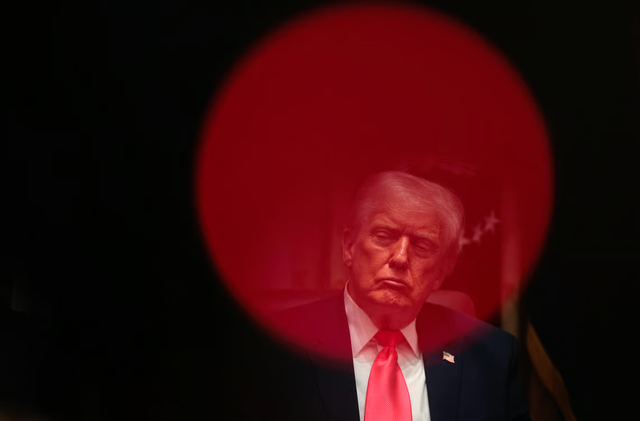
Let's try to reconcile the affirmative tone of the approximately thirty pages of the "national security strategy", published on Friday night by the White House, with the exclusive news from the Reuters agency, which states that from 2027, the leadership of NATO, and a series of obligations related to it, will have to be European.
The result is not far from the conviction that the Euro-Atlantic Alliance, as we have considered it until now, is at its end. And, the time has come to accept the fact that one chapter of history has closed and another must be written from scratch. Under the worst conditions, of course: without choosing the time and objectives, and immersed, as we are, in a situation of uncertainty with few precedents, in recent ages.
Take it or leave it, because this is the "Trump doctrine". In fact, the document, written in a rather rough way and not immune to contradictions, has a great quality. It forces us all to open our eyes to the fact that there is a clear ideological structure that drives President Trump's elections, although often difficult to decipher, due to its 'explosive' character.
Otherwise, it is a kind of manifesto, this is clear seeing that the reference to President Monroe's doctrine, which is much mentioned at this moment in the US, is enriched by what appears in quotation marks as the "Trump doctrine". So, the hand that has drafted the analysis seeks to tell us explicitly that this year of the Trump Presidency has not been a series of confused and wavering actions, but the application of this new doctrine of national and international politics.
Thus, the American president wanted to sanction the separation from Europe and its 'colonial stance towards the United States', that is, to establish America's right to self-determination, which then translates into an imperialist stance in the name of protecting American interests, the "Trump Doctrine" becoming his contemporary expression.
The focus is on the Western Hemisphere, which must be stable and protected from the dangers of mass migration, where governments, all together, fight drug cartels and criminal organizations and where access to strategic positions is guaranteed. And, not coincidentally, Trump has been talking about those strategic positions since the first day of his presidency. Strategic places are Panama and its ports, which are now in the hands of the Chinese; Canada, with which relations are increasingly strained; and Greenland, which continues to be his target for control of the Arctic and other materials.
Of course, it is reassuring to read that the American president at least says that he wants to support European allies in preserving freedom and security. But much less reassuring is the passage in which he speaks of the need to restore faith in Europe's own civilization and Western identity. For the fact that this could translate into much clearer intentions of intervention in the politics of European states, which is being talked about a lot these days.
However, the key issue, the key element remains to be observed as the dots are connecting one after another, in a clear picture. We recall the verbal attacks of JD Vance in Munich a year ago, the constant negative memories against Europe, accused of being a parasite, protected by the US, without devoting a sufficient part of its budget to defense, as well as the references to the dominant liberal ideology on the European continent.
The question would naturally arise as to why this heterogeneous mixture ends up inside the White House's strategic document, and the only answer is the assumption from which we started. It is not a strategic document, but a pamphlet of the Trump Doctrine, which holds together all the spirits that move behind him and have returned him to power. There is social conservatism, calls for the reindustrialization of the US and the reconstruction of the middle class, the technological and innovative drive that should keep the US in first place in the world.
And these ambitions are completely legitimate, of course. But, at the moment they go hand in hand with the weakening of the ties of the Atlantic Alliance, they force Europeans to become aware and make a decision about the role they want to play.
Otherwise, it is not the first time in history that Europe has had to do without the American umbrella; in fact, the opposite is true. This idea of American defense is more of a legacy of the post-war period, developed after two world wars. Today, things have changed. To add to the general uncertainty, the Trump doctrine has arrived, which may seem contradictory at times, but not unclear.
We Europeans have the task of renegotiating with each other and with History the role we want to play. We also want to make it clear that saying we are European has a meaning that is not negotiable. And this emphasis seems necessary, since another unspoken temptation of the new White House doctrine seems to be that of going back in time on the lessons of our History, treating us as separate nations.