"Condemned" protesters?! Who trapped Rama inside the Prime Minis...
/ 2026-10-23 16:02:00Focus


It is not news that the German economy is doing badly. Siegfried Russwurm, president of the Federal Association of German Industry, said in January: "Compared to most other large industrialized countries, our country is falling even further behind. We see no chance of a rapid recovery in 2024 ."
But very few people expected that the federal government would significantly revise the growth forecast for 2024 - from 1.3 to 0.2 percent. "We are quite surprised," says Almut Baler of the RWI Economic Research Institute in Essen.
There are good things…
Some things have developed positively. Inflation has fallen: last year the average inflation was 5.9 percent, while this year an inflation of 2.8 percent is expected. "According to the annual economic report of the federal government, inflation can be curbed," Finance Minister Christian Lindner said optimistically in the Bundestag.
It is also positive that the labor market is stable. About 46 million people are in regular employment in Germany, and this year an increase in employment is expected. Wages rose, so people had more money to spend and stimulate the economy. But consumption was not as expected - because they prefer to save.
The uncertainty is too great, criticizes Baler and blames politics for it. "Many hoped that things would improve if clear guidelines were given to manage the energy transition and the challenges of the future," he says.
Habeck and Linder - with opposite attitudes
The Social Democrats (SPD), the Greens and the Liberals (FDP) in the coalition have so far failed to have a clear direction. There have been continuous quarrels, especially between the Minister of Economy Robert Habeck from the ranks of ecologists and the head of the FDP and the Minister of Finance, Christian Lindner.
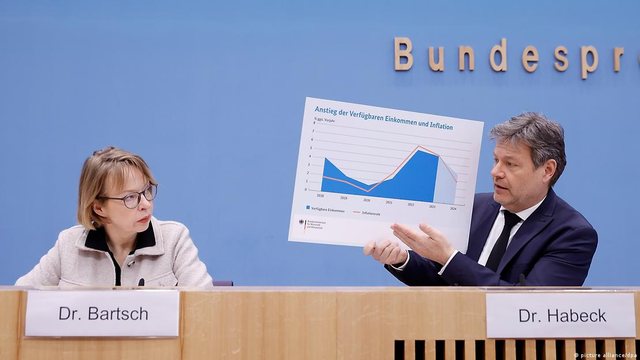
They both agree that Germany's competitiveness as a business location is under threat. At the presentation of the annual economic report in Berlin, Habeck spoke of an "extremely challenging situation". But while Lindner wants tax breaks for companies, Habeck wants a special debt-financed investment fund, which Lindner rejects. Habeck would not comment on these disputes. Now it is more important to deal with the reform projects approved by the government," he says.
Problem No. 1: lack of workers
Germany suffers from structural problems that have been building for years. The biggest problem according to Habeck is the labor shortage, which will worsen in the coming years and slow down growth. "We need all knowledge and skills, all hands and minds, all talents," he says.
What is needed, he believes, is more education, more opportunities for women and better incentives for older people to volunteer more. But more skilled foreign workers and a better integration of refugees into the labor market are also required.
The question also arises: "who are we as Germany?". I can tell you that if we don't see all these people as partners, friends and Germans, then our economy will fail."
Renewable energy sources must be massively expanded, industrial processes must be made climate neutral through subsidies. Unnecessary bureaucracy should be reduced.
Trade relations with other countries should be expanded, there should be more social housing and the transport infrastructure should be modernized. A total of 70 billion euros of investments are planned for 2024. In addition, there are another 49 billion euros from the climate fund that can be used.
Too many unnecessary laws
It is not only companies that are watching with great interest what decisions the government is making. The SPD, the environmentalists and the FDP are far from their target of building 400,000 new apartments every year. The reduction of bureaucracy, announced since the beginning of this government, is not happening.
"We have a lot of unnecessary laws. If we remove them we would lose nothing," says Clemens Fuest of the Ifo Institute for Economic Research in Munich. Previous governments are also to blame. "But we have a large increase in the burden, an explosion of the planned economy, we have interventions that burden the economy".
Will energy be affordable again soon? Economy Minister Habeck sees a glimmer of hope when it comes to energy prices. Gas and electricity are significantly cheaper. "Energy prices are not yet where we want them to be, but they have fallen faster and significantly than we could have expected a few months ago."
Those who need a lot of energy - let them go abroad
But is this enough to survive in international competition? Marcel Fratzscher, president of the German Institute for Economic Research (DIV), doubts this: "In the short term, nothing will change because energy costs in Germany will remain significantly higher than in other economies that were not so dependent on Russian gas and oil," says Fratzscher.
He believes that financial (state) support for companies that use large amounts of energy is the wrong approach. "Transformation means that you can't cement existing structures, but you have to allow change. So it's not bad if some companies that need more energy move production and jobs abroad."
But on the other hand, promising industries should be promoted. "This strategic orientation with a plan, priorities and, above all, a coordinated European policy, is what we lack at the moment," concluded Fratzscher. DW