How Belinda Balluku is fabricating the rumor about Top Channel's...
/ 2026-10-19 16:19:54Focus


Dressed in a wig and disguise, 10 military checkpoints and a wooden boat – The details that make the escape like a Hollywood movie
María Corina Machado began her dramatic escape on Monday afternoon, wearing a wig and disguise, leaving the outskirts of Caracas, where she had lived in hiding for more than a year.
The goal: to arrive in Norway by Wednesday to receive the Nobel Peace Prize – one of the boldest political acts by an opposition leader in modern Venezuelan history.
The secret operation, prepared for about two months, involved an extremely dangerous itinerary: from Caracas to a coastal fishing village, from there by wooden boat through the Caribbean, and then a private flight to Oslo.
10 hours through military checkpoints
According to a person close to the operation, Machado traveled for about 10 hours, passing 10 military checkpoints, each time risking capture. She arrived at the coast around midnight, where she rested for a few hours before heading towards the most dangerous stage: the sea crossing.
At 5 a.m. on Tuesday, Machado and her two associates boarded a simple wooden skiff, battling strong winds and rough seas toward Curaçao.
The danger did not come only from the Venezuelan authorities. In the past three months, the US military had bombed over 20 similar naval vessels in the Caribbean, killing more than 80 people it accused of drug trafficking. For this reason, the Venezuelan network that was helping Machado coordinated with the US military.
"We announced exactly the area where it would depart from, so they wouldn't blow up the boat," said the person involved in the plan.
American intervention and military presence in the region
Various sources said the Trump administration was aware of the operation, although the level of US involvement remains unclear. At the same time as the boat was sailing towards Curaçao, two US F-18 jets entered the Gulf of Venezuela, conducting about 40 minutes of maneuvers around the potential sea route.
The US has also deployed the aircraft carrier USS Gerald Ford to the region, loaded with dozens of fighter jets - part of a military buildup that has further strained relations with Caracas.
Vacation in Curaçao and final flight to Oslo
Machado arrived in Curaçao around 3 p.m. on Tuesday, exhausted from the journey. She stayed one night in a hotel and on Wednesday morning boarded a private jet to Oslo, arranged by an associate in Miami.
Before takeoff, she recorded an audio message, thanking “so many people… [who] risked their lives” to make her escape possible.
Her journey was kept so secret that the Nobel Institute itself did not know whether Machado would arrive in Norway in time. During the ceremony, the chairman of the Nobel Committee, Jørgen Watne Frydnes, said that she had undergone “a journey in conditions of extreme danger.”
The award was received by her daughter, Ana Corina Sosa, who declared to those present: "She will return to Venezuela very soon."
After Oslo: Europe, the US and a new political battle
Machado is expected to rest for a few days in the Norwegian capital. He has lived in total isolation, with little food and no physical contact with people for almost 16 months.
In a week, she intends to embark on a European tour to solicit support for the Venezuelan cause and then travel to Washington, according to her associates.
Meanwhile, in Oslo, as guests sat down to the official five-course dinner served on special Nobel service, details of her escape were circulating among diplomats and officials from the US and Venezuela.
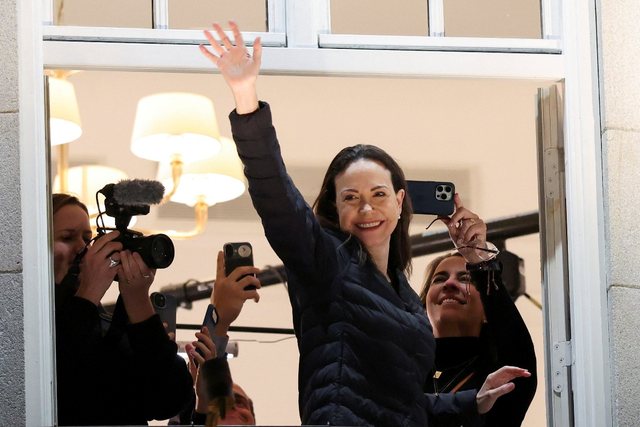
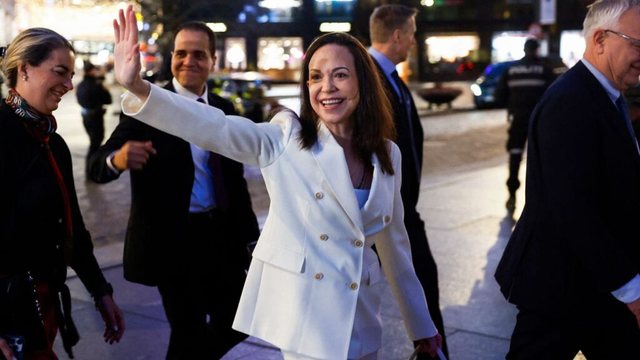
At the historic Grand Hotel building, Machado then appeared before supporters from the balcony - a symbolic moment, after a trip that challenged the Venezuelan regime and reinforced her status as a central figure of the opposition.
The Maduro regime's reaction
In Caracas, officials erupted in accusations. Vice President Delcy Rodríguez called the escape a “failed show” and accused Machado of collaborating with the US in “the plundering of Venezuela’s assets.”
The attorney general, Tarek William Saab, has warned that the opposition leader will be considered a "fugitive" if she does not return, leaving open the possibility that Machado will no longer be allowed to enter her country.
Will her departure harm or strengthen the opposition?
Although leaving the country carries the risk of political isolation – as has happened with other Venezuelan leaders in exile – opposition figures believe Machado will be even more powerful abroad, able to lobby, mobilize international supporters and push for more economic and diplomatic pressure on Maduro.
She has publicly supported the US military buildup in the region and declared: "Maduro started this war, and President Trump is finishing it."