Is this police force professional and capable of handling violen...
/ 2026-10-16 18:54:07Focus


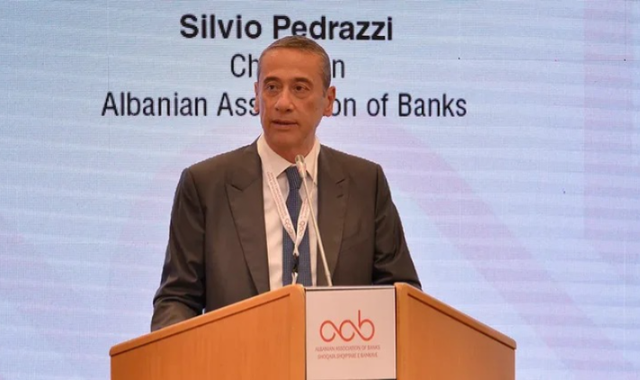
Yesterday, almost every media outlet reported the official launch of the Albanian Development Bank , a new financial institution with 100% state capital that promises to help businesses, startups, and the Albanian economy.
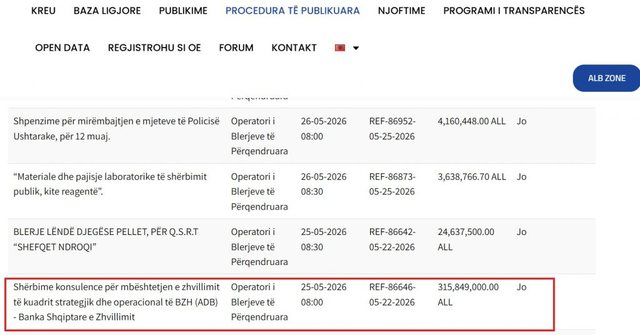
But while the propaganda talked about development, the documents show that the bank, before it even started work, has opened a tender of 315,849,000 lek for "consulting services to support the development of the strategic and operational framework of the BD".
So over 3 million euros just to show the bank how it should function!
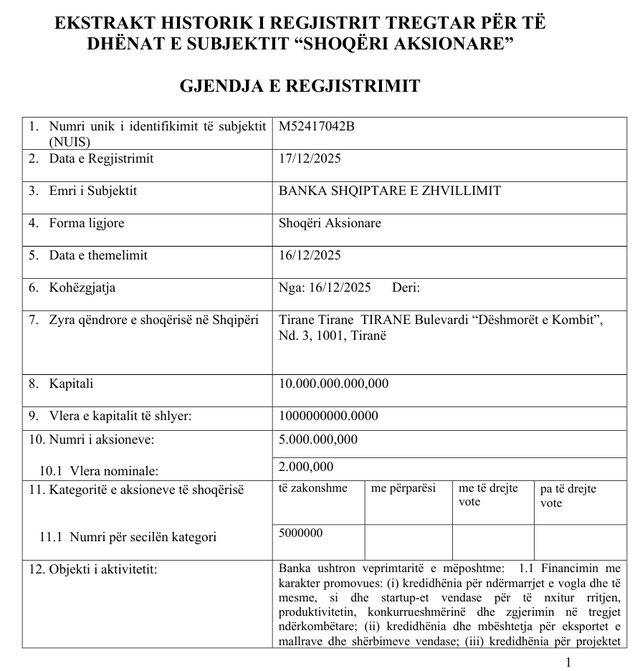
In the Central Bank of Albania, the Albanian Development Bank is registered with a registered capital of 10 billion lek, while the capital paid up so far is 1 billion lek from the Albanian state.
The bank's administrator is the Italian Silvio Pedrazzi , while Irida Huta, Arben Shkodra, Eris Hysi, Artur Asllani and Daniel Marc Demeulenaere have been appointed to the Supervisory Board .
However, even though we are dealing with an institution that is financed with public money, there is no transparency regarding the salaries of the administrator, the council members, the newly recruited employees, the operating costs or administrative expenses of the new bank, along with the rent they pay to the ABA Business Center and Bashkim Ulajt.
Meanwhile, the bank's own objective, according to the statute published in the Central Bank, is to finance small and medium-sized enterprises, Albanian startups, exports, public projects and the country's economic development.
But the bank that was created to finance development is starting out by financing itself.
The 315 million lek tender is not about building a banking system or advanced technology. Essentially, it is about the basic documents of the bank's functioning: strategy, operational organization, how loans will be granted, how risk will be managed, how the institution's procedures and policies will be built.
So the Albanian state has established a bank with an administrator, staff, supervisory board, and public capital, but is paying millions of euros more for someone from abroad to write the way it should function.
And this is just the first phase.
The statute itself provides that the bank's capital will be gradually repaid by 2029, with other billion-dollar injections from the state budget.
In a country where small businesses complain every day about a lack of credit, where Albanian startups survive without support, and where universities cannot even finance their laboratories, millions of euros are initially going to purchased consultancies, structures, boards, and strategies.
The Albanian Development Bank was presented as an instrument to develop the Albanian economy. So far, it is emerging as another structure that absorbs and disappears public money before producing any concrete effect for citizens./ Kontrast