Is this police force professional and capable of handling violen...
/ 2026-10-16 18:54:07Focus


On September 10, 2021, just five days before the deadline for submitting bids in seven tenders for segments of the Tirana Grand Ring Road – a procurement package worth around 18 billion lek, or 148 million euros at the current exchange rate, Minister of Infrastructure Belinda Balluku urgently called Evis Berberi, then head of the Albanian Road Authority, to the office.
The meeting took place at 11 a.m., according to the decision of the Special Court that later decided to suspend the government's number two from office. What was discussed at that meeting remains unclear. But two hours later, phone exchanges between Balluk and Berber reveal the way in which beneficiaries of public money were selected.
“Wait a little while for Ilir Shtufi and Nova and make it clear that you are going with EUT. And don't see him anywhere else,” the minister wrote. Berberi met Shtufi that same afternoon and reported back: “I met him ok.”
According to the prosecution, “EUT” referred to the company “Euroteorema”, while “Nova” was “Nova Construction 2012”, Shtuf’s business. Four days later, these two companies and a third, “PE-VLA-KU” sh.pk, signed a partnership agreement. The next day, on September 15, they were announced as winners of the tender for the construction of the “Tirana Outer Ring Road, Lot 4”, with a fund limit of 2.5 billion lek.
For prosecutors, the messages from that day are evidence that the minister directly influenced the formation of the operators' union and, consequently, the outcome of the competition, a result that, according to them, was accompanied by unjustified tolerances by the Bid Evaluation Commission, despite the disqualifying criteria in the documentation.
Although the SPAK investigation focuses on Lot 4, an analysis of the procurement procedures for all segments of the Tirana Ring Road, conducted by BIRN, suggests that competition between operators was lacking and the bids that were declared winners were very close to the limit fund. According to public procurement experts, in these cases the numbers speak for themselves.
“Overall, in this sector, due to the large concentration of budget funds, the close ties of domestic lobbyists and foreign 'friends' of Prime Minister Rama, corruption remains a challenging problem for SPAK and other law enforcement agencies,” said Zef Preçi, director of the Institute for Economic Studies.
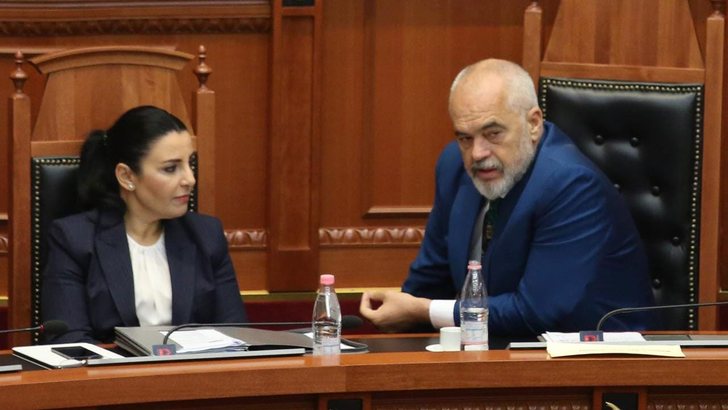
Belinda Balluku was indicted two weeks ago on charges of violating equality in tenders. On Thursday, she was suspended from duty by a decision of the Special Court and banned from traveling abroad.
In a statement to Parliament on Wednesday, she described the criminal charges against her as "mud, innuendo, half-truths and lies."
Predetermined procedures
The Tirana Ring Road is the largest road project within the capital, a circular road that aims to create a traffic circle around Tirana to avoid traffic passing through the city center. This road has a length of 28.7 kilometers and 45.9 billion lek (450 million euros) have been procured for its construction.
Data obtained by BIRN through the Right to Information Act from the Albanian Regional Agency for Regional Development (ARRSH) shows that in 2021, immediately after the parliamentary elections, funding for the Grand Ring Road experienced a boom and 7 tenders were awarded, recording the highest annual rate of budget spending.
Messages between Berber and one of his subordinates, identified as Miranda Shkurti, also charged with this tender, show that on Thursday, August 12, 2021, ARA officials worked long hours to make the tenders public and complete the documentation required in the Public Procurement Agency's online application.
All the while, Berberi, even without sleep, was controlling the process. At 11:09 PM, he wrote to Shkurti, head of public procurement at the ARRSH: "Throw it after 12 so that we can rest easy tomorrow because they will make us furious."
The rush, as the messages show, was related to the requirement that the bids be opened on September 15 and the publication should be done on time. But the investigation, focused on Lot 4, shows that the entire procedure was a bureaucracy that had no impact on the final result.
In fact, subsequent conversations between Balluku and Berber show that the winners and the way they would participate in the competition were determined in advance. Just four days before the opening of bids for the seven tenders, Balluku directs a consortium of companies to participate in one of the competitions. In messages, she conditions one of the companies that was expected to be among the winners not to participate in the other competitions.
In addition, the prosecution says that the minister and her subordinates did everything to keep the process under control. Of the eight participants in the competition, seven were disqualified because they did not meet the criteria; among them was a company that was declared the winner in another lot of the competition for the Grand Ring Road, opened that same day. More than that, some of the bidders went to the tender “with their hands in their pockets”: without an economic offer, without basic documents such as a bid security or a self-declaration.
But, although everything seemed to be in order and the rivals in the competition disqualified, the prosecution says that the administration under Balluk had to turn a blind eye to a series of problems of the winning operator. The prosecution found that the union of operators, in the criterion of "similar works", had presented works that were not related to roads at all.
"It turns out that the object of these contracts presented as 'similar works' is the construction of residential buildings, while the object of the procurement contract concerns construction works for highways and roads," the request for a security measure for Balluk and others states.
The prosecution says that the investigations clearly showed that the minister and her subordinates had illegally assisted the winner.
"Citizen Belinda Balluku, in her capacity as Minister of Infrastructure and Energy, in collaboration with the head of the contracting authority, citizen Evis Berberi; members of the Procurement Unit, Jonida Avdolli, Adrian Kroi, Denis Xhoxhi; as well as members of the Bid Evaluation Commission, citizens Erald Elezi, Klarita Konomi, Miranda Shkurti, have created unfair advantages and privileges for the merger of the winning economic operators 'Euroteorema Peqin' sh.pk, 'PE-VLA-KU' sh.pk and 'Nova Construction 2012' sh.pk, acting in violation of the law," the document states.
Lack of competition
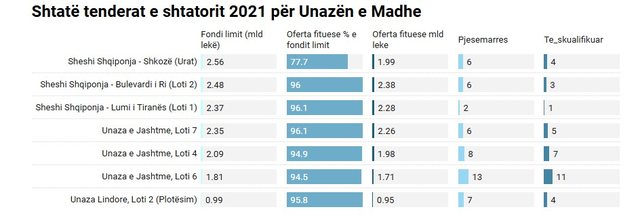
Of the seven tenders on September 15, including “Lot 4,” six were won with amounts ranging from 94.5% to 96.1% of the limit fund. Of the 48 companies that participated in the competition, 35 operators – or 73% – were disqualified. In some cases, large companies were eliminated from the competition for lack of basic documentation, such as failure to submit a staff list; in other cases for unusual technical criteria, such as the lack of a specific noise license.
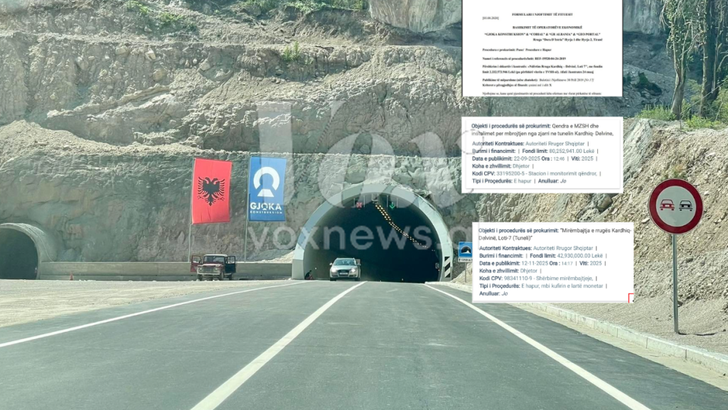
This case comes as the second accusation of bid-rigging against the deputy prime minister, who was suspended from office by the Special Court. In addition to the Ring Road case, Balluku is also accused of bidding for the Llogara tunnel construction tender, for which she was indicted on November 3 of this year. She has denied the charges.
On the other hand, BIRN data shows that this is not a 2021 anomaly, but part of a pattern that has been occurring for many years. An analysis of 21 out of 23 tenders for the Tirana Ring Road, where 45.9 billion lek were awarded between 2011 and 2024, shows that ten procedures were won with more than 98% of the limit fund, the rest with over 94%; while in only two tenders did the competing companies submit bids that saved the budget over 20% of the fund.
Experts say the tenders, many of which had only one qualified bidder, present a number of red flags and signs of a lack of competition.
In 21 Ring Road tenders, this has translated into overpayments of 30–60 million euros.
Eduart Gjokutaj, director of the ALTAX center, says that these figures are consistent with a distorted market and emphasized the large loss that the budget suffered due to this distortion.
“In 21 Ring Road tenders, this has translated into overpayments of 30–60 million euros,” he said.
"Institutional investigations have confirmed recurring patterns of disqualifications, which may reduce trust in public procurement mechanisms," Gjokutaj added.
A repetitive scheme
The procurement for Lot 4 is not the first time that a procedure for the construction of a segment of the Tirana Ring Road has been found to be manipulated.
In 2018, a scandal erupted when it was revealed that DH Albania – a Delaware-registered company that had won a 2.2 billion lek tender for the construction of the “Shqiponja” – “Palace of Arrows” roundabout segment – was in fact a shell company. The scandal ended with the company’s administrator being sentenced to 6 months in prison for falsifying documents.
SPAK's investigations against Ballukur do not currently appear to have progressed beyond the Lot 4 procedures, but data collected by BIRN on the tenders for various segments of the Grand Ring Road show that they suffered from the same syndrome, raising suspicions of pre-determination of the winners.
According to Zef Preçi, the lack of competition in public tenders for infrastructure has become the norm during the Socialist Party's government.
"In recent years, a large number of procedures have been conducted with a single bidder, reducing competition, because in many cases the bids are predetermined," he said.
In the 21 procurement procedures for the construction of the Tirana Ring Road, the number of companies disqualified from the competition has ranged between 85% and 95% of participants.
Nearly half of the tenders were conducted with only one qualified company.
Tender data shows that some companies were included in the competition simply as numbers. In almost all procedures, there was at least one company that did not submit a financial offer.
"Most companies are disqualified for formal errors, such as the lack of bid security or 'failure to declare staff,'" said expert Eduart Gjokutaj.
"The repetition of these disqualifications suggests a participation that has no real impact on competition, producing an effect similar to 'bid rigging' from a competitive analysis perspective," he added.
Gjokutaj explains that, based on estimates from the Organization for Economic Cooperation and Development, OECD, such disqualifications could increase public budget costs by 20–30%.
“This phenomenon corresponds to the economic model of 'market sharing' in oligopolies, where a few companies control over 70% of infrastructure tenders,” he said, referring to a report by the Competition Authority.
In addition to massive disqualification, the phenomenon of “tender rotation” was also observed in tenders. This was documented for the first time in the Grand Ring Road in 2011, when the Competition Authority, after investigating the case, found that although there were strong indications of bid rigging — such as bid rotation and almost 100% proximity to the limit fund — “the investigation did not find direct evidence of collusion between the winning enterprises (Gener 2 Sh.pk; the Albavia & Favina & Alpin Srl merger; and the Gjoka Konstruksion & Gjikuria merger).”
But the phenomenon may have continued in subsequent tenders, although the number of participating companies has formally increased, creating only the illusion of competition. Analysis of the documentation shows that companies, which have previously built complex works, suddenly “forget” to submit a license certificate or provide accurate bid security in a procedure that ends up being won by their “rival”. The same rival makes similar mistakes in another procedure that goes to the first company.
This pattern of "intentional errors" is key to understanding how peace is maintained in the market: large companies enter the competition only to fill the number of participants, but submit deficient documentation to voluntarily disqualify themselves, paving the way for the predetermined winner without having to lower the bid price.
"Corruptive collaboration between operators, leading to the use of the limit fund close to 100%; the presentation of false data; market sharing; or the use of other companies 'on behalf of each other' [is done] only to avoid transparency," said Zef Preçi, director of the Institute for Economic Studies.
Gjokutaj, for his part, says that SPAK's investigations into these tenders have confirmed a pattern that is constantly repeated.
“This coherence of the models matches the evidence that SPAK has documented in cases such as the Llogara Tunnel and the Grand Ring Road,” he said.
According to him, this is evidence of an economically related phenomenon of "rent-seeking" and "institutional capture".
He says the cost is high, reducing GDP growth potential by 1–2%, according to IMF regional analyses.
"Financially, the model could cause public budget losses of tens of millions of euros," Gjokutaj concluded./ reporter.al