Is this police force professional and capable of handling violen...
/ 2026-10-16 18:54:07Focus


In our markets, every product has a story. A story that we rarely know.
Meat sold as fresh may have been in and out of refrigerators, perhaps even sitting there for days.

Milk, whose label claims to be natural, has added ingredients that are not listed anywhere on the label.
Or the fruits that entice from afar by appearing ripe and "healthy", although they do not have an equally healthy history, the reality is that they speak from afar by calling out the name, pesticides.
Sometimes pesticides exceed the permitted norms, and yet most of us choose to put them on our plates, sometimes asking questions and sometimes buying in silence.
Institutions control but do not always prevent. Even the information that circulates is often truncated or contradictory.
The result?
The Albanian citizen finds himself faced with a dangerous paradox, faced with unsafe food, and even unsafe information.
These two risks, combined together, leave him (the poor citizen) defenseless.
Alarms about contaminated products suddenly erupt and then fall silent as suddenly as they began, creating a complicated battle to understand the truth.
This battle starts with the simplest but most fundamental question: What are we eating, people?
While the National Food Authority (NFA) regularly publishes announcements that are indicators of poor food safety, those announcements rarely attract an audience.
They often pass as small news, without analysis, clarification, and instructions for the consumer.
There are countless cases where products are removed from circulation after they have been on the market. This shows a clear and major problem: Control comes after consumption and not before it. This issue in itself does not remain a technical issue but a public health issue.
According to official announcements from the National Agency for National Economy, in recent months alone, several daily consumer products have been blocked due to irregularities in composition, labeling, and storage conditions. Cause gives rise to effect, and effect comes from cause.
Among those products is pork and beef that have been found to have high bacterial presence during inspections at slaughterhouses and storage points. Meat that we regularly buy in stores.
Milk and its by-products resulted in high microbial loads, making these products potentially dangerous for consumption.
And we continue to think that if we leave the house in the morning after drinking a glass of milk, we get the right vitamins to start the day with energy. Eh…
The product may be removed from the market, but the citizen who bought it yesterday never finds out.
Interesting or not?
This is where the second problem begins - Information is not distributed in real time and in the right form.
In Tirana, where the food market is the largest in the country and also the most diverse, food safety is perceived as guaranteed simply because it is considered a big city.
Relite lives differently. Supermarkets, markets, shops, and street vendors coexist in the same supply chain.
It is the consumer who is faced with dozens of brands, most of which do not contain complete information on either the origin or the ingredients.
And what does he choose to be sure that he is making a safe choice? He buys the product that has the highest price with the thought that it will be the best quality. Hahah. Welcome to the labyrinth of marketing, dear citizen!
The health consequences are those that the entire population panics about. The diseases that come as a result of the contaminated contents of the foods we happen to buy are seemingly common and therefore underestimated: vomiting, sudden abdominal pain, headaches, slow digestion, and then progressing to more serious diseases such as cancer.
The efforts of special structures regarding food security in the country are not always effective.
It is worth saying that the existing legislation has shortcomings; it does not yet have a complete law on animal health, covering all steps, from farm to consumer.
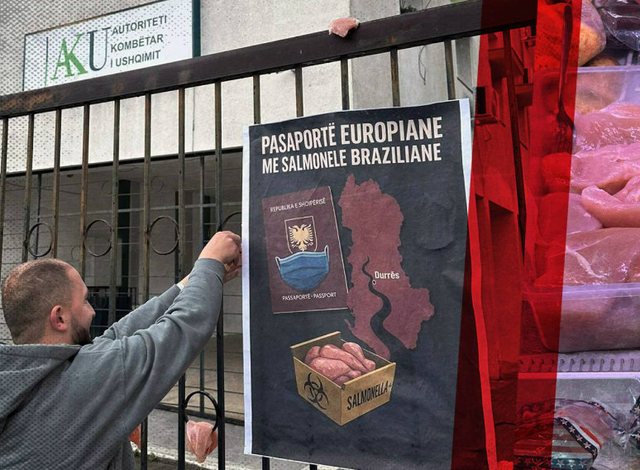
The salmonella case (imported from Brazil) has not resulted in hospitalizations, indicating that there are still problems with traceability and documentation.
The draft law in Albania currently proposes the creation of three new institutions for the official control of food, animals and plants, but there is still no announcement as to whether this decision will proceed or not.
This party is not the only one with a leading role. The media, including journalists, also plays a leading role.
In this case, our role doubles, communicating information and at the same time protecting our own and public health.
Free and professional media and journalism have a form of impact, being an instrument of control for authorities and businesses, they can achieve by being under the pressure of coercion and control, to make them exercise efficient, safe and trusted decision-making by citizens.
So far, the authorities have resulted in insufficient control, the import of suspicious products, and a lack of awareness.
The issue remains unresolved. While the laws exist, along with the laws, there is a lack of implementation and abusive practices.
These make this a serious challenge. An integrated approach is required that includes all state authorities, producers and even the consumer himself.
The problem continues…