Is this police force professional and capable of handling violen...
/ 2026-10-16 18:54:07Focus


Amira Hass* - Haaretz
My friends in Gaza will soon be ordered to be “evacuated” from their temporary shelters and “swallowed” in the southern part of the Gaza Strip, just as my parents were once “evacuated and swallowed”: my mother in Bergen-Belsen, my father in a ghetto in Transnistria.
The language of the army, full of lies, pollutes every report, every discussion. This is not the problem of my tired and hungry friends. It is our problem, the Israelis. So is the cry of those who are willfully blind and those who stubbornly insist: “You should never make comparisons.”
Minister of War, Israel Katz, made a promise and is keeping it: The mission of displacing and transporting, concentrating and compacting, crushing and destroying hundreds of thousands of other people on a small piece of land south of Gaza is continuing, unabated by protests, condemnations or historical parallels.
No one is saving the Palestinians, the hostages, or us from our own disgusting selves.
I write, still hoping for a miracle. That Europe and the Arab states will wake up. That they will use the levers of power that are actually in their hands.
The bombings of our heroic pilots, the cannons of our brave commanders will ensure that Gaza City is emptied of people and crushed by bulldozers driven by the joyful and God-fearing Zarvivites.
Israeli soldiers are filled with values, raised to perform meaningful military service. Even those who protest with their parents and families of hostages against the government do not refuse the call or disobey orders.
When the Chief of Southern Command, Yaniv Asor, declares Gaza City a “criminal zone,” every soldier will have permission to shoot anything that moves. Even a 78-year-old woman. Even her 12-year-old grandson.
I can already hear those who will say without hesitation: It's their fault; we gave them time to evacuate to the south.
The protesters on Kaplan Street have one remaining lever to thwart the decisive plans of Prime Minister Benjamin Netanyahu and Finance Minister Bezalel Smotrich, plans tied to Putin-style regime change: a mass refusal to participate in these campaigns of destruction and expulsion.
But they don't use it. For them, the flag is never black enough.
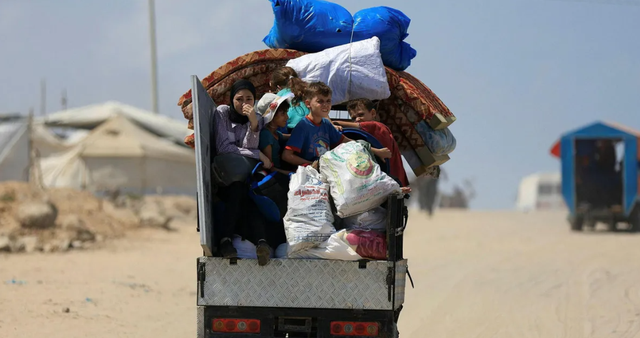
My limited imagination does not allow me to think of my friends and their families, weak, sick, grieving, being evicted for at least the eighth time, trying to find another unknown place, in an even smaller and more crowded piece of land than the previous one. In a cart? On foot for 20 kilometers? Running, breathless, while shells chased them, columns of smoke and dust rising behind them?
My terrified imagination refuses to see those who remain in half-destroyed homes, despite the horror advice of IDF spokesman Avichay Adraee, praying for a quick death from the bombings.
Their apartments in the refugee camps, built and bought with years of wages, have become smoking, crumbling walls. Of the few things they have managed to collect or improvise since the last expulsion, mattresses, pots and spoons, firewood, blankets, maybe even a solar panel… what will they be forced to leave behind this time?
Certainly not the sack of flour they bought for 1,000 shekels. Not the 20-liter canister of water, half-clean. Not the diapers for their 90-year-old mother.
My inadequate imagination doesn't understand where, among all the packed tents, they will place theirs.
Where they will sweat until winter, then shiver to the core as rain and rising sea waves drench them, between one round of bombing and another. And the drones overhead will buzz nonstop, day and night.
Terror. Longing. Hunger. Thirst. Itchy skin. Pain. Anger. Exhaustion. A sick child crying. The words are the same, but in Gaza they carry a weight, a substance, a volume that we cannot understand.
Words have fallen from my vocabulary, except for these: “helplessness,” “paralysis,” and also “complicity in crime against our will.”
*Amira Hass is an Israeli journalist and writer, known primarily for her columns in the daily newspaper "Haaretz" covering Palestinian issues in Gaza and the West Bank, where she has lived for nearly thirty years.