Is this police force professional and capable of handling violen...
/ 2026-10-16 18:54:07Focus


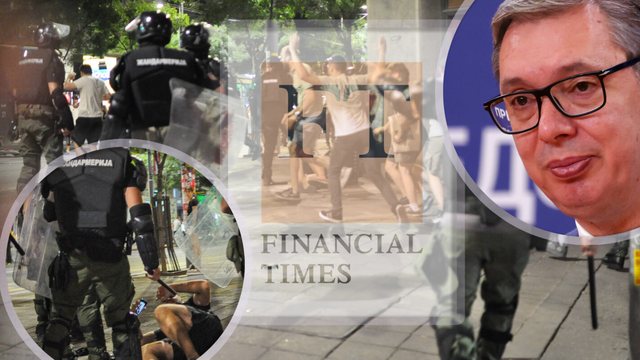
Editorial from the Financial Times board
After a decade in power, veteran government leaders face a dilemma: Will they increase repression and undermine any free media that exists, or will they reach out to the opposition for reform? This has happened often around the world since the Cold War. Autocrats usually resort to the former option and become even more ruthless.
Now, with protesters in the streets, it is time for Aleksandar Vučić to make a choice.
For 8 years as Serbia's president and before that as prime minister, he has ruled with an iron fist, but his country remains a managed democracy and has not turned into an autocracy. Vučić has maintained balances on the global stage. He has maintained relations with Moscow without straining relations with the EU and the US; he has turned a blind eye to Serbian arms sales to Ukraine. He has asked Beijing for billions of dollars in investment.
Although Serbia is only a candidate country for EU membership, Vučić has close ties with the bloc's leaders, from Macron to Ursula von der Leyen. He also developed a good relationship with Donald Trump's relatives during his first term in the White House.
Vucic’s defense routine may be worth studying in other countries. But at home he is running out of steam, as frustrations with his irresponsible and opaque rule have turned into protests. The spark was the collapse of a train station tent last November in the city of Novi Sad, which killed 16 people. The station had been renovated by a Chinese company under China’s Belt and Road Initiative. Vucic’s opponents blame the collapse on state corruption, poor governance and weak oversight, which they see as hallmarks of his regime.
Since November, opposition demonstrators have taken to the streets and demanded early elections. Last week, he faced the most violent protests ever between civilians and police. Over the years, Vučić, an extreme nationalist in his youth, has spread the spirit of pro-Serb sentiment and the reunification of territories where Serb minorities remain, such as in Bosnia and Kosovo. That card is no longer as strong in his game.
Vučić can clear the way for the media, for the opposition, and allow independent investigations into government scandals, but that is not the path an autocrat chooses. He is thinking of cracking down and hitting harder.
Britain and Europe have spoiled it for too long.
Realpolitik does not want Serbia to slide into Russia's orbit, but this now seems impossible. Vučić must be pushed towards responsibility and fair elections; this is the only hope for EU membership.
The other alternative is to suffer like Georgia, which has turned into a fake democracy over which the EU has no influence, except to make statements.
America seems to have forgotten the Balkan basin for the time being.
But the UK and the EU, no. They need to act and use economic leverage.
If they don't and Serbia sinks deeper into the pit of authoritarianism, the fault will not only be Vučić's, but the entire West's that is now playing tricks.