Is this police force professional and capable of handling violen...
/ 2026-10-16 18:54:07Focus


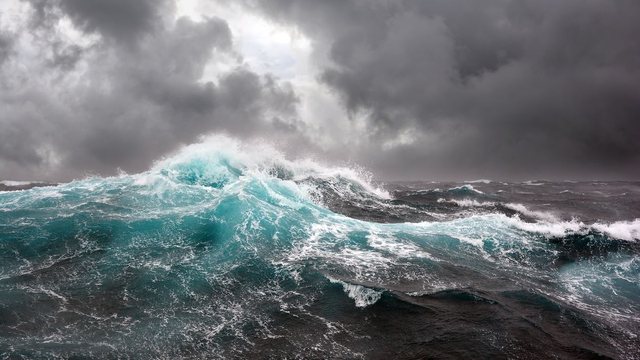
Scientists say the discovery is "very worrying", as the collapse would be catastrophic for Europe, Africa and the Americas.
There is a moment in every major global crisis when uncertainty disappears – not because the situation improves, but because the data begins to agree on the worst-case scenario.
This is exactly what is happening with the Atlantic Meridional Overturning Circulation – the Atlantic current system that functions as an invisible engine of global climate.
For years, scientists have debated how fast it is weakening. Now, for the first time, the answer is becoming clearer. And scarier.
Climate models have always been divided. Some suggested a moderate slowdown by the end of the century. Others warned of a drastic decline.
The problem was: which ones should be believed?
The new study doesn't add another opinion to this debate. It narrows it. By combining real ocean data with simulations, the researchers reached a conclusion that changes the entire narrative: the "pessimistic" models are the ones that best match reality.
This means that a slowdown of 42% to 58% by 2100 is no longer an extreme scenario. It is the most likely scenario.
And in this system, such a weakening is not just a decline. It is the brink of collapse.
How a system that can be stopped works
The Atlantic Meridional Overturning Circulation transports warm water from the tropics towards Europe and the Arctic. There, the water cools, becomes denser and sinks to the depths, creating a cycle that regulates global temperatures.
It's a delicate balance – and that's where it's breaking down.
Global warming is disrupting this mechanism in several ways simultaneously:
-The water in the north no longer cools as quickly;
-Melting ice and precipitation add freshwater, reducing salinity;
-Water becomes less dense, so it doesn't sink as much as before.
The result is a repeating cycle: the more the system weakens, the more conditions are created to weaken it even further.
A point of no return, closer than thought
According to Stefan Rahmstorf, one of the most prominent researchers of this system, the probability of collapse is no longer marginal. It has gone from a theoretical risk to a real possibility – over 50%.
And more worryingly: the moment when this collapse becomes inevitable could come within this century, perhaps even in the middle of it.
This is a fundamental change. We are no longer talking about a problem of future generations. We are talking about a process that can begin within today's lifetime.
What does a collapse mean?
The consequences are not abstract. They are concrete and immediate.
Western Europe faces much harsher winters and drier summers. The tropical rainfall belt shifts, threatening agriculture for millions of people in Africa and Latin America. Sea levels in the Atlantic rise by an additional 50 to 100 cm.
So while the planet as a whole warms, some regions – notably Europe – could experience extreme cooling. A climate paradox that shows how complex the system is.
But the problem could be even bigger.
There is one detail that makes this situation even more alarming: many models do not include a critical factor – the melting of Greenland's glaciers.
This additional fresh water weakens the system even more.
In other words, even these "pessimistic" predictions may still be conservative.
When science stops debating
For decades, climate change has been accompanied by debate, uncertainty, and margins of interpretation. But in rare cases, consensus begins to form around the worst-case scenario.
This is one of those cases.
The Atlantic Meridional Overturning Circulation is not just an ocean current. It is one of the pillars that maintains the planet's climate stability.
And for the first time, science is clearly saying: that pillar is no longer shaking – it is approaching breaking point.
If the probability of collapse is real and imminent, then the question is no longer “will it happen?” but: Is there still time to prevent it?
Because in Earth's history, when this system has stopped, the changes that have followed have not been gradual.
They were immediate. And irreversible.