Is this police force professional and capable of handling violen...
/ 2026-10-16 18:54:07Focus


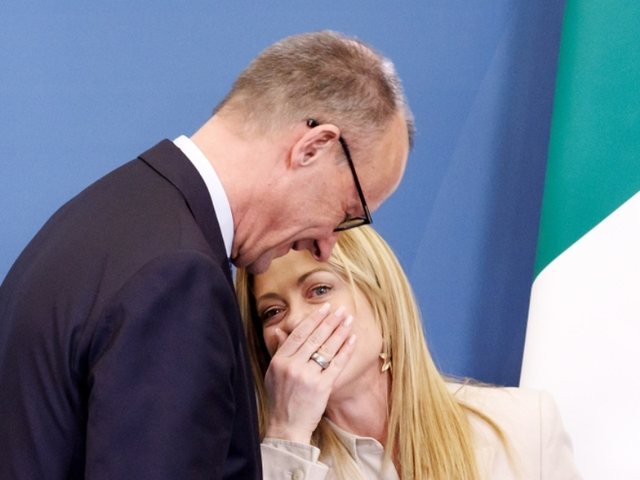
The first point is that "we don't have time anymore, we need to move quickly, we don't need a program but a chronoprogram, with set deadlines and a series of reforms implemented or established by the end of the year."
Giorgia Meloni discusses this with her staff, writes it in black and white in the letter that, together with Merz, she has sent to all member states: twenty have joined, including Macron, and will meet tomorrow before the start of the European Council.
The key word that unites everyone, despite the different approaches, is urgency, the awareness that we are close to the 90th minute and that to settle a geopolitical match where, as Mario Draghi says, the risk is to "hide" as a Union that has weight, we must act now or never.
At the Chigi Palace, with her staff and in contacts with other European leaders, Meloni is at the center of a constant exchange of documents, both reserved and public, technical sheets coming from the ministries: she chairs a preparatory meeting precisely on EU competitiveness in the morning.
The axis with Berlin seems strong, even in identifying concrete files, such as the single market and the simplification of the bureaucratic burden. Macron has a different, more Keynesian approach (requesting investments of 1,200 billion euros with European debt), which Chancellor Merz does not like, but no problem: Macron shares the sense of urgency and will participate in the pre-summit promoted by Rome and Berlin. Moreover, the list of priorities on which the Commission is working, and which the Italians and Germans support, is already very extensive.
“We need a change of pace and the abandonment of all ideological positions,” they say in the prime minister’s office. This sums up the moment well. The reports of Enrico Letta and Mario Draghi, so far partially implemented, together with the growth data of China and the US, and the gaps that are accumulating towards Beijing and Washington, determine the mood of all the member states.
The urgency, on the eve of the Council to be held tomorrow at the Alden Biesen castle, near Maastricht, overshadows the divisions: the president of the European Commission has warned that if time must be quick, the so-called "enhanced cooperation", already applied to funds for Ukraine, will have to be used.
This means that for specific files, it will move forward with those who agree, the emergency cannot follow the classic rules of majorities, unanimity or qualified majority.
Government sources are realistic, "A case-by-case analysis will be made, no one, not even Berlin, is happy to break the rules of the majority, but if the alternative is to remain motionless, it is clear that Rome will not back down either."
Moreover, the widening gap in Chinese and American competition, in all sectors, from investments in the artificial intelligence industry to defense, imposes strategic reflection.
The letter that the Chigi Palace and the Chancellery have drafted together, inviting other leaders to a pre-summit, also includes the conclusion of the so-called "28th regime", important for companies and start-ups (or scale-ups, existing companies that want to quickly take on an international dimension), who want to invest in the EU and open establishments in several countries, will be able to choose the European legal framework, no longer the national one. Thus, the single market is transformed from a regulated market into an integrated legal space, a big step. Also for Rome. / Corriere della Sera