Protests, violence, curfews: From France to Albania, why Europe'...
/ 2026-10-20 23:47:20Focus


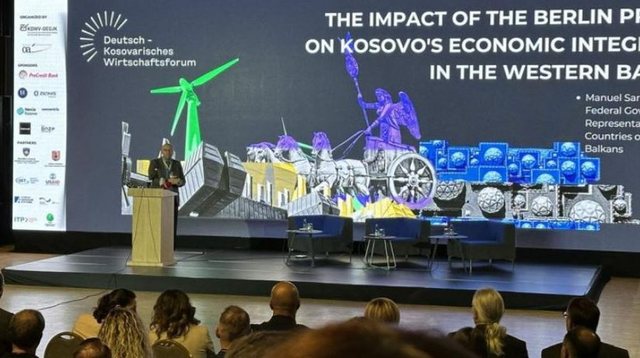
The envoy of the German government for the Balkans, Manuel Sarrazin, insists that Kosovo should create opportunities for foreign investors and benefit from the common regional market. According to him, "Economically and politically, Germany is among the main partners of Kosovo and the German state believes in the potential that Kosovo has."
Manuel Sarrazin made these statements at the Second German-Kosovar Economic Forum, organized by the German-Kosovar Economic Chamber in Pristina, in cooperation with the Eastern Committee of the German Economy. The regional market took place among the main speeches at the beginning of the Forum proceedings. This forum serves as a special platform where political and business leaders from Germany and Kosovo discuss geopolitical challenges and new economic opportunities.
Sarrazin: We want investors to come to Kosovo
Sarrazin added that there is still no new news regarding Kosovo's participation in the Berlin Process, when there are only two weeks left in marking the 10th anniversary of this process. Germany has repeatedly called on Kosovo to remove the security measure for Serbian goods, calling this measure contrary to the Central European Free Trade Agreement (CEFTA).
"All the economies in the Balkans are not a sufficient market for a company to come. Many investors go to Serbia. They want to invest there and do business with the whole region. Well, we want this to change, we want investors to come to Kosovo and create a common regional market. I don't know any investor from Germany who is investing in any of the countries of the Western Balkans and who does not see the potential of the neighboring countries in the whole region", said Sarrazin.
The German envoy said that he is aware of the problems that Kosovo has with Serbia, but he said that "the region must be shown that positive developments are possible".
"For us, for the German government, our engagement in Kosovo is strategic. We see it in the political level of security", said Sarrazin.
On the sidelines of the Forum, the German envoy also met the Deputy Prime Minister of the Government of Kosovo, Besnik Bislimi, with whom they spoke about CEFTA, but, according to Bislimi, "there is nothing concrete" regarding the removal of security measures for Serbian goods. In the same line as the German emissary for the Balkans, the member of the German Bundestag, Peter Beyer, who was part of the Forum, but also met some of the leaders of Kosovo's institutions and political parties, expressed himself. The order for them was very clear.
"Seeing a Berlin process, a Summit without Kosovo would be unimaginable. He is no longer the Summit of the Berlin process, so this should not happen and for all those involved, they should be clear-minded and make wise decisions", said Beyer, who added that relations between Germany -Kosovo has a long history. Beyer said that he appreciates "Chancellor Angela Merkel who gave the idea to make an offer for the six countries of the region. I assure you that the change of governments in Berlin has no influence when it comes to support for Kosovo", said the member of the German Bundestag, Peter Beyer.
Exception of Kosovo?
The envoy of Germany for the Western Balkans, Manuel Sarrazin, and other German diplomats during their frequent visits to Kosovo in recent weeks, had mentioned the possibility of excluding Kosovo from the Berlin Process if the Government in Pristina does not remove the measures to Serbian goods. The security measure to stop Serbian goods was imposed on June 14, 2023, the same day that Serbian forces kidnapped three Kosovo police officers while patrolling the border strip with Serbia.
From December 2021, Kosovo has suspended participation in the Central European Free Trade Agreement (CEFTA), as Serbia, Bosnia-Herzegovina and Moldova have refused to discuss the departure of the UN Mission, (UNMIK) as a representative of Kosovo within the regional trade agreement. On October 14 and 15, under the leadership of German Chancellor Olaf Scholz, the Berlin Process will be held, where the free trade agreement is intended to be signed. Currently, free trade in the Balkans is realized through CEFTA, but Kosovo has rejected this path in the past, as it was represented by UNMIK in this mechanism and not as an independent state.
The participating countries in CEFTA include Albania, Bosnia and Herzegovina, Kosovo, North Macedonia, Montenegro and Serbia, as well as many other member countries of the European Union and Great Britain. Germany is the country that starts its presence in Kosovo in terms of investments. According to a report by the German Association for International Cooperation (GIZ), there are over 600 million euros that the German government has allocated in two decades of action in Kosovo, helping and raising sectors such as: engagement and employment of young people, economic cooperation, energy efficiency, emergency and reconstruction phase in Kosovo, new support - integration, improvement of waste management services, basic education sector, promotion of tourism, etc./DW