Protests, violence, curfews: From France to Albania, why Europe'...
/ 2026-10-20 23:47:20Focus


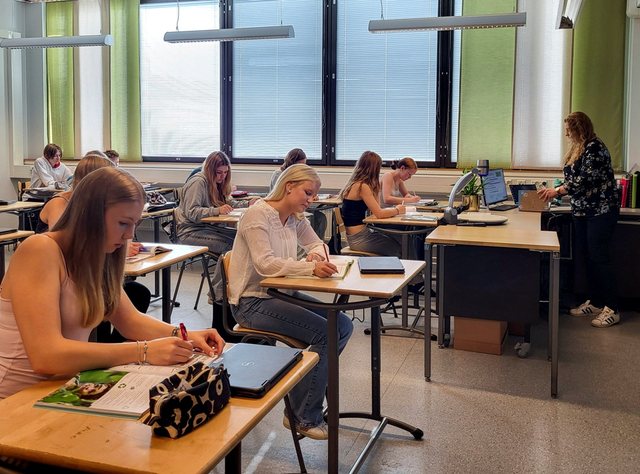
This fall, students in the Finnish town of Riihimaki returned to school with backpacks full of books and notebooks. This year, students have abandoned laptops and other digital devices in the classroom.
Finland's public education system is world-renowned for its success in recent decades and its willingness to try new teaching techniques.
Until recently, many schools gave free laptops to all students from the age of 11. But Finnish parents and teachers, like everywhere else in the world, have become increasingly concerned about the impact of digital devices on children.
So in Riihimaki, a town of about 30,000 inhabitants 70 km north of Helsinki, which since 2018 had stopped using most textbooks in high schools, the authorities are trying to do something different for the beginning of this year academic, back to pen and paper.
Maija Kaunonen, an English teacher at Pohjolanrinne High School, says that although she was not against digital devices, she is happy about the return of books.
"I am happy about the change. I'm not against digital stuff at all, I've been using it for many, many years, but first of all I'm not impressed with digital equipment. They were not good enough, I think, for teaching purposes. Books make young people focus more during lessons and there are fewer distractions with books, and I think that's much better."
She recounts the problems she encountered when children used digital devices during lessons.
"Most students I think were just doing the exercises as fast as they could so they could spend time playing games and chatting on social media and so on. And it took them very little time to change the web pages. So when the teacher approached them, they could say, 'yeah, I was doing this exercise' but most of the students were using their laptops for games and things like that. So there were a lot of distractions.”
Apart from the teachers, the students are also happy with the new changes.
"It's quite a nice thing because the ability to concentrate improves and also, for example, if you have to do homework late at night, it's easier to sleep when you haven't spent any screen time."
“Maybe when we were using Chromebooks more, sometimes I would go to different websites. I didn't always focus on the essentials.”
"I can concentrate better. And doing homework is easier because I don't have to rely on a digital device to do it. As for writing, it's a bit tiring but you learn faster."
Minna Peltopuro, a psychologist by profession, says that the time spent on the screen should be reduced to a minimum.
Finnish teenagers currently spend up to six hours a day of screen time. For him, excessive use of digital devices comes with physical and mental risks and causes problems such as eye problems and increased anxiety.
"The total time should be minimal, so not hours in front of the screen, but something less. And another is multitasking. I mean you're doing an exercise on the computer and then you go check Instagram, are there any messages? And then you go back to math and then you go to Snapchat and then you go back to math and you see that, ok, I can't do this without any guidance. And you go to another page on the computer to find the instructions and go back to math and so on. So the brain is very vulnerable when you are doing many things at a time especially at a young age. So they can't manage it well."
Across Finland, children's learning outcomes have fallen in recent years, prompting the government to plan new legislation to ban the use of personal devices, such as phones, during school hours to cut children's time screen.