Is this police force professional and capable of handling violen...
/ 2026-10-16 18:54:07Focus


A sea storm that hit the coast of Vlora in January 2012 irreversibly damaged the cooling system at the Vlora power plant, just a few months after the works had been completed.
With an investment value of 130 million euros from three international institutions, the power plant would solve the issue of lack of energy in crisis situations or when there was no rain. It was also designed to reduce the purchase of energy abroad, but it never turned on the turbines.
"From the high degree of the wave, the water pipes took in air, which mixed with sand; this is because there was no auxiliary mole for extinguishing the waves", says one of the engineers who worked at the TEC at that time, as he remembers that the wind exceeded 80 km/h and more than five centimeters of rain fell.
Immediately after the incident, there were attempts to put it to work, but they failed, ruining an investment of millions of euros.
Kasem Mahmutaj, an engineer who was appointed General Director of the Vlora TPP two months after the defect, says that during the period he served in this work (March 2012-November 2013), they only did maintenance and conservation.
"Specialists have tried to put it into operation, but the pumps, which absorbed the sea water to bring it to the plant, were filled with dirt. Due to the waves and the strong wind, the tubes had risen up to the surface, as air was introduced into them along with the water. This large amount of air created the chamber effect", says Kasëm Mahmutaj, while adding that the problem with this work went beyond the weather conditions.
Considered an investment of special importance, since it was built twelve years ago, the TEC of Vlora has burdened the Albanians with a bill that is approaching 200 million euros, not functioning for a single day.
Two confidential reports reveal that KESH has let an asset lie dormant for 10 years, which could be repaired with a bill of 13 million euros.
Currently, the Albanian Electric Power Corporation spends 3 million euros more than this value from its budget for maintenance, loan interests and personnel expenses, receiving degradation and losses in return.
How much does it cost to put Vlora's TEC into operation?
Planned to cover the needs in cases of crises or emergencies, the Vlora TEC was not put into operation even during the crisis that Albania experienced two years ago as a result of the Russia-Ukraine war.
Officially, the Albanian Electricity Corporation denies having a conclusion on the repair of the defect, which holds hostage the commissioning of the investment of 130 million euros in Triport.
"Several inspections and evaluations have been carried out, but a final and categorical conclusion has not been reached, whether the system is repairable or should be replaced by a new system", said KESH in a written response to Investigative Network Albania.
Contrary to KESH's response, INA Media had access to at least two detailed studies for the return to working condition of the Vlora gas power plant through TAP.
There are two confidential reports, made on behalf of the Ministry of Energy during the socialist government. One of the studies was done in June 2017 by the German consulting company Roland Berger.
In the analysis of the commercial model and future ideas for the Vlora thermal power plant, the German consultant calculates that the rehabilitative investment of the TEC costs 13 million euros (including the costs of conversion to gas supply).
Meanwhile, another confidential report, submitted to the World Bank by the British company Economic Consulting Associates, details a plan for the gasification of the Vlora TPP through TAP.
"10 million euros for the repair of the cooling system and 3 million euros for the cost of converting the gas asset. Also, gas supply infrastructure is required from the TAP exit point in Fier to Vlora", the report details.
Gjergj Simaku, energy expert, who has also held the post of deputy minister, says that Albania could recover this strategic work through TAP, but lost this opportunity.
"Specifically, it has been requested that the TAP gas pipeline has an exit point only for the TPP, but even for these exits for the TPP, there is a contract that was requested to be renewed by TAP, in order for Albania to buy gas , but Albania will not buy gas even for the next 10 years, because it did not sign this agreement when TAP was put into operation", explains Simaku.
The bill that had to be paid to put it into operation was much more favorable than what we currently have to pay for floating TPPs.
"We could pay about 15 million euros and make it work with gas, but we don't have gas, because the gas agreement was not made at the right time with TAP, and then in the crisis we found as an emergency solution the acquisition of two TPPs other years, floating - which for me was the most wrong thing that happened because of the staggering costs", - he further argues.
The conservation plan of the power plant at that time suggested that its commissioning after repairing the defect would only happen in a situation when Albania would face a crisis, but the year 2022 proved that this did not happen.
The TEC was not put into operation even at the height of an energy crisis, which faced the world with uncertainty and prices in the stratosphere due to the Russia-Ukraine war.
Albania imported 1.4 billion kWh of electricity, about 11% of consumption, with a total bill of 503 million euros. The average price at which energy was purchased to meet the crisis was 305 euros/MWh, the highest ever recorded in history.
"The thermal power plant could produce energy at a price twice as cheap as the import prices," says Azmer Dulevič, electrical engineer.
The Vlora Thermal Power Plant is designed to produce energy through the burning of oil, as well as through the steam created by the burning of oil. In addition to commissioning with gas, engineer Klodian Gradeci, who previously ran important enterprises in the energy sector in the country, says that KESH could use the TEC during the crisis of 2022 even with diesel only.
"TEC Vlora has a defect in the cooling system, which starts the steam turbine. The reason, that until 2021 only the diesel turbine could not be put into operation, was the very high cost of production and the lack of economic leverage", he argues.
KESH explains that, if it were to work, the cost of producing energy with diesel goes up to 180 euros/MWh, as it imported the energy at almost twice this price. On the other hand, the production of energy with natural gas is even cheaper.
"The forecast of costs with current gas prices could be 101-112 Euro/MWh. Fixed costs are added to this cost, about 15 Euro/MWh", says KESH.
These costs are also evaluated as competitive by the Energy Regulatory Authority.
"Now it is possible for the production cost to be competitive in the market. "The situations have changed," says Petrit Ahmeti, chairman of the Energy Regulatory Body.
However, the power plant was not put into operation, neither with oil nor with gas.
"Even more disturbing is the fact that no one is held accountable. Today we are faced with the facts, that there is a financial loss in the sector and no one is responsible for this", says the expert on energy issues, Azmer Dulevič.
In March 2021, the Albanian government signed an agreement with the American companies ExxonMobil and Excelerate Energy for the introduction of liquefied gas in Albania, the conversion of the Vlora TPP with gas, as well as the construction of a new gasification terminal in Vlora.
The Americans intended for the project to start at the end of this past year, but the fact is that we are still far from starting the gas turbines. Until the gasification of the TEC, the asset will continue to spend millions of dollars, as it has done during the last decade.
In order to cope with the energy crisis as a result of the Russia-Ukraine war, the Albanian authorities chose not to turn their eyes away from the Vlora TPP, but to rent two floating TPPs.
According to the contract, the Albanian state will pay about 68 million dollars in rent for two years to the company Excelerate Energy or, in other words, 94 thousand dollars per day.
This figure is almost 5 times higher than the value of 13 million euros, which would be needed to put the TEC of Vlora into operation.
Despite the fact that Albania is no longer in an emergency situation and the floating ships have not turned on the generators for a single day, the Albanian state will continue to pay the contract in full, artificially increasing the costs.
Millions for maintenance
Positioned in Pyllin e Soda, only 6 kilometers from the city of Vlora, the power plant does not leave the impression of a neglected facility. Otherwise known as the Vlora TPP, it started construction in 2007 and was supposed to solve Albania's electricity deficit, especially in the south of the country, where there are no energy producers.
According to the Albanian Electric Power Corporation (KESH), which is the owner of this asset, from 2012 to the end of 2022 the power plant's maintenance bill amounts to 150 million lek per year (1.4 million euros per year). In other words, in total about 16 million euros were spent on maintenance, even though it was not put into operation. (The euro is calculated at the current exchange rate, 106 Lek)
But these are only part of the salty bill of annual losses. The balance sheets of the power plant show that keeping it out of operation is burdening the KESH budget with high annual losses.
Its construction cost 130 million euros, while for ten years it has been taking tens of millions of euros more to maintain. It was financed through a soft loan from the EBRD, the World Bank and the European Investment Bank.
From 2012 until the last balance, submitted to the National Business Center for 2021, it has cost Albanians 5.8 billion ALL or 55 million euros to keep the TEC out of operation.
"In this case, Taxes should have started bankruptcy procedures, as long as, since 2013, TEC Vlora has been in losses, as well as negative financial continuity", says Eduard Gjokutaj, financial expert from the ALTAX organization.
The biggest losses are from the expenses for amortization and depreciation of the asset, a clear indicator that the investment is going to waste and putting it to work is urgent.
The TEC has an installed capacity of 97 MW, with which it could produce up to 730,000 MWh per year, an amount that could cover more than half of the country's annual electricity deficit. At the end of 2011, when it was completed, it contained 7 percent of the country's installed capacity.
A TPP for the protracted crisis
Throughout the 1990s and 2000s, the country experienced a continuous electricity supply crisis. Domestic production became capricious, as it depended on rainfall, the distribution network was amortized, a large part of the energy consumed was unpaid. This condition produced frequent power outages. In that situation, specialists and politicians were desperately looking for alternative sources of energy.
Part of the alternative generation would come from private hydropower, another part would come from combustion.
"It was seen as a solution, since we were in crisis", says Zana Guxholli, who at that time was an adviser to the government on economic issues.
"Generators roared in every corner and the distribution system was very weak."
Planning began in the early 2000s and, despite delays, in 2007 an Italian engineering company, Tecnimont, which had international experience in energy sources, was contracted.
Tecnimont would build for KESH a so-called combined cycle TEC, since energy would be produced in two ways, which would be combined with each other: a turbine with a power of 67 MW would produce energy from burning oil and the other with The 30 MW would take the steam created by heating the water used to cool the oil turbine.
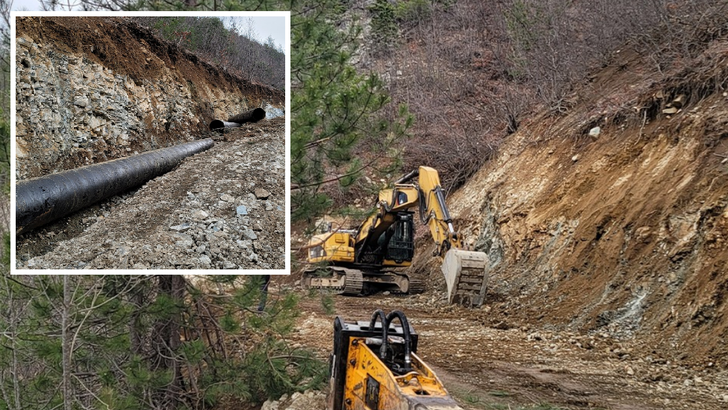
The water would be taken from the sea with a plastic fiber pipe 600 meters long and 150 cm in diameter; it would be de-sanded and de-salted in a storage facility at the power plant complex and cool the oil turbine during combustion. The generated steam would run the second turbine and condense it into water during that process. The water would be cooled and discharged into the sea through another equally long pipe, at a temperature that should not differ more than three degrees from the temperature of the sea, so as not to harm the living world in it - the fish .
Tecnimont started building it in 2007 and had it ready in October, two years later. But a storm at sea damaged the pipes that brought water to the plant and returned it to the sea and, according to a report, the company blamed subcontractors, a group of divers from Ortona, a town near Ancona, who specialized in underwater constructions.
Tecnimont took it upon himself to shut the thing down. It took another group of divers from Italy to repair the pipe and it lasted about a year longer, but shortly after handing it over, in October 2011, in January, another storm damaged the pipes and blew sand into the plant. There was something like 10 percent of the funds left unexploited.
At that moment the Albanian authorities and the company went into open war. KESH blocked the disbursement of the last installment, 10 percent of the contract value. Tecnimont denied responsibility and abandoned the works. The case is in international arbitration in The Hague.
"That TEC is now getting very old and is morally dead, which means that its control system has become expensive, but not insurmountable", concludes Gjergj Simaku, energy expert./ inamedia