How Belinda Balluku is fabricating the rumor about Top Channel's...
/ 2026-10-19 16:19:54Focus


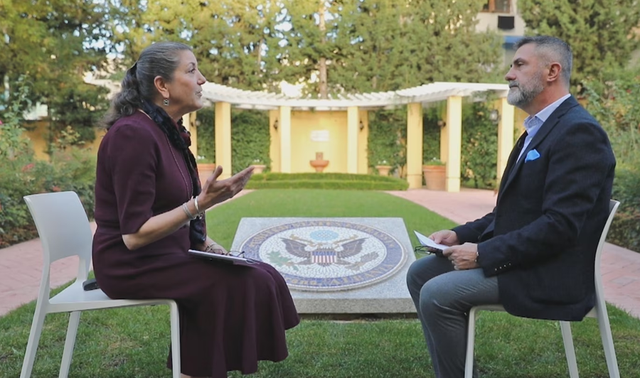
The assistant-administrator of the American Agency for International Development, USAID, Mrs. Erin McKee, says in an interview for the Voice of America that the phenomenon of corruption is not eradicated only by the government, but that the citizens themselves must seek to put an end to corrupt practices. Speaking with our correspondent in Tirana, Armand Mero, she explains that USAID's support for Albania extends to many areas, from the rule of law, to democracy, economic competitiveness or cyber security.
VOA: Ms. McKee, thank you very much for the opportunity to do this interview. First, I would like to know, what is the purpose of your visit to Albania?
Ms. McKee: First, thank you for the invitation today. I am here to reiterate and celebrate the enduring partnership between the United States and Albania, my agency, USAID, in particular, and the people and government of Albania. We celebrated just last year, 30 years of cooperation and I am noticing the progress and the product of this cooperation during my journey here.
Voice of America: You also visited Vau e Deja. What was the reason you went there?
Ms. McKee: I'm glad you asked. I traveled to Vaun e Dejës to see the cooperation we have with KESH, which we have had for a long time, to help Albania strengthen its energy security, and as we know, energy independence is vital for a healthy democracy. USAID and my team, in Washington and here in Tirana, have been working hard to ensure that Albania's incredible renewable resources are used smartly on a market-based and diversified basis, not only for Albania's energy independence, but also for Albania's contribution to the rest of the Western Balkans, with an important role and potential for all of Europe. I was happy to see that collaboration in action.
Voice of America : What other projects is USAID supporting in Albania?
Ms. McKee: I'm very happy with that question. We are working alongside the Albanian people, our partners in the Albanian government and all sectors of society to strengthen Albania's democratic future. We know that a future in the EU is vital for Albania, to unlock its full potential to realize the democratic goals it has set for itself, to see opportunities and market diversification.
Thus, our programs and projects over the past 30 years have supported that effort. I will give you an example. This morning I had the privilege to open together with the Minister of Health, civil society, our partner UNDP, as well as many civil society organizations, a community center. This means providing integrated services to the most vulnerable members of Albania, the population that needs special attention, so that they can be part of Albania's future in the EU, that their voice is heard and to be full participants in democracy and economy, so that Albania can offer not only to its citizens, but also to the rest of Europe.
Voice of America : The United States is a strong supporter of Albania's European integration process. Specifically, how is USAID supporting this process?
Ms. McKee: In addition to the community center that I mentioned, it is to make sure that no Albanian is left behind. We have been working with competitiveness to ensure that Albania's economy, as it enters the EU and competes in the EU market, is strong and diverse. And from what I've seen, it has a lot to offer. We have also worked, of course, for the rule of law and to make it possible to break the cycle of corruption that damages democracies across Europe, frankly, every country, because nothing erodes a democratic future more than the erosion of the trust people have in their governments and in their society. Therefore, focusing on the rule of law, democracy, economic competitiveness, energy and security of critical infrastructure are all requirements for both EU membership and a strong, stable and democratic future. Therefore, our programs and projects are focused on those efforts.
Voice of America: You mentioned the issue of corruption a little while ago. What are the projects or plans of your Agency to support Albania in addressing this phenomenon, to promote transparency in the government and other institutions?
Ms. McKee: I'm glad you asked because you mentioned the government and other institutions, which is a part of the fight against corruption, but it's also necessary for citizens to repel corruption, to be able to shed light on corrupt practices. It takes independent journalism to make sure stories of corruption are told and heard. We have an expression: there is no better disinfectant than sunlight. And for that light to come from citizens, from the judiciary, from prosecutors and anti-corruption institutions, to the commitment to create an accountability community - this leads to strong democracy. Our work is developed in this space, to help people find their voice and root out corruption. It cannot be the government alone that eradicates corruption. Citizens must continue to demand an end to corrupt practices.
Voice of America: Cyber security is a major issue for Albania given Iran's cyber attacks last year. The United States has given a lot of help - 50 million dollars. Is USAID part of that support for Albania's cyber security?
Ms. McKee: I'm very proud to say that yes, we are. As in the humanitarian environment where USAID has a history of responding to humanitarian crises, in this attack as well, we were the first to respond and assisted with State and Defense Department colleagues who helped to both identify the source and to build Albania's capacities and capabilities to strengthen its critical infrastructure, including cyber security, so that it can withstand future attacks, as well as to invest in the next generation to ensure that capacities and skills for IT specialists, cyber hygiene, cyber security not to happen from abroad, from the United States - of course, we will continue to be partners with Albania - but so that Albania can take care of its own critical national infrastructure. I would like to give you an example: when Putin first invaded Ukraine in 2014, we worked hard to strengthen e-government, transparency and accountability, using a lot of digital economy and digital work in this space. Citizens were looking for it. It's a 21st century requirement, but at the same time, you have to protect that information. So when Putin invaded Ukraine again and launched asymmetric attacks on their critical cyber infrastructure, our partnership helped build resilience to withstand those attacks and keep systems from going down. We look forward to doing the same with Albania.
Voice of America: You said that between Albania and USAID there is a long period of cooperation, over 30 years. How would you characterize this historical relationship between your Agency and Albania?
Ms. McKee: First of all, I would characterize it as a partnership. USAID's approach is not to give handouts but to support them to rise. And while we've invested over $500 million, it's not all about the money. It is about long-term partnerships and models of success that the Albanians have taught the United States and that the United States has shared with the Albanians.
So the partnership we've built in economic diversification, energy security, local government, central government, the rule of law, the fight against corruption, everything we do to help Albania reach and fulfill its full potential is something I'm all for proud, not as a donor, as someone outside, but as a partner of Albania, as we look towards the future.
VOA: As we look at developments in the region and globally, including Russia's war against Ukraine and now Israel-Gaza, how do you see USAID's role in the Western Balkans?
Ms. McKee: In the Western Balkans and in general, I would actually ask Albania to help us. You are very focused and I hope you are speeding up your journey towards EU membership. I would like to look back on our partnership in the near future as a model that other Balkan countries can follow. As I said, we have worked for economic competitiveness, the rule of law, to make sure that the peoples of the Western Balkans, and in this case the Albanian people, have an interest in that future. And with your success, you can demonstrate to your neighbors, the other peoples of the Western Balkans, where we also have programs, that it is not only possible but also the path to follow; here's what we learned and here's what we can do together to achieve that future.
VOA: Ms. McKee, thank you very much.
Ms. McKee: Thank you very much for meeting with me today.