Is this police force professional and capable of handling violen...
/ 2026-10-16 18:54:07Focus


By Callum Jones, Andrew Witherspoon and Aliya Uteuova – The Guardian
Most Americans have yet to feel this boom, but they have heard a lot about it from the president himself. From the first minutes of his second term, opening his inaugural address, Donald Trump was blunt.
"America's golden age begins now," he declared.
But at a White House reception last weekend, just over 10 months later, the US president seemed to acknowledge that the promised deadline had been significantly delayed.
"We're going to have... I say it's the golden age of America. It's an era like never before for this country. And I can't wait to see the results. You'll see the results in six months to a year," Trump said.
The American economy has faced difficulties throughout 2025. The golden age did not materialize immediately, as Trump had claimed after his return to power in January.
In the two areas where the president promised rapid improvements, employment and prices, the results so far have been disappointing. The labor market started the year relatively stable. Although it had slowed, by 2024 the American economy was adding an average of 168,000 jobs per month.
During his joint address to Congress in March, Trump declared that he had inherited an "economic disaster" from the Joe Biden administration and vowed to create jobs "like never before."
The "golden age" that is not coming
In reality, employment growth has stalled in 2025. According to official data for the first 11 months of the year, only 55,000 jobs were added per month on average, a 67% drop compared to 2024. Unemployment, which during the last year of the Biden presidency fluctuated between 3.9% and 4.2%, has risen under Trump to 4.6% in November, the highest level in more than four years.
During the election campaign, Trump promised a “new American industrialization,” turning the United States into a “manufacturing superpower” and reviving factory jobs. But in practice, manufacturing employment has not grown this year. The economy has added factory jobs in only two of the ten months since Trump returned to the White House.
According to the administration, realizing this vision requires strengthening Trump's main economic policy: tariffs.
The president has raised the average effective US tariff rate from 2.4% to 16.8%, the highest level since 1935, according to analysis by the Budget Lab at Yale University.
The implementation of the new tariffs has been erratic, with unclear deadlines, delays and frequent changes. The process has been “more painful than I expected,” Trump’s chief of staff, Susie Wiles, admitted to Vanity Fair.
"Nobody believes what's happening"
Economists have repeatedly warned of the potential negative impact of tariffs on millions of Americans. The costs of tariffs on imported goods are often passed on to consumers, raising prices in stores.
Federal Reserve officials have debated for months whether Trump's tariffs will cause a temporary price spike or a long-term inflationary pressure. Inflation had reached its highest levels in decades in 2022, as a result of the pandemic, but was falling throughout 2024 and early 2025.
However, Trump has insisted that he inherited an “inflation nightmare” from Biden. In a televised speech this week, he declared: “We are bringing down high prices and we are bringing them down very fast.”
In reality, inflation has remained stable since the spring. In November, the consumer price index rose by 2.7% on an annual basis, according to official data.
Trump has repeatedly denied responsibility for inflation and called concerns about prices “a hoax.” Asked by Politico what grade he gave himself on the economy, he replied: “A-plus-plus-plus-plus-plus.”
In the same televised speech, the president insisted he was "solving" the problem of food prices, claiming that the prices of turkey and eggs had fallen significantly.
"Everything else is falling apart," he said. "It's not over yet, but we're making incredible progress. Nobody believes what's happening."
"Hard to see how 2026 will be better"
There are signs that the administration is trying to ease the pressure on the economy. Last month, Trump lowered tariffs on some imports, including beef, tomatoes, coffee and bananas. He also announced a $12 billion aid package for farmers and discussed the possibility of stimulus checks for citizens.
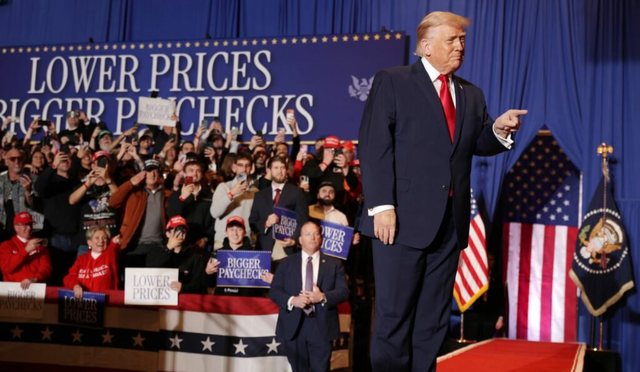
At a rally in Pennsylvania, Trump appeared in front of a large banner that read: “Lower Prices, Higher Wages.” According to Axios, the president and his team strongly believe that the economy will accelerate significantly early next year.
This expectation is related to the impact of Trump's big tax bill, which is expected to increase household income and investment.
But economists remain skeptical.
“Most low-income Americans will be hurt by these policies,” said Simon Johnson, a Nobel laureate and professor at MIT. “It’s hard to see how 2026 will be better for most people.”
The US economy is forecast to grow by 2% this year, down from 2.8% in 2024. For next year, expectations are also moderate.
Trump, however, remains optimistic. "We are poised for an economic boom like the world has never seen," he declared this week.
Most Americans haven't seen this boom yet. But they've heard a lot about it.