Is this police force professional and capable of handling violen...
/ 2026-10-16 18:54:07Focus


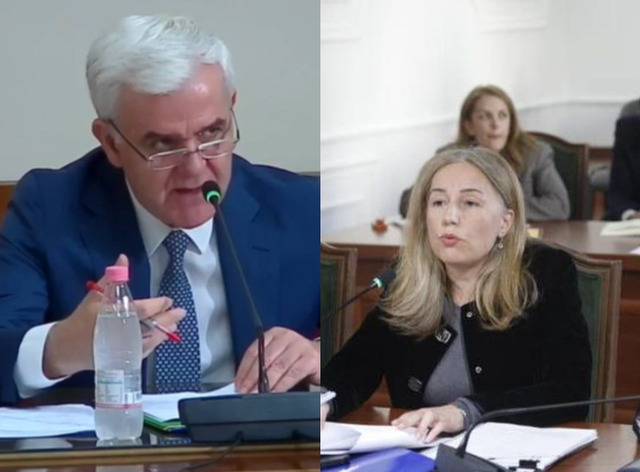
The High Prosecutorial Council (KLP) has faced a wave of criticism during its latest reporting before the Special Parliamentary Committee.
The chairman of this commission, Fatmir Xhafaj , has described the KLP as one of the most problematic links in the current justice system, questioning the efficiency of its decision-making.
"In my assessment, there are some positive steps in the work of the KLP, but the KLP remains one of the weakest justice systems in Albania. Many issues related to the prosecution system arise from questionable decision-making by the KLP. Compared to other years, there is improvement, but compared to what the law has given, compared to EU expectations, there is much to do," said Xhafaj.
The paradox of vacancies: Over 100 vacant positions, only 12 new prosecutors needed
One of the hottest topics of discussion was human resource management. Although the chairwoman of the KLP, Mirela Bogdani, acknowledged the existence of a large number of vacant positions, the strategy followed by the institution to fill them was strongly contested by Xhafaj. He accused the council of a lack of vision and miscalculations in relation to the School of Magistrates.
"Were you unable to make an account of this nature or is there some kind of irresponsibility? Last year you asked the School of Magistrates for only 12 prosecutors. There is no official number. Even to fill vacancies, you are asking for 12 prosecutors, when you had the opportunity for more, you yourself, while you have over 100 vacancies, you have some hidden vacancies, I have been dealing with this for years. You are not asking for an increase in prosecutors through the School of Magistrates, nor an increase in the total number. How are we going to solve it? When will we have a complete filling of vacancies according to the current number of prosecutors and effective vacancies?", he addressed Bogdani.
For her part, Bogdani defended herself by arguing that the selection was conditioned by the high standards required by the institution.
"The reason given was the quality of the number of candidates," Bogdani said.
Accusations of nepotism and training "for the boss"
The debate became even more heated when the issue of support staff recruitment and training was raised.
Xhafaj cast doubt on the employment criteria, implying that the institution has become a haven for the families of people in the justice and political sectors.
"Do you need extras? Not to make a fuss, to take friends and acquaintances, husbands, wives, children of prosecutors, judges or politicians? You and some other institutions have made it a place where the children of prosecutors and judges come together," said the chairman of the commission.
In this regard, the chairwoman of the KLP explained that training is covered by ASPA or external donors, while she raised the idea of the need for specific training on collegial functioning for the members themselves.
BKH and internal clashes: Apology request for ethics
Asked about the appointment of the new head of the National Bureau of Investigation (BKH), Bogdani asked for time, emphasizing that the process has just passed the selection phase.
"We have not yet made any effort given that the selection process has just been completed. Not only the appointment is important, but also the interaction to reflect international standards, it will take some time," said Bogdani.
Another moment of reflection was about the clashes and high-pitched voices within the Council, which have often come to light in public.
Bogdani publicly apologized, but described the divergences as a normal part of a collegial body, promising new rules if the situation does not change.
"Measures for inter-institutional dialogue, we apologize for the often raised tones of debates, in collegial institutions a kind of conflict naturally arises, let alone approaches. We often have strong confrontations regarding the same concept of how to address it. We have taken measures and I believe that if we do not manage to reach an agreement or an appropriate solution, we will adopt ethical rules," she said.
In closing, the digitalization process was also discussed, which according to Xhafaj is penalizing the institution's evaluation.
The Chairperson of the KLP specified that this procedure is in the hands of the Prosecutor General and is expected to be finalized within a year.