How Belinda Balluku is fabricating the rumor about Top Channel's...
/ 2026-10-19 16:19:54Focus


As the protests in Tirana have entered their second week, they have escalated from opposition to two planned 5 billion euro ($5.7 billion) resorts, linked to Jared Kushner and envisioned in highly ecologically sensitive areas, to demands that the entire Albanian political class be removed from power.
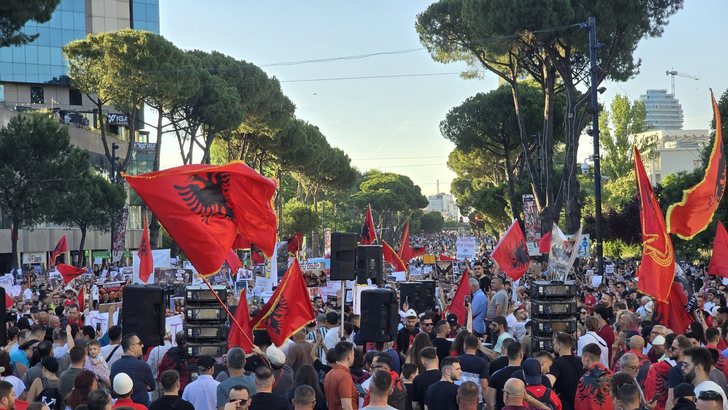
Anger erupted on the coast on May 30, when construction workers began work on one of these projects. Protests spread to the capital two days later. Since then, every evening at 6 p.m., thousands of citizens have gathered in a central square and marched along the main boulevard toward the Prime Minister’s Office, carrying national flags, homemade banners, and protest posters.
Without formal leadership, the marches are being organized through social media and are gathering students, environmental activists, citizens, and professionals.
Videos shot during the “Flamingo Revolution” — so-called because of the birds endangered by luxury projects — have been shared massively on TikTok and Instagram, helping to keep the protest alive.
Protesters say that both the ruling Socialist Party and Sali Berisha's Democratic Party are corrupt and willing to sell the country to the financially strongest, without much care for its nature and beauty.
The two parties have dominated Albanian politics since the fall of communism in the early 1990s. Rama has been in power for 13 years, while Berisha, 81, a former prime minister and president, has been sanctioned by the US on corruption charges.
Albania is no stranger to protests. Over the past three decades, there have been at least seven major waves of protests.
The biggest was in 1997, when the collapse of pyramid schemes, indirectly supported by the ruling Democratic Party, plunged the country into economic crisis and sparked riots, during which around two thousand people were killed.
But this wave is different: largely peaceful and comparatively small, but growing, it has become both a political act and a social event.
“This is probably the first protest in Albania in 30 years where people are taking to the streets completely on their own, without any major political push,” said Fitim Zekthi, an analyst and lecturer at the European University of Tirana.
"Even if it ended today and there were no further developments tomorrow, this protest has already done something very big: it has shown that people can react."
"The government and the entire Albanian political class are now thinking carefully about what they are seeing. I think Albanian politics tomorrow will not be the same as it was yesterday. There will be a different kind of accountability and a different public reaction," he added.
Resort projects on Sazan Island and the Zvernec Peninsula, backed by Kushner's investment company, Affinity Partners, have attracted the attention of the European Commission.
The latter has expressed concerns to the Albanian Minister of the Environment, Sofjan Jaupaj, about "possible shortcomings" and has warned that the country's path to membership could be put at risk if EU environmental rules are ignored.
“I want to emphasize that Albania must avoid any action that could undermine the fulfillment of the closing criteria,” Commission spokesman Guillaume Mercier said at a press conference on June 9.
"We expect the Albanian authorities to act without delay."
Rama, 61, has so far rejected calls to halt the projects, presenting them as part of a push towards elite tourism, which he says will bring more investment and jobs. He insists the Zvërnec project will go ahead.
The government says the two projects are following different paths: the Sazan project involves public land and is still in negotiations with the state, while the Zvërnec project is on private land. Although preparatory work has begun in that area, Rama has repeatedly stated that neither project has received final approval and that environmental and other procedures have not yet been completed.
The prime minister has also rejected calls for his resignation, saying that more than 800,000 people voted for him in last year's election, about 52% of the votes cast. In a video shared on social media on June 6, he suggested that the protest turnout was not large enough to call his mandate into question.
In Tirana, the nightly marches start from Skanderbeg Square, the largest in the city, where the Bank of Albania, the National Library, the Palace of Culture, and a mosque are located.
Drivers stuck in traffic honked their horns in solidarity as protesters moved through the streets. Environmental activists provided microphones and loudspeakers, creating an open podium where anyone could address the crowd.
“We want to change the way we are governed,” one protester said Tuesday evening.
"We want to build a state based on law and justice. Zvërnec was the last straw."
Protesters are demanding that the government scrap the strategic investment framework, which allows large projects to move through approval procedures more quickly and gives developers access to state support, permits and, in some cases, public land. They say the mechanism has become a shortcut for politically connected construction projects, rather than a development tool in the public interest.
They also demand that Albania undo recent changes to laws on protected areas and cultural heritage, arguing that the new rules weaken the protection of territories that should be preserved from construction. A special government plan for the development of mountainous areas has been added to their list of concerns.
Last year, Albania ranked 91st out of 182 countries and territories in Transparency International's Corruption Perceptions Index, with a score of 39 out of 100. The organization says corruption remains a significant challenge and links corruption risks in the region to weak democratic institutions and insufficient accountability mechanisms.
For Tana Shehu, an Albanian in her 70s who joined the protest in Tirana this week, the rallies brought back memories of the last days of communism. She said she was proud of the young people who are on the streets today.
“Don't you see that they are changing the world?” Shehu asked.
“I'm here to support them and tell them they're not alone.”/ Bloomberg