Is this police force professional and capable of handling violen...
/ 2026-10-16 18:54:07Focus


TIRANA/KSAMIL/VRINA – As hoped for years, the turn of the south of the south has finally come to be reborn again, once again, again. To understand that what is happening is a miracle, it is enough to remind the reader that birth itself is a pretty big embarrassment, let alone rebirth, which involves a rather complicated procedure. So imagine the thrill of second and third rebirths.
But the government is determined to make the southern Riviera as civilized as the Turkish and Sochi.
Thus, it is learned that the archaeological site of Butrint will undergo an epochal transformation. In fact, the correct term, sources tell Patronažisti, is not transformation, but transfer, since that pile of ruins and antiquities, as it is, will be moved somewhere further away, at the foot of Mount Milesa, to make way for what the Minister of Tourism and Gliko me Arra, Lela Këmbora, so fondly calls 'rejuvenation'.
The fact is, it has been shameful for the Albanian state that a strategic point like Butrint is occupied by some ruins that remind one of a third and fourth world country, and that are dangerously built without permission. But from now on, the hill that rises above the Butrint canal will be adorned by a tourist complex with villas, where only electric vehicles such as golf carts, elevators, escalators, etc. will circulate, while through a special VKM, mullet and sea bass will jump from the lake directly into the pans of vacationers.
***
Responding to the nonsense of some critics that the archaeological site should not be moved, that it is a cultural asset, that it is very old and could be damaged, etc., etc., Minister Këmbora assured everyone:
"There is no danger. We will make the new Butrint even older than it was!"
The shy former translator who once made the Tall One cry in the middle of the parliament hall has become, as the French say, a "chasergevap."
Her dream of reviving the Karakatina of Butrint began a few years ago, when she wanted to set up a meat-salami-soufflé restaurant with an aluminum frame in the archaeological park, so that hungry visitors could fill their stomachs. Were the pigs listening?
Instead of thanking him for bringing a little civilization to an area where there is not a single inch of land and where only thorns grow, some people with cabbages on their heads accused him of alienating the archaeological site for personal gain.
Këmbora left that battle, but then I Gjati entered the game, who cannot tolerate the lack of taste and the villagers blinded by the lack of etiquette.
He asked Japanese architect Harakiri Kamikaze to design a completely contemporary entrance to the park, with light wooden structures, kiosks serving sushi and geisha giving massages, just like what happened in Butrint in ancient times. At the time, no one realized that the Japanese project was the entrance not to the old ruins, but to the new tourist plan.
***
But the reborn Butrint would be incomplete without the rest. Opposite it is Vrina, a village that produces tangerines. How beautiful, Vrina-tangerines… They could also produce oranges, but they abandoned this idea because orange does not rhyme with the name of the village.
At the back of Vrina is the coast that looks out over Corfu. Throughout the area, I Gjati has demanded the verification of all state lands and properties – and some private ones here and there, especially when the owners are old men with one foot in the grave and their children are immigrants in Australia – because, he said, “we will bring them back to life” .
The ultimate plan is that the complexes that will be built opposite Corfu, combined with the miracle of architect Arigato Sayonara in the new Butrint, will completely empty the Greek island of tourists, starve the local inhabitants, and force the Greek state to say to the Tall One: " You know what, brother? Take this desert because we don't want it at all! Just bring us a crate of tangerines every now and then."
***
That Albanian tourism is entering a qualitative phase with the assumption of the 14th mandate of the Long One, (even in the books of hysteria it will be said: In the time of the 14th Long One…) is best demonstrated by the Monastery project.
As the name suggests, the existence of an old monastery at the entrance to Ksamil gave the area its name. But the Monastery – which is part of the protected cultural heritage area, along with Butrint (well, let's leave the jokes aside) – also has a wonderful sea bay below it, where Minister Këmbora recently said she had granted a small permit for a small tourist unit.
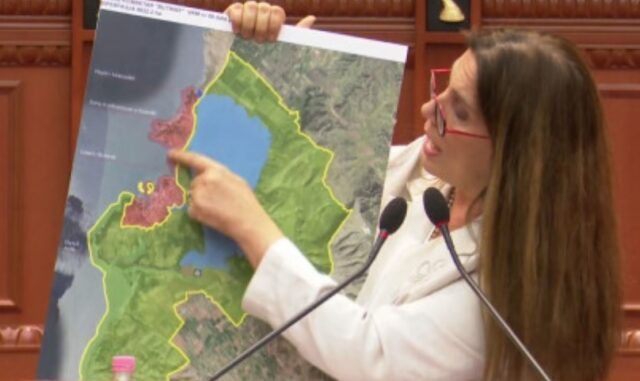
Këmbora did not hesitate to use her entire linguistic arsenal in parliament, when she took the map in her hand, lowered her glasses halfway down her nose like an academic and pointed to it with a pencil in one hand:
"Here, my dear, this tiny, tiny spot here will be for quality tourism, while the rest of it will be preserved to the best of its ability. You see? Look, it's really tiny," and he lowered his voice to illustrate the smallness of the spot.
Today, it is being learned that the small dot has swallowed the entire area, including the bay and the Monastery, while the deserted monks will likely serve tea to Lela Këmbora and ring the bell when she goes on vacation there.
However, Minister Këmbora insists that everything is being exaggerated. In a recent statement, she said:
"As our 14th Prime Minister said, the Albanian language has some wonderful traps. In fact, at the last meeting he happily posed a riddle to us from old Butrint: Well, we call a small bird a zoçkë; but what do we call a small dot…? We all found it with the first one."
Note: Patronažisti is a satirical column for pro-prime ministers with royal numbers from behind