Is this police force professional and capable of handling violen...
/ 2026-10-16 18:54:07Focus


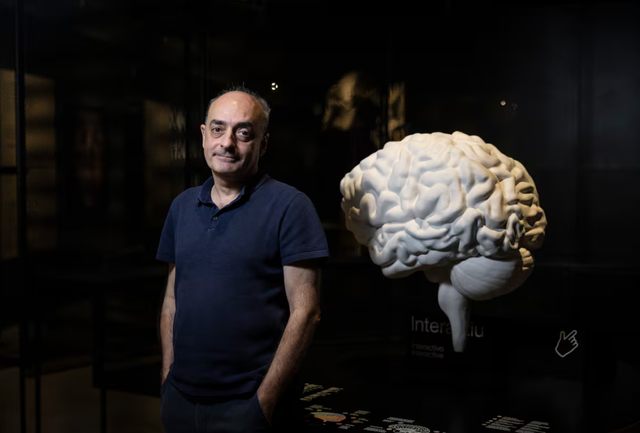
Spanish geneticist Carles Lalueza-Fox, one of the world's most renowned experts on ancient DNA and human evolution, addresses the paradoxes of human identity in his latest book, "Identity: What DNA Can Tell Us About Ourselves."
In an interview with El País, he explains that genes can reveal a lot about our origins, but they do not define who we are. He also talks about people who look almost identical without being related by blood, the privacy of DNA, and how genetics can be misused in politics.
You say that personality is like time: we know how to define it until someone asks us what it is...
Identity is much more complex than we think. From family to nation to continent, genetics prompt us to question who we are. But we often look to DNA for answers to things it can't explain.
Can genetics change the way we see ourselves?
Yes, because sometimes it reveals unexpected things about our ancestry. There are people who discover that their ancestors were part of communities they were not aware of. But the probability of inheriting traits from a distant ancestor is very small. So DNA doesn't necessarily tell the story we expect to hear.
You have studied people who have sozi. What did you find?
We analyzed the genomes of people who look remarkably similar, even though they are not related. We found that they shared similar gene variants that affect facial structure. But the surprise was that they also had similarities in behavior, habits, diet, and even tendencies like smoking or not. So the similarity goes beyond appearance.
Does each of us have a sozi somewhere in the world?
Almost certainly, yes. If we consider the eight billion inhabitants of the planet and the possible combinations of genes that shape the face, the probability is very high that each of us has more than one person who looks extremely similar to us.
Could this create problems?
Absolutely. We live in a society where cameras and facial recognition software are increasingly used. It can happen that someone is mistaken for another person. It is a challenge that will become increasingly important as technology develops.
In your book you say that even identical twins are not exact copies...
The latest studies show that after the embryo splits, small mutations occur. On average, identical twins differ from each other by about five mutations, although in some cases there can be even more. So even they are not completely identical.
Is there anything left of privacy when it comes to DNA?
Not as much as we think. If a relative of yours has had a genetic test and the data is in a database, it is possible for you to be identified, even if you have never had the test. This has important ethical and legal consequences.
What do you think about commercial DNA tests?
Many of them give simplified or dubious interpretations. When someone tells you that you are “ten percent Viking,” that doesn’t mean what people think. They are statistical models of ancestry, not historical or biological labels.
Is there a risk that genetics will be used for political purposes?
Yes, and this has happened before. National, ethnic or racial identity has often been used to justify division and conflict. In reality, genetics shows that populations have mixed continuously throughout history. It does not support the idea of “pure” peoples.
You write that our identity is not in our cells. What do you mean?
Most of us will be forgotten in two or three generations. What remains are not our genes, but the way we lived and how we influenced others. It is much more democratic to be defined by our actions than by our biological inheritance. After all, identity is built by our choices, not just by our DNA.