Protests, violence, curfews: From France to Albania, why Europe'...
/ 2026-10-20 23:47:20Focus


By Alessandro De Carolis
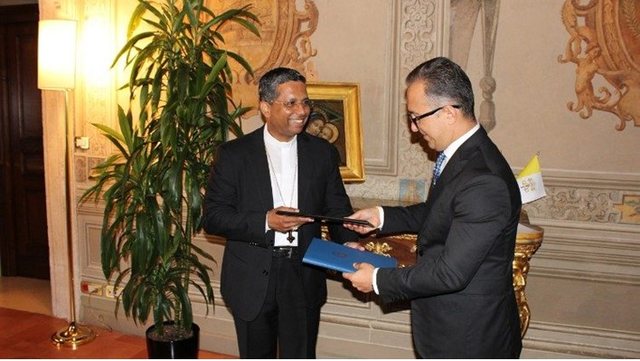
A long journey, rooted in the Second Vatican Council, marked over the years by dialogue and mutual appreciation, culminating in the Bilateral Agreement of 2011, and now enriched with another Memorandum of Understanding on interreligious dialogue.
In his greeting to the Azerbaijani authorities present at the ceremony on Monday morning at the Vatican, Cardinal George Koovakad, Prefect of the Dicastery for Interreligious Dialogue, summarized the journey followed by the Holy See and the Republic of Azerbaijan to achieve the signing of the document relating to a “vital area” — dialogue between different faiths. According to the cardinal, this document represents “a clear sign of the common desire to continue working together for the integral formation of every person, as believers and as citizens.”
Encouragement from the Popes
Furthermore, Cardinal Koovakad noted, “in recent decades, the Holy See and the Republic of Azerbaijan have shown a common desire to develop and strengthen their relations.”
The Cardinal noted that this desire has been encouraged by a series of steps, including the Apostolic Journeys to Azerbaijan of Pope Saint John Paul II in 2002 and of Pope Francis in October 2016, as well as the visit of Secretary of State Cardinal Tarcisio Bertone in 2008, during which he expressed closeness to Pope Benedict XVI.
The memorandum signed on Friday is based on the bilateral agreement of April 2011 between the Holy See and the Republic of Azerbaijan. The prefect noted that this agreement, in addition to consolidating bilateral relations and enabling the Church to carry out its mission in the Caucasian Republic, has become “a valuable instrument for promoting the principle of religious freedom”, a principle also sanctioned in the Constitution of Azerbaijan itself. This text, he continued, testifies to “respect for a minority religious community and the way in which Christians and Muslims can live together in harmony”.
Rooted in the teaching of the Second Vatican Council
Cardinal Koovakad stressed the importance that Pope Francis has devoted in recent years to interreligious dialogue, understood as a driving force for a “culture of peace” in the spirit of the Document on Human Fraternity, and even earlier, by the Second Vatican Council in Nostra aetate, the Council’s Declaration on Religious Freedom, which will celebrate its 60th anniversary next October.
Since 1965, the Cardinal said, “new areas of common commitment have emerged, such as the desire to care for and protect the environment, as well as the need for an ethical use of artificial intelligence. Concrete gestures of cooperation on such important issues will contribute to building a more peaceful world, a desire that lies in the heart of every man and woman of good will.”
Push for peace
Cardinal Koovakad expressed gratitude to the President of Azerbaijan, Ilham Aliyev, as well as to Ramin Mammadov — the highest state authority for religious associations — “for approving and supporting this important Memorandum.”
He also praised the “continuous commitment” of Sheikh ul-Islam Allahshukur Pashazade, president of the Council of Muslims of the Caucasus, who, as he recalled, “supported the construction of a new Catholic church in Baku after the destruction of the existing one in the 1930s.”
The cardinal concluded his speech by echoing the words of Leo XIV in his address to the Diplomatic Corps at the beginning of his pontificate, while expressing the hope that the “friendly bilateral relations” between the Holy See and Azerbaijan “will now receive a renewed impetus to move forward and will be further strengthened, as we seek to promote ‘truth, justice and peace’ for all humanity.”