How Belinda Balluku is fabricating the rumor about Top Channel's...
/ 2026-10-19 16:19:00Focus


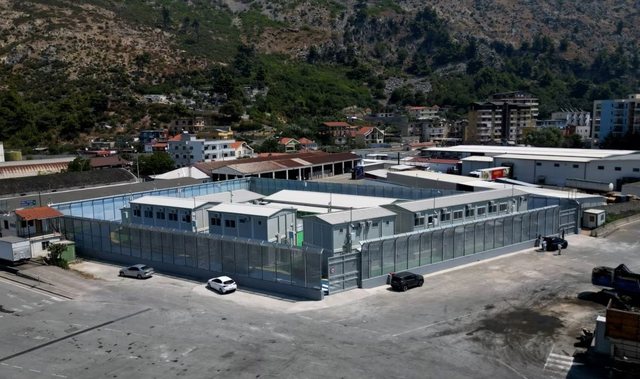
A year after Italy opened migrant centers in Albania, intended to house people detained at sea, the legally contested centers are almost empty.
Several non-governmental organizations have criticized the living conditions inside the centers, while Italian courts have blocked several attempts to deport migrants to Albania.
But while the European Union is discussing the possibility of creating "return centers," Italy's far-right government has vowed to send migrants to centers abroad, in Albania.
“Very worrying”
On October 16, 2024, two centers were opened in the port of Shëngjin and in Gjadra, in northern Albania. They are managed by Italy.
On the same day, dozens of cameras filmed the arrival of the first Italian navy ship carrying 16 men from Egypt and Bangladesh, detained at sea as they attempted to reach the EU.
Their identities were initially verified at the port. They were then taken to the center in Gjadra, where they could wait for their asylum application to be processed, if they were to submit such an application.
But, very quickly, four of the men were identified as "vulnerable" persons and returned to Italy.
Within two days, the other 12 people were also returned, after an Italian court ruled against their detention.
The court cited disagreements regarding the list of "safe" countries of origin drawn up by the Italian Government, which includes countries that do not meet European legal criteria.
A year later, Italian judges have repeatedly rejected deportations, slowing plans to place up to 3,000 migrants in the centers.
According to legal expert Gianfranco Schiavone, a report by Italian non-governmental organizations found that a total of 132 people were sent to centers in Albania.
Of them, only 32 have been repatriated, although it is not known for sure how many have returned to Italy and how many have been sent to other countries.
It is also difficult to obtain official confirmation on the details of the program and the conditions at the centers – Albanian authorities referred AFP's questions to Italian authorities, who did not provide answers to specific questions about this scheme.
"The situation is very worrying due to the extreme difficulties detainees have in exercising their fundamental rights in general," Schiavone said.
According to a report by a group of NGOs, at least nine people attempted suicide while being held in the centers and 21 cases of self-harm were also recorded.
"The Italian Experiment"
Amid ongoing legal battles, Italy plans to use these centers as detention facilities for people awaiting deportation, as Italian authorities have already declared the migrants "illegal."
Schiavone said that this effort is also likely to be blocked by European courts.
"There is no provision that allows the administrative detention of foreigners awaiting deportation from Italy to carry out this process in a country that is not a member of the EU."
But this could change within months if the "return regulation", currently being discussed in the European Parliament, is approved: this legal framework would pave the way for the creation of centers for migrants outside the EU's borders.
Since her election in 2022, Italian Prime Minister Giorgia Meloni has made the fight against irregular migration one of her government's top priorities.
Legalizing what is being described as Meloni's experiment would be a significant political victory for her far-right party, the Brothers of Italy.
But Filippo Furri, from the non-governmental organization ARCI, said he hopes the EU will reconsider this approach and consider it "illegal and economically unsustainable."
Meanwhile, the risk for people who migrate is that "this Italian experiment will spread to other countries," he said.
During a visit to Albania in May, British Prime Minister Keir Starmer expressed his desire to create "return centers."
But his Albanian counterpart, Edi Rama, was hesitant about launching another program in his country and said that the Italian model "needs time to be tested."
"If it works, it can be replicated. But not in Albania, somewhere else in the region," Rama said./REL