How Belinda Balluku is fabricating the rumor about Top Channel's...
/ 2026-10-19 16:19:00Focus


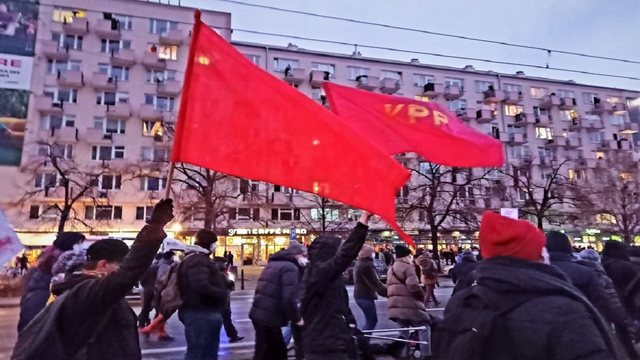
Poland has officially banned the Communist Party after a Constitutional Court ruling confirmed that its program and ideology are in direct conflict with the Polish Constitution.
This decision marks the legal end of a small, but symbolically important political force, which for years was considered problematic by state institutions.
The Constitutional Court stressed that the ideology of the Communist Party violates the constitutional principles of a democratic state, arguing that the promotion of communism contradicts Poland's legal system and the country's historical memory.
According to the panel, "there is no place in the Polish legal order for a party that glorifies the crimes of communist regimes."
This stance reflects the strong anti-communist line of the Polish state, which has intensified especially in recent years.
A process that began years ago
Although the decision was made now, the process to ban the party began in 2020, when the Attorney General filed the first request for liquidation.
The issue came back into the spotlight in November of this year, when Polish President Karol Nawrocki filed a new request with the Constitutional Court.
According to experts, the slow procedural pace was a result of legal complexity, but also of internal debate over the limits of political freedom.
A small but symbolic party
Founded in 2002, the Communist Party of Poland had a limited membership base, from a few hundred to around a thousand according to various estimates.
However, despite its small electoral weight, the party carried a strong historical symbolism, linked to the legacy of the communist regime that ruled Poland for almost half a century.
This has made it the subject of ongoing debate: on the one hand, defenders of freedom of political expression, and on the other, conservative and nationalist forces that demanded the banning of any form of apology for communism.
A political epilogue in a polarized climate
The Constitutional Court's decision is expected to intensify the debate over the limits of political freedom in Poland. For its supporters, it is a necessary step towards cleansing public space from totalitarian ideologies.
For critics, it is a precedent that could be used to expand state control over small or politically unpopular parties.
In practical terms, however, the decision closes a political chapter of the past – as Poland focuses on the broader geopolitical and security challenges it faces today.