Protests, violence, curfews: From France to Albania, why Europe'...
/ 2026-10-20 23:47:20Focus


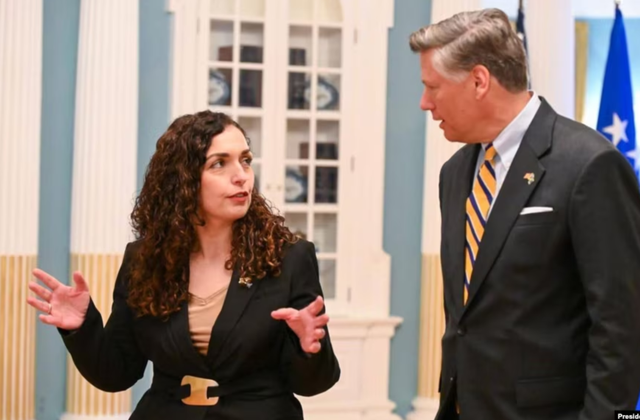
The administration of the US President, Donald Trump, has approved the continuation of the compact program of the Millennium Challenge Corporation (MCC) of the US Government for Kosovo, said the President of Kosovo, Vjosa Osmani.
According to Osmani, she has been officially informed about this issue by the US Deputy Secretary of State, Christopher Landau.
"Great news for Kosovo! Deep gratitude to the United States of America," she wrote on Facebook.
The Kosovo Presidency said that Osmani, during his stay in the United States earlier in July, had submitted the request to American officials for the continuation of this program.
In April 2024, MCC and the Government of Kosovo launched the implementation of this compact program, which is focused on providing clean energy solutions.
The program is worth $236.7 million. Of this amount, 202 million are from the MCC and another 34.7 million are the contribution of the Government of Kosovo.
MCC's compact programs are five-year grants that are issued by this corporation to states that meet the eligibility requirements for such programs. In 2022, Kosovo had reached an agreement with the MCC on the compact program.
According to the agreement, the key project of this program is that of energy storage.
Through it, Kosovo will have energy reserves through high-capacity batteries of 170 megawatts. These batteries will enable the provision of reserves of about 347 megawatts per hour.
At the launch ceremony of the implementation of the program, officials of the Government of Kosovo had said that through this program, by the end of 2027, it is envisaged that Kosovo will have the largest capacity of batteries in the world per capita.
At the time, the Kosovar executive said that the MCC compact aims to introduce an advanced energy storage system to create reliable, renewable energy grains which will be integrated into Kosovo's grid and reducing the need for energy to be produced from coal.
Meanwhile, the MCC has stated that the compact will serve as "the cornerstone of Kosovo's transition towards green energy, increasing the country's energy security and promoting its socio-economic transformation".
Kosovo produces most of its energy through the burning of coal, in two power plants: Kosovo A and B. According to the Energy Strategy, which was adopted in 2023, Kosovo aims to generate 35 percent of its energy needs from renewable energy by 2031.
The strategy also envisages phasing coal out of use entirely by 2050.
Otherwise, MCC has been cooperating with Kosovo since 2016. In addition to the compact energy program, MCC has also had other programs for economic development in Kosovo in the amount of $50 million.
This US agency has also offered scholarships for women's education in the field of energy./REL