


Is this police force professional and capable of handling violen...
/ 2026-10-16 18:54:07Focus


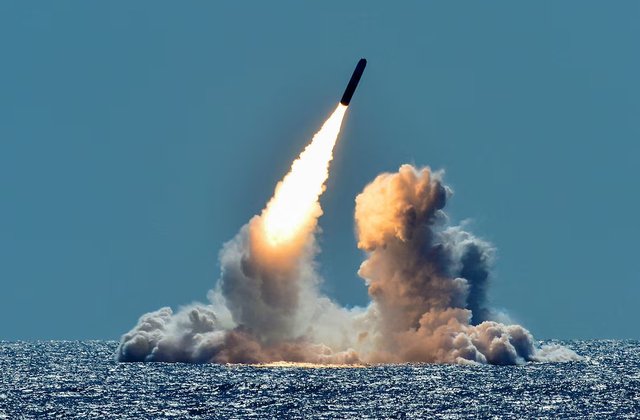
Without a last-minute deal, the US and Russia on the brink of a new, out-of-control nuclear race
The United States and Russia are close to embarking on a new round of nuclear arsenal re-equipping with additional long-range missiles equipped with nuclear warheads unless a last-minute deal is reached before an arms control treaty expires in less than a week.
With the New START treaty expiring on February 5, Russian President Vladimir Putin has proposed that both sides stick to existing nuclear warhead limits for another year, to buy time to decide what comes next.
US President Donald Trump has not officially responded to Putin's offer.
Some US politicians and security analysts argue that he should reject it, paving the way for the United States to immediately increase its arsenal to counter China's rapid nuclear expansion.
If both sides do not agree to maintain limits on missiles and nuclear warheads, for the first time in more than half a century they will be left without mutual limits on the size of their strategic arsenals — the weapons that would be used to strike each other's capitals, military bases, and industrial centers in the event of a nuclear war.
Security analysts say the value of nuclear treaties goes far beyond setting numerical limits: they create a transparent and stable framework that prevents arms races from spiraling out of control.
In their absence, both sides lose a critical communication channel for “understanding where the other side is coming from and what its concerns and motivations are,” said Darya Dolzikova, a nuclear specialist at the British RUSI institute.
“With the New START treaty currently expiring and the lack of negotiations on its replacement, communication between the parties on this critical strategic issue is being lost. That said, Russia has suspended its participation in the New START treaty in 2023, so we haven’t had the data on exchanges for quite some time now. But, again, this overshadows, if we can call it that, a perhaps slightly less tangible but truly critical aspect: the ongoing communication and engagement between the two sides, as well as efforts to understand where the other side is coming from and what its concerns and motivations are within the framework of its strategic equation,” said Darya Dolzikova, a nuclear weapons expert.
The New START treaty sets a limit of 1,550 deployed strategic nuclear warheads for each side, as well as no more than 700 land-based or sea-based missiles and bomber aircraft to deliver them.
"If it expires, let it expire," Trump said this month, adding that the treaty should be replaced with a better deal.
But this would be a very difficult and time-consuming task, as the situation is now much more complex than in 2010, when New START was negotiated.
Russia has developed new nuclear-capable systems, the Burevestnik cruise missile, the Oreshnik hypersonic system and the Poseidon torpedo, which are not included in the framework of the old treaty. Meanwhile, Trump has announced plans for a space-based missile defense system called Golden Dome, which Moscow sees as a provocative attempt to shift the strategic balance in Washington's favor.
“In the case of Russia, it seems that they have some concerns about the survivability of some of their existing strategic nuclear delivery systems, which we think was somewhat of a driving force behind the testing of some of these new, so-called ‘innovative’, strategic systems. So, the Burevestnik and Poseidon capabilities, which Putin announced were being tested. There is a drive on the Russian side to strengthen the survivability and, it seems, the diversity of their strategic systems. However, these new systems are most likely not covered by the terms of the New START agreement.”
For the US, a key concern is China's growing arsenal. It currently has about 600 nuclear warheads, but the Pentagon estimates that by 2030 it will have over 1,000.
Trump says he wants to pursue nuclear disarmament with Russia and China, but Beijing considers it unreasonable to expect him to enter into disarmament talks with two countries that have much larger arsenals.
A bipartisan congressional commission in 2023 said the US is facing an "existential challenge" from not one, but two equal nuclear powers, and must also be prepared for the scenario of simultaneous wars with Russia and China.
The recommendations included preparing to bring back into service some or all of the strategic nuclear warheads that had been removed from service under New START and are stored in reserve.
Experts say this could include returning nuclear warheads to Minuteman III intercontinental ballistic missiles, Trident D5 naval missiles, and re-equipping about 30 B-52 strategic bombers, which had been adapted for conventional missions, with nuclear warheads.
They also agree that a new arms race has already begun. Prokhor Tebin mentioned “hypersonic technologies” and “the continued development of precision non-nuclear weapons.”


