Protests highlight trauma crisis, operating rooms under reconstr...
/ 2026-10-15 18:35:16Focus


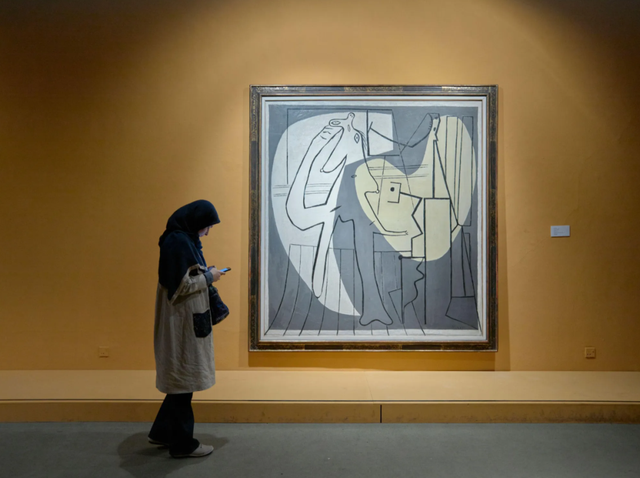
A priceless Picasso work is in danger of being lost to the public due to the war in Iran. The painting, known as "The Painter and His Model," is part of a multi-billion dollar collection of 20th-century masterpieces currently under the bombed skies of Tehran.
More precisely, it is stored in a basement that also serves as a fortress in the Iranian capital, in the warehouses of the Museum of Contemporary Art.
What is special is that its history is closely linked to world economies. Due to the OPEC oil embargo of 1973, which quadrupled the price of oil, paralyzed the American economy and generated extraordinary profits for Iran, the richest collectors no longer lived in New York, but in the Middle East. Thus, Pablo Picasso's "The Painter and His Model" became the property of Iran since the 1970s.
A masterpiece in danger
The 1927 painting, according to Bloomberg, is perhaps the most important canvas in the world that cannot be visited or seen. Art historian Jeremy Melius has described it as “one of the greatest achievements” of the artist’s career, a masterpiece of Picasso’s surrealist period. Without its innovations, art historians believe the Spanish master would never have been able to paint his famous Guernica.
"It's terrible to think that he is in danger along with all the residents of the city," Melius appealed.
Bought with oil money
The painting arrived in Tehran thanks to Farah Pahlavi, the wife of the Shah of Iran. Shahbanu, as she was known, was an art enthusiast who wanted to turn her country into a cultural avant-garde. She founded the Tehran Museum of Contemporary Art (TMoCA) and dedicated her life to researching works for the collection.
Andy Warhol, Pablo Picasso, Roy Lichtenstein, but also Francis Bacon, Jackson Pollock, Edgar Degas, Mary Cassatt and many others became part of the empress's collections. William Rubin, director of the painting department at the Museum of Modern Art in 1973, has stated that the painter and his model were saved because Shahbanu had the money and charisma to purchase it from the Swiss art dealer Ernst Beyeler in 1977, at a time when New York was still recovering from the 1975 debt crisis and MoMA was struggling for funds.
A value of 300 million
The cost of the collection, paid for between 1975 and 1977 with the proceeds from national oil sales, ranged between $25 million and $30 million. In 2018, the value of Shahbanu’s paintings was estimated at $3 billion, and today they are undoubtedly worth much more. Meanwhile, even after the recent price increase, $30 million worth of 1977 crude oil would be worth about $300 million today.
It is surprising that, despite the fact that the painting depicts a naked woman, the Iranian theocratic regime has allowed the painter and his model to be exhibited at TMoCA. The work was the centerpiece of the “Picasso in Tehran” exhibition in 2025, which attracted 55,000 visitors in just 15 days. /La Repubblica