Is this police force professional and capable of handling violen...
/ 2026-10-16 18:54:07Focus


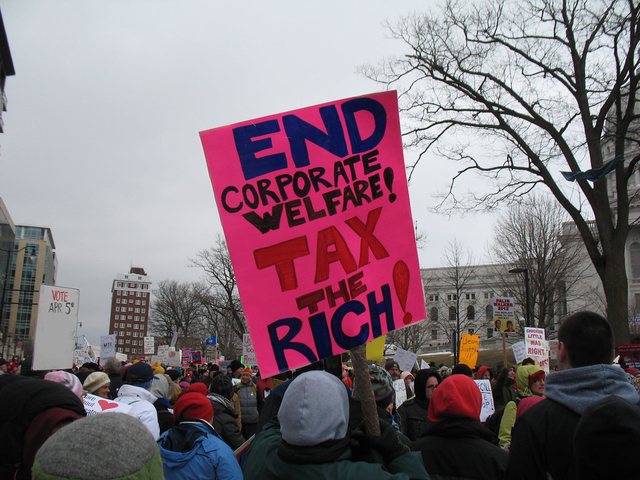
Rising income inequality and the public display of billionaire power are fueling calls for new taxes on the world's wealthiest individuals. Can wealth ever be taxed fairly?
Few people like paying taxes. But many voters see no problem with the super-rich being taxed and paying their “fair share.” One way is to raise income taxes. There is also the option of an annual or one-time tax on everything someone owns above a certain threshold.
Some governments want to tax extreme wealth to lower taxes on the middle class or to alleviate social inequality. Others want to fill budget gaps. Still others argue philosophically that excess wealth should be limited because it no longer contributes to the well-being of these individuals.
Debate in the United States
The ultra-rich are considered individuals with a net worth of at least $30 million (€25.9 million), while the super-rich have $300 million or more.
In the United States, Mitt Romney, former Massachusetts governor, senator and US presidential candidate, sees a major problem in the tax loopholes related to capital gains. “We have reached a point where any combination of solutions to our country’s economic problems will involve the wealthiest Americans contributing the most,” he wrote in a December 2025 New York Times article titled “Tax the Rich, Like Me.”
Zohran Mamdani, the new mayor of New York City, has proposed raising the city’s income tax rate from 3.9 percent to 5.9 percent on incomes over $1 million a year. In early March, lawmakers in Washington state approved a new tax on personal incomes over $1 million. The measure awaits the governor’s signature. Others are considering similar measures.
These proposals are important because the United States is the world's largest economy. It is also home to the largest number of millionaires and billionaires, according to Forbes magazine.
A fair wealth tax?
"Taxing the super-rich is a fair, economically efficient decision. In some countries it helps other important goals, such as strengthening democracy," said Brian Gell, a law professor at the University of California, Berkeley.
In many countries, the super-rich control so much of society's resources that they can influence political and economic outcomes, Gell says, which can lead to unstable policies and disastrous economic consequences.
A major obstacle to taxing the super-rich is part of existing tax systems, as most of them only impose taxes when investment assets are sold, Gell says. "Super-rich families can afford to sell only a small portion of their wealth, which allows them to choose when and often where to pay taxes," he added.
Who's afraid of a wealth tax?
What if, instead of a corporate tax, you pooled all your assets and then taxed that amount, i.e. introduced a wealth tax? Since 1965, 13 countries in the Organization for Economic Co-operation and Development (OECD) have introduced a tax on net wealth. Today, only four countries still have wealth taxes, including Norway, Spain and Switzerland.
Overall, these taxes have raised little revenue and caused administrative problems, Enache and Mengden say. Another problem has been legal disputes.
In 1995, Germany's Federal Constitutional Court ruled that the wealth tax violated the principle of equality and declared it unconstitutional. As a result, Germany abolished the tax in 1997. The Supreme Court of the Netherlands ruled in 2021 that the country's wealth tax violates European law on property rights and the prohibition of discrimination.
Property taxes are difficult to calculate
When it comes to wealth taxes, the big problem is determining someone's total wealth. Cash is easy to count, but what about all those houses, cars, private jets, and investments? Not to mention art collections or the contents of bank vaults. This becomes even more difficult and costly if it has to be done every year.
Wealth taxes discourage saving and investment, which hurts entrepreneurship in the long run, according to a study by the Tax Foundation. In addition, wealth taxes “can lead to capital flight and the relocation of wealthy individuals to neighboring countries,” Mengden and Enache said. “After Norway raised its wealth tax by 0.1 percent, high-net-worth individuals fled the country to countries like Switzerland and the United Kingdom.”
Brian Gell doesn't believe that the ultra-rich can simply move their wealth around rather than allow it to be taxed. "For example, good legal design can make it much harder for wealthy investors to avoid taxes," Gell said.
Can California lead?
When it comes to a new wealth tax, California could lead the way with a single 5 percent tax on people with wealth exceeding $1 billion.
If the measure passes the November vote, it will be a major test for the leading economy. In 2024, strong growth made the state the world's fourth-largest economy, behind the United States as a whole, China and Germany.
Supporters say the tax will raise government revenue. Critics say it will drive the wealthy away to Texas, Florida or Nevada.
Gov. Gavin Newsom opposes the idea, as do tech leaders and perhaps many of the state's 200 billionaires. Their biggest concern is that the tax takes into account illiquid assets and unrealized gains.
This means that "theoretical paper gains" on stocks or real estate will be taxed. Critics fear that this could force some people to sell their homes and make other transactions. Governments have many tools when it comes to taxation, but they must be used wisely if the goal is to make taxes fair. /DW