


How Belinda Balluku is fabricating the rumor about Top Channel's...
/ 2026-10-19 16:19:00Focus


World War I was a sort of cultural suicide that destroyed Europe's preeminence. European leaders sleepwalked—in the words of historian Christopher Clark—into a conflict that none of them would have entered had they envisioned the world as it would be at the end of the war in 1918. In previous decades they had expressed the rivalries between them by creating two groups of alliances whose strategies were linked according to the respective mobilization plans. As a result, in 1914, the assassination of the Austrian Crown Prince in Sarajevo by a Serbian nationalist was allowed to escalate into a general war that began when Germany implemented the all-out plan to defeat France by attacking neutral Belgium on the other side of Europe. .
European countries, not quite aware of how much technology had empowered their respective military forces, inflicted unprecedented destruction on each other. In August 1916, after two years of war and millions of casualties, the main parties in the West (Britain, France and Germany) began to look for ways to end the carnage. To the east, rivals Austria and Russia were seeking the same. Since no conceivable compromise could justify the sacrifices already made, and since no one wanted to appear weak, various leaders were reluctant to initiate a formal peace process. For this reason, they asked for the mediation of America. Exploration conducted by Colonel Edward House, President Woodrow Wilson's personal envoy, revealed that peace based on a modified status quo ante was within reach. However, Wilson while he was willing and eventually impatient to play the mediator, he left everything until after the presidential elections in November. By then, the British offensive on the Somme and the German offensive at Verdun had added another two million casualties.
In the words of the book on the subject written by Philip Zelikow, diplomacy became the road less trodden. The Great War continued for two more years and caused millions more casualties, irreversibly damaging the balance in Europe. Germany and Russia were engulfed in revolution; the Austro-Hungarian state disappeared from the map. France shed the last drop of blood. Britain had sacrificed much of its youth and economic capacity to achieve victory. The punitive Treaty of Versailles that ended the war proved far more fragile than the structure it replaced.
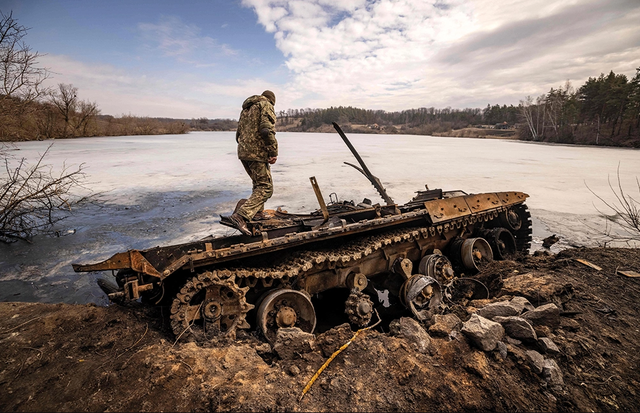
Does the world today find itself at a similar turning point in Ukraine, as winter imposes a pause on large-scale military operations there? I have repeatedly expressed my support for the military efforts of the allies to repel Russian aggression in Ukraine. But the time is coming to build on the strategic changes that have already been achieved and integrate them into a new structure towards achieving peace through talks.
Ukraine has become a major state in central Europe for the first time in modern history. Aided by allies and inspired by its president Volodymyr Zelensky, Ukraine has halted the advance of Russian conventional forces, which have hovered over Europe since World War II. And the international system, including China, opposes Russia's threat to use nuclear weapons.
This process has highlighted the original issues regarding Ukraine's NATO membership. Ukraine has created one of the largest and most effective ground armies in Europe, equipped by America and its allies. A peace process should link Ukraine to NATO, however it is expressed. The alternative of neutrality no longer makes sense, especially after Finland and Sweden joined NATO. That is why, last May, I recommended the establishment of a cease-fire line along the borders that existed at the beginning of the war, on February 24. Russia would withdraw from the occupied territories, but not from those occupied nearly a decade ago, including Crimea. That territory could be the subject of talks after the ceasefire.
If the pre-war border between Ukraine and Russia cannot be reached either by fighting or talks, recourse to the principle of self-determination can be explored. Internationally monitored referendums on self-determination can be held in particularly disputed territories that have changed hands several times over the centuries.
The goal of the peace process would be twofold: the confirmation of Ukraine's freedom and the definition of a new international structure, especially for Central and Eastern Europe. Eventually, even Russia would find a place in such an order.
The preferred outcome for some is a Russia that emerges powerless from the war. I don't agree. Despite its propensity for violence, Russia has made a decisive contribution to the global balance and balance of power for more than half a millennium. Its historical role should not be degraded. The steps back militarily have not eliminated its global nuclear capability, enabling Russia to threaten escalation in Ukraine. Even if that capability is diminished, Russia's disintegration or the destruction of its capacity for strategic policy could turn its territory spanning 11 time zones into a contested vacuum. Its competing societies may decide to settle disputes among themselves by violence. Other countries may seek to achieve their claims by force.
As world leaders try to end a war in which two nuclear powers compete over a conventionally armed country, they must also reflect on the impact of emerging technology on this conflict and on long-term strategy. Autonomous weapons already exist, capable of identifying, assessing and targeting what they perceive as threats, thus capable of starting war themselves.
When the goal in this area is crossed and high technology becomes the standard weapon - and computers become the main executors of strategy - the world will find itself in a state for which there is still no defined concept. How can managers exercise control when computers prescribe strategic instructions on a scale and in a manner that essentially limits and threatens human input? How can civilization be preserved amid such a maelstrom of conflicting information, perceptions, and destructive capabilities?
No theory of this alternative world yet exists, and consultative efforts on the subject have yet to evolve—perhaps because meaningful negotiations may reveal new achievements and that discovery itself poses a risk to the future. Straddling the line between advanced technology and the concept of strategies to control it, or even understanding its full implications, is as important an issue today as climate change and requires leaders who know technology and history together.
The search for peace and order has two components that are sometimes treated as contradictory: the achievement of elements of security and the demand for acts of reconciliation. If we cannot achieve both, we will achieve neither. The path of diplomacy can seem complicated and arduous. But progress towards it requires vision and courage to undertake the journey./ THE SPECTATOR






