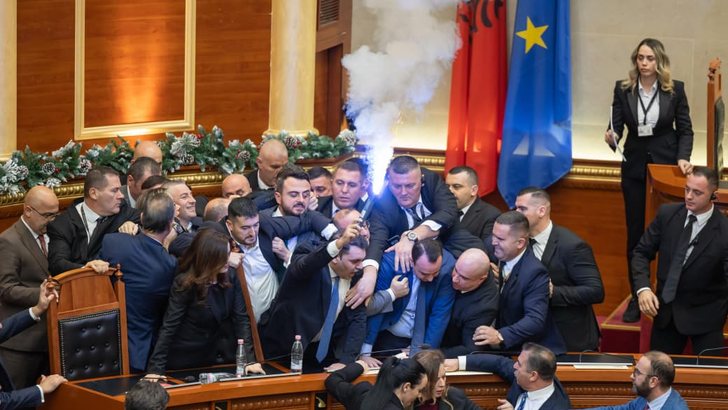
Is this police force professional and capable of handling violen...
/ 2026-10-16 18:54:07Focus


It seems like a fish in the sea and a frying pan in the fire, but it is necessary that the attempt to overthrow Rama be accompanied by the alternative of the day after. Is the technical government, a request of many "opposition" parties, the best alternative or should we demand, as the BASHKA Movement is doing, early elections an hour or so earlier?
The request for a technical government means that Rama will be forced to resign, as well as the manner in which he will surrender. However, no matter how strong the political and social pressure on Rama is in the coming weeks/months, nothing would prevent Rama, feeling in difficulty, from trying two ways out: 1. He resigns as prime minister, but is replaced by a figure within his party; thus, the government remains solely with the SP. 2. He does not resign, but calls early elections as a test of confidence in relation to society.
Whoever demands a technical government at all costs, claiming that Rama cannot be overthrown by elections if he or his party remains in power, is left with the task of threatening and carrying out the threat of non-participation in the elections. Lulzim Basha proved it in 2019 by burning the mandates of MPs and boycotting the local elections. Any sensible person has understood that this tactic was the most failed and empowering political move of Rama's central and local government.
The above does not exclude the possibility that, for his own account, Rama will accept the idea of a caretaker government. But what does a caretaker government mean in the conditions of Albania, in an institutional context where the Socialist Party has 83 + 3 MPs? The idea that Rama will not influence the composition and policies of the caretaker government is a lie for the naive or a dream as sunny as the one that expects the American Delta Forces to arrest Rama in Surrel.
The technical government will practically be a deal between Rama and Berisha (and any political tails close to them) for the partial sharing of power. The best that the “opposition” can achieve would be a government where the ratio in the executive will reflect the ratio of strength in parliament (60% to 40% for the ruling party). Such a government, despite the “technical” names, coupled with the full legislative power of the SP, its control over the administration (remember how much the ministers did to Lulzim Basha in 2017), preferential relations with organized crime and the oligarchy, would again mean the full de facto power of Rama. As today practically, but worse than today symbolically, as it would give Rama the privilege of irresponsibility for the conduct of the elections. If he wins again, he will shut up the critics: “You won with your rules. What more do you want?!”
The idea that the "technical government" Rama-Berisha will produce progressive constitutional reforms is an even more far-fetched dream than the one with Delta Force. So, to hang the livers around the necks of wolves and wait for them not to eat them. The common interests of Rama-Berisha have nothing in common with the public interest and the democratization of the state. Together they - in the name of European integration or some other fairy tale - will govern for several years. Initially, they will steal together both as brothers and as competitors (who steals more in the perspective of the match in the next elections). Second, they will sew constitutional changes that limit the powers of the justice institutions and impose a two-party system (by establishing a British-American-style majoritarian representation model, or by maintaining the proportional model but with a very high threshold for representation in parliament).
The demand for a technical government is also derived from the political impotence widespread in many parts of the Albanian "opposition." Rama has created the myth of invincibility, so much so that it seems to the black-collar workers of other parties that every time elections are held, regardless of social conditions, Rama will win more and more.
In addition to being defeatist, this perspective is also incorrect. Power has a relational character and also depends on factors outside the party scene. Initially, on legitimacy, that is, how much society accepts you. Corruption scandals have brought the sewage to the streets. The fact that we knew about these things is not decisive. We know that the sewage is beneath us, but when it erupts on the streets we turn a blind eye. The emergence of corrupt acts and the relationship of political power holders with organized crime makes it impossible for the average citizen to turn his head the other way, to pretend that nothing is happening or that what is happening is normal. He is more ashamed of himself and his fellow citizens. Secondly, the tightening of the noose of the justice institutions towards Rama's collaborators, and probably towards Rama himself in the future, weakens the latter. When people think that you could end up being questioned by SPAK for hours, if not arrested in an optimistic scenario, the shadow of power today is much weaker. Rama's partners in the criminal underground and the economic oligarchy will temporarily become demoralized and will seek other partners in the party spectrum (there are plenty of villains who are eager to experience such a "fate"), thus weakening Rama. The dissatisfied within the SP will take advantage of the opportunity to put the milk bottle in the queue for the inheritance of power within the party. Third, there is the international factor. Apparently, the Americans are much colder than before with the government. More open and stinging statements could damage Rama's image as a son-in-law of the West. Also, the insistence on not handing over Balluk and resisting SPAK could bring distancing and criticism even from EU representatives. In conditions where Rama's only major promise remains rapid integration into the EU, this would be a serious blow to him.
Rama is weaker than ever today and should not be given time to recover within the framework of the co-government with the DP. Therefore, the demand for early elections is imperative. Despite the injustices of the Electoral Code – which will remain as such as long as there is no new governing majority to change it – despite Rama being in power, the elections are the best chance to finally overthrow him and, with him, to give a strong kick to the edifice of the old party system.
Admittedly, this path also carries its own risks, but it is still much more hopeful and productive than dreaming with open eyes. Of course, this cannot be an option for discredited political figures like Sali Berisha or for the axama who hide their political cowardice by cursing the people. The Albanian people are ripe for change. Rama's victory in May was like Pyrrhic, a final victory and received more with displeasure than with grace, by a society that still endured the threat and submitted to the logic of comparing two evils (Rama vs Berisha). But Berisha is not and should not be considered the only opposition factor. Not even the most important if we think of politics as a movement through contradictions.
The BASHKA movement has the greatest potential to become the most important political alternative for several reasons: 1. High moral reputation in the eyes of citizens, which even our opponents openly and silently acknowledge. 2. Political courage to oppose both the government, the rotten party system, and the economic oligarchy. A sign of a genuine anti-systemic force, where by system we mean corruption and all-round fraud. 3. The spirit of activism tempered by many years of organization, countless protests, and organic relations with the main social strata. 4. Ideas systematized in the program and the political and intellectual capacity to govern.
The above only makes sense if the condition of political thought and action is faith in the people, in the potential that every oppressed citizen has to come together and transform into a plurality: