Berisha: Altin "Troplini" Dumani amnestied electoral crimes, SKA...
/ 2026-10-19 11:44:20Focus


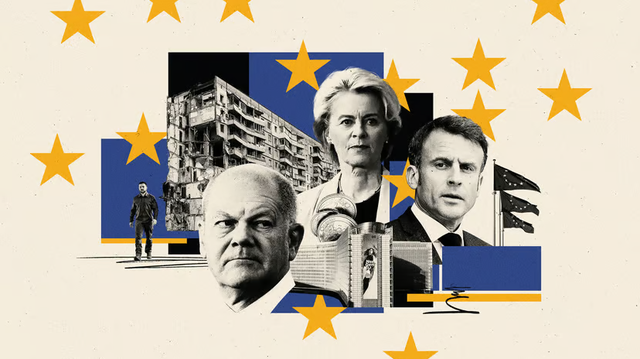
The East is rising, Germany is falling, Britain is out
Football is a game where "22 men chase a ball for 90 minutes and in the end the Germans always win", said Gary Lineker, an English footballer. For decades, the EU had a predictable political dynamic. Regardless of the number of members, 6, 12 or 27, there was a compromise, even if the decisions were made by Germany and France.
But the old model of dominance by its two biggest members doesn't seem to be working anymore. As Europe faces repeated crises, a new geography of power is taking shape.
Three years of the epidemic and then the war in Ukraine have helped to reconceptualize the European project. This involves changing the balance on issues that matter. Defense and eastward expansion, once dormant policy areas, are now priorities – giving a new voice to Ukraine's neighbors in Central Europe.
The rise of China and the prospect of a resurgence of Trumpism in America has led the EU to rethink its economic agreements – often along statist French lines. Climate imperatives have reinforced the value of taking action at the collective level – an approach favored by the EU's quasi-federal institutions in Brussels. And from Finland to France, populists on the far right are gaining ground ahead of European Parliament elections in June.
Not so long ago Angela Merkel was the undisputed leader of the continent. Her successor as German chancellor, Olaf Scholz, has not taken up her mantle. Many looked to Emmanuel Macron to replace Merkel. But he faces an increasingly difficult political situation at home, which on January 8 resulted in the dismissal of the prime minister. He cannot stand for re-election in 2027 and Macron reflects a self-confidence that often clashes with other EU leaders.
Germany and France have unmatched authority when aligned. But this rarely happens. Without clear leadership, who matters these days depends on what's on the table. Take defense and security, issues at the forefront of everyone's mind, given the situation in Ukraine (and more recently, the Middle East).
After the invasion of Russia in February 2022, few looked to Germany for leadership: it had left itself dependent on Russian gas and its armed forces were so unfit for purpose that Scholz declared the need for a Zeitenwende, a radical change in approach .
In contrast, countries in Central Europe, led by Poland and the three Baltic states, felt vindicated after years of warnings about the danger posed by Russia. Their influence is in two directions: Sending weapons to Ukraine and expanding the EU.
The EU has not been enlarged since Croatia. Now nine candidates are in various stages of negotiations. Most notable is Ukraine, whose cause was championed by Central Europe despite initial reservations from France and Denmark; on December 14, EU leaders agreed to start formal accession talks.
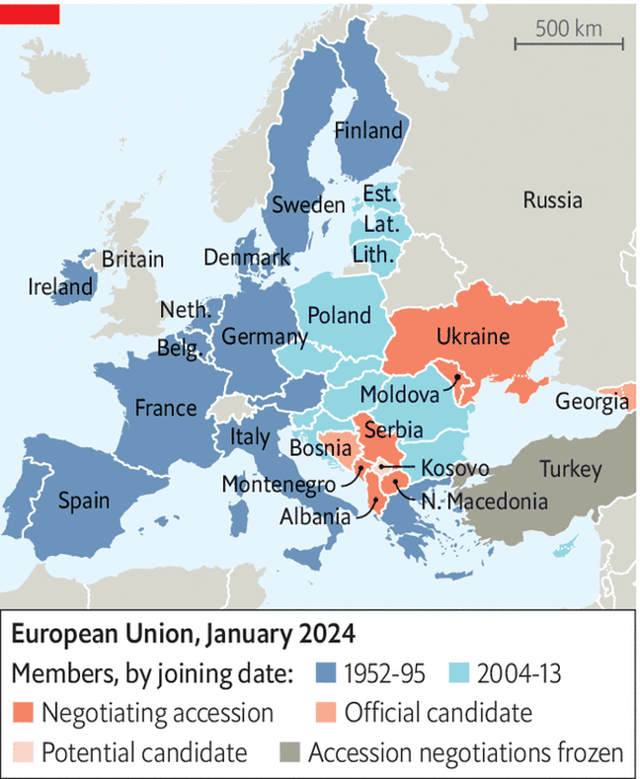
When the bloc expands to 36 countries, which could take years or decades, the center of gravity will shift decisively eastward.
More broadly, central Europeans now have enough weight to prevent ideas emanating from the far west from getting ahead of them. Chief among them is "strategic autonomy". This means that Europe should be able to act independently of others, for example by bearing more of the burden of defending itself. Policy makers in Poland or Slovakia find the security guarantees offered by NATO - and therefore America - much more convincing. French calls for EU armed forces to buy European (ie often French) military equipment have been largely ignored.
However, for all the influence Central Europe has when it comes to Ukraine, its voice is barely heard when it comes to other parts of European policymaking. (The moral authority accumulated in Warsaw and Bratislava by helping Ukraine was somewhat damaged after they closed their borders to agricultural exports last April, angering leaders in Kiev.)
Because when it comes to economic policy, Europe is being pushed to think more and more in French terms. Here, Macron's clarion call for strategic autonomy has proven far more powerful. Driven by a long-standing distrust of globalization — and new fears about supply chains that could be disrupted by pandemics or unsettled geopolitics — France wants the continent to be more self-sufficient.
Tensions between America and China, as well as the prospect of a new Trump administration in 2025, have other Europeans listening.
Macron has promoted the notion that Europe has been "naive" in its dealings with the rest of the world, keeping its markets open when its trading partners have not (for example America with its protectionist transition plan green, or China with huge subsidies). EU rules banning national governments from supporting favored industries were shelved during Covid-19 and have never been reinstated. With the "Europe first" mantra, politicians now have more control over the shape of the economy.
The French idea of Europe having an industrial policy was once taboo, but is now an accepted approach. France's leadership impulses prevailed because its ideas filled the void left by Britain, which voted to leave the EU in 2016 and finally exited four years later.
If it had remained a member of the club, Britain would have enthusiastically thwarted the French plans. Now the task has been left to its former northern European allies, such as Denmark, Ireland or the Netherlands, as well as the commission in Brussels. But this alliance could only moderate the French plans, not prevent them entirely.
Britain is not the only one not to be found at the front table of the EU. A more surprising absence is Germany: Mr. Scholz is seen as missing from the European scene. A complicated coalition that includes the left-wing Greens and free-market liberals has reduced his ability to strike deals in Brussels. "The German coalition moves slower than the debates within the EU," says a senior Brussels official. This has cost the Germans in terms of influence.
The absence of Germany has often been in favor of France. Many EU policy decisions have a distinctly French tinge these days, for example the absence of any new trade deals (anathema to French farmers) or a partial easing of European rules limiting budget deficits.
But the lack of German commitment hampers Macron's ambitions: the federalist schemes created in Paris only really work when counterparts in Berlin adhere to them.
No one thinks that the poor chemistry between the cold, northern Scholz and the ardent Europhile, Mr. Macron will soon get better. In other circumstances, France might have sought alliances that might have further shifted the balance of power. But there are few places where this can be required. Italy is led by Giorgia Meloni, whose right-wing populism makes cooperation difficult.
The Netherlands is losing its long-serving prime minister, Mark Rutte, possibly in favor of Geert Wilders, an ideological ally of Ms Meloni. Spain's chaotic politics has limited its appetite for influencing European debate. Donald Tusk, recently returned to Poland, is liberal and pro-EU, but he has a lot of work at home.
Perhaps the biggest beneficiary of this vacuum has been the EU's centralized institutions in Brussels. Under the leadership of Ursula von der Leyen, herself a German, since 2019 the European Commission, the executive arm of the EU, has amassed more power than ever before.
The 32,000-strong Brussels machine has long been a formidable regulatory force, as Silicon Valley barons have found over the years. But more and more it has weighed on the issues of politics and geopolitics. This started with Covid-19, when governments asked the commission to oversee the procurement of vaccines for the entire bloc.
Is this a sign of a federal Europe in the making, a European superstate in the making? For the likes of Hungary and Poland, it can feel that way. But there are limits to the powers of the commission. Part of Ms von der Leyen's influence stems from the fact that she coordinates closely with national capitals, for example on sanctions against Russia. It can influence, for example, Europe's attitude towards China.
Perhaps she is the closest thing to a European leader these days. But her power still depends on others following her; she will have to convince national leaders to re-nominate her for a second term after European elections in June. And Brussels still spends just over 1% of the bloc's total GDP.
Elections also have a way of rearranging the European order. Populists have done well in the Netherlands and Slovakia, not so well in Poland and Spain. They are expected to gain ground in the European Parliament elections. The most powerful force in post-war Europe – a sharp consensus in favor of liberal values and the rule of law – may be threatened.
Once the elections in Europe are over, attention will turn to those in America, still the main guarantor of European security and a major contributor to Ukraine's war effort. A Trump victory would cause fear.
The fact that votes cast an ocean away from Paris, Berlin and Warsaw cause fear in these countries shows that the authorities in these countries still have a lot to do, at least in terms of security.