"The fate of the homeland is in our hands" - An appeal by Ismail...
/ 2026-10-18 16:09:54Focus


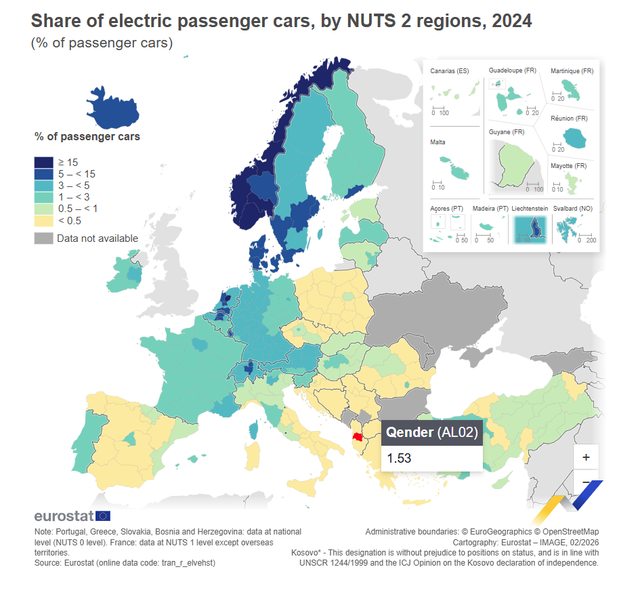
The center of Albania stands out in a map published by Eurostat for the weight of electric passenger cars for 2024. The center of the country is the only one colored green not only in the Balkans, but also in Italy, with the exception of the wealthy area of Bolzano.
According to the Eurostat map, in the central area of the country the number of electric cars has reached 1.53% of the total, the highest not only in the regions of the Balkan states but also in some Eastern European countries. In the north of the country 0.2% of vehicles are electric and in the south they are 0.13%.
In Italy, the Bolzano region alone has 1.8% of electric vehicles, while Tuscany has 1.01%. North Macedonia has 0.26% and Greece 0.3%.
The high share of electric vehicles in this area of the country is mainly linked to the high number of vehicles registered as electric taxis in recent years. According to the Directorate of Transport and Road Traffic, there were 2,850 licensed vehicles and 130 legal entities operating in the capital city of Tirana by the end of May 2025. Based on the 2023 Census data on the resident population, the Albanian capital currently has 4.8 taxis for every 1,000 inhabitants. This figure ranks Tirana among the countries with the highest number in Europe and the Balkans.
In addition to taxis, many individuals are turning to electric cars, which are more economical due to their low energy consumption compared to fuel-powered vehicles.
Albania, meanwhile, remains one of the countries with the lowest number of vehicles per 1,000 inhabitants, with 328 of them, out of 578, which is the EU average.
According to Eurostat, in 2024, the largest share of electric passenger cars in relation to total passenger cars was registered in the northern regions of the European Union.
As in 2023, the Flevoland region in the Netherlands recorded the highest percentage in 2024, with 22.1%, marking an increase of 5.0 percentage points compared to 2023. It was followed, by a significant margin, by Stockholm in Sweden (14.4%), Hovedstaden in Denmark (13.3%), Prov. Vlaams-Brabant in Belgium (12.9%) and Midtjylland, also in Denmark (12.6%).
Only four other EU regions have a share above 10%: Sjælland (11.6%), Syddanmark (11.0%) and Nordjylland (10.2%) in Denmark, as well as Utrecht in the Netherlands (10.7%).
When analyzing utility vehicles (trucks, road tractors and special vehicles, excluding trailers and semi-trailers), they are more evenly distributed across the regions of the European Union.
Among the 15 EU regions with the highest share of commercial vehicles in total vehicles in 2024, Valle d'Aosta in Italy leads with 22.0%. This is partly explained by the fact that the region borders Switzerland and France, making it an important European corridor for freight transport between the two countries. It is followed by Prov. West-Vlaanderen in Belgium (20.5%), as well as Northern and Western in Ireland and French Guiana, both with 20.0%.
The list of top 15 regions also includes 4 regions in Finland, 3 in Belgium, 2 in Spain, as well as 1 region each in Ireland and Cyprus (represented by a single region at this level of detail).
According to Eurostat, the weight of commercial vehicles is influenced by several factors, such as regional transport systems and the relevant infrastructure for different modes of freight transport, for example the capacity of motorways, railway lines, ports and airports. The economic characteristics of the region also play a role, such as whether the regional economy is dominated by manufacturing or the service sector, and whether the region is located along the main European freight transport corridors. (Monitor.al)