"Condemned" protesters?! Who trapped Rama inside the Prime Minis...
/ 2026-10-23 16:02:00Focus


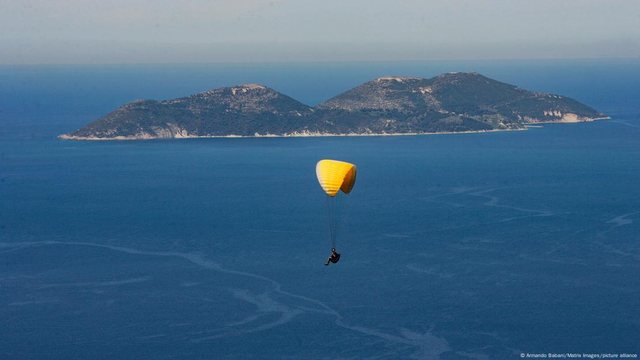
The European Environment Agency has released a report on the quality of the continent's waters for use by holidaymakers for bathing.
In 2024, over 85% of EU bathing waters at almost 22,000 sites were rated as excellent, while 96% of them met at least the minimum quality required by the WFD. However, 1.5% of EU bathing waters were of poor quality, indicating that management measures were not always appropriate or were not being implemented at all.
There is still significant pollution of surface and groundwater, which is not included in the WFD assessment. This pollution could be further exacerbated by climate change. Improving water sustainability for people and the environment is of great importance.
The quality of coastal bathing waters is generally better than that of rivers and lakes. In 2024, around 89% of coastal bathing waters in the EU were classified as excellent, compared to 78% of inland bathing waters.
According to this report, Cyprus leads in bathing water quality at 99.2%.
Second on the list is Bulgaria with 97.9%, while third is Greece with 97%.
But what happens to Albania?
Our country is ranked last on the list. According to this report, only 16% of our waters are of excellent quality. 49.6% of the waters are of good quality, 11.8% are of sufficient quality, while 22.7% are of poor quality.
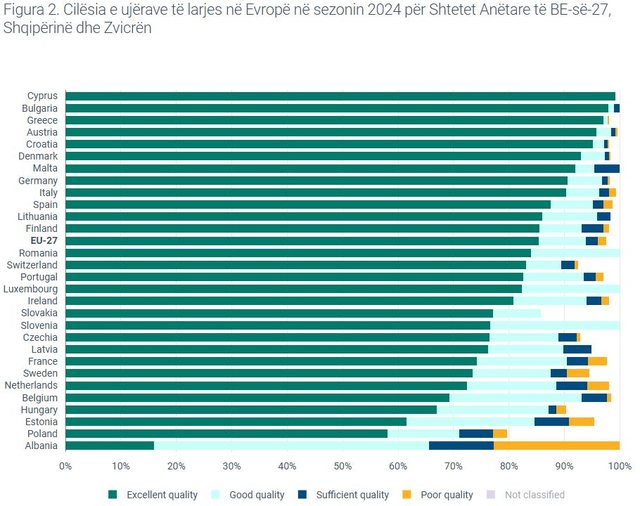
Report conclusions
The quality of bathing water in Europe has improved significantly over the last decades, largely thanks to EU legislation. The combined effect of systematic bacteriological monitoring in accordance with the EU Bathing Water Directive and major investments in urban wastewater treatment plants led to a drastic reduction in the pathogens that were previously released. Thanks to these ongoing efforts, bathing is now also possible in many urban areas.
While most bathing waters in Europe are in excellent condition from a bacteriological perspective, chemical pollution of surface and groundwater remains significant and could be exacerbated by climate change. Improving water sustainability for people and the environment is therefore essential.
Other water quality challenges, such as toxic cyanobacterial blooms, which are not part of the monitoring required by EU bathing water rules, often result in warnings and bathing restrictions.