Is this police force professional and capable of handling violen...
/ 2026-10-16 18:54:07Focus


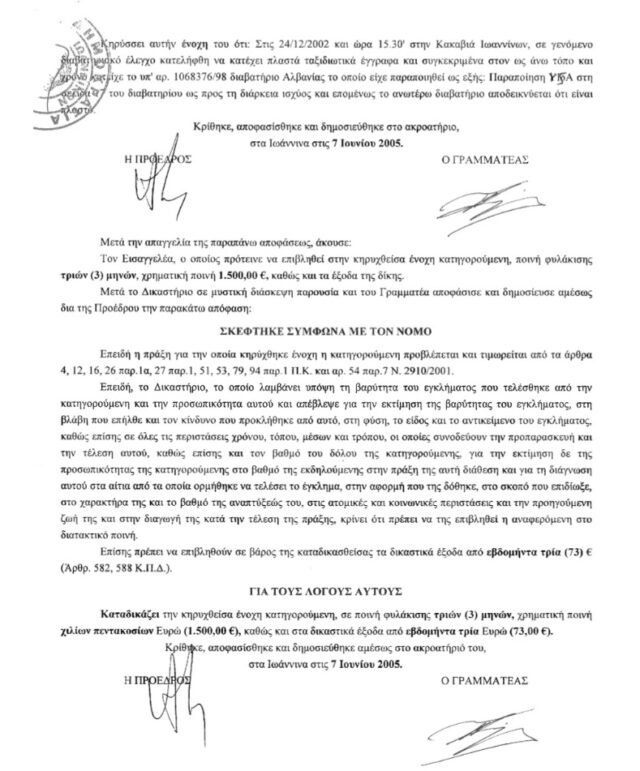
Special Judge Irena Gjoka has been convicted in Greece for "visa forgery", according to a confirmation from the General Prosecutor's Office.
The documents administered by the Decriminalization Sector at the General Prosecutor's Office have now been sent for evaluation to the High Judicial Council, the structure responsible for the disciplinary investigation of judges.
The main institution of the Prosecution officially announced that " on 19.01.2026, it decided to approve the results of the verification, a decision which on the same date it forwarded to the High Judicial Council as the body responsible for verifying the conditions of the ban in implementation of Law No. 138/2015 "On guaranteeing the integrity of persons elected, appointed or exercising public functions", and Assembly Decision No. 17/2016 "On determining the detailed rules on the implementation of the bans provided for in Law No. 138/2015 "On guaranteeing the integrity of persons elected, appointed or exercising public functions ".
The General Prosecutor's Office launched an in-depth investigation into Judge Irena Gjoka, based on the request of the Career Development Committee of the High Judicial Council, on 08.05.2024.
What happens next?
Decriminalization is a complex process and combines within itself elements of disciplinary and criminal violations.
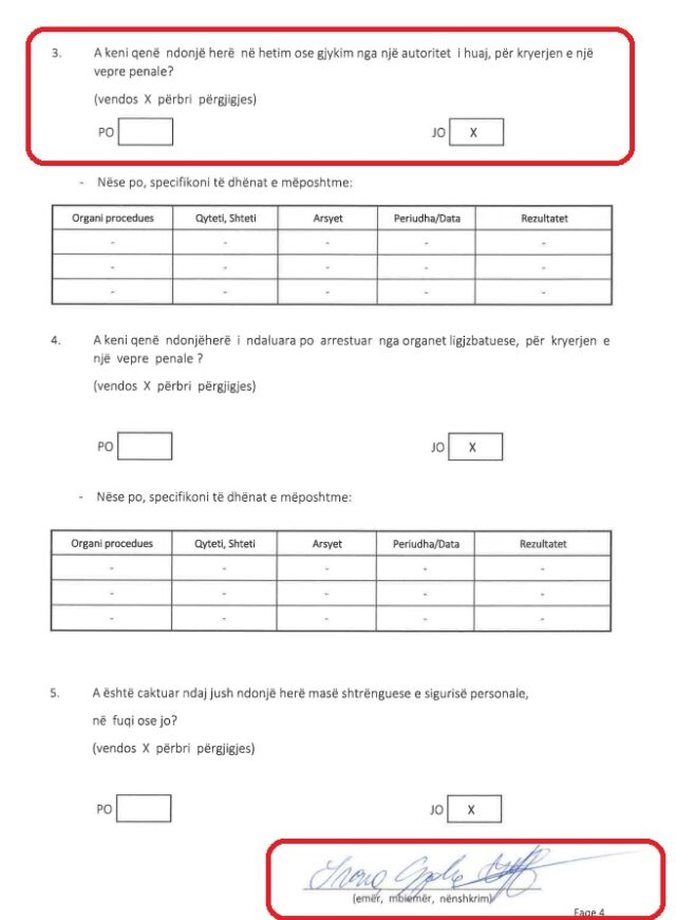
In this specific case, the General Prosecutor's Office has found that Judge Irena Gjoka did not declare in the Decriminalization form a 2005 conviction in Greece, a country of the European Union.
The Law on "Decriminalization" considers concealing data on the form as a serious disciplinary violation, which is followed by dismissal from duty of the declaring subject.
However, the case is now expected to be reviewed by the High Judicial Council, while Irena Gjoka's case is also under investigation by the Special Prosecution Office (SPAK), following a report of falsification of forms, submitted in May 2024 by the opposition Democratic Party.
Is it a disciplinary violation?
Official data shows that Judge Irena Gjoka has been criminally convicted by the Court of Ioannina with a fine for "visa forgery".
The High Judicial Council will have to examine at least two essential elements; (1) Does Irena Gjoka's conviction fall within the conditions of the Decriminalization Law; and (2) Does the fact that Judge Gjoka did not record this conviction on the Decriminalization form constitute concealment, with consequent dismissal from office.

The Law “On the Integrity of Officials…” (Decriminalization) provides that officials who have been found guilty and sentenced to a prison sentence of over 6 months (regardless of whether it has been suspended or commuted) are prohibited from being appointed or exercising public functions. For officials who are in office and are found in these conditions, they are dismissed from office.
Meanwhile, Irena Gjoka has been fined by the Court of Ioannina. The High Judicial Council will review whether or not the judge is in the conditions of detention.
But the most important point of the KLGJ's review is expected to be the discussion of whether or not the fact that Irena Gjoka did not record this decision on the relevant form will be considered a disciplinary violation. In similar cases, various officials, including members of the Albanian Parliament, have been removed from office and have lost their mandate due to "refusing" or "concealing" a criminal conviction, regardless of the type of conviction.
Is it a criminal offense?
In May 2024, the Democratic Party filed a criminal complaint with the Tirana Prosecutor's Office against Judge Irena Gjoka, for the criminal offense of "falsifying the Decriminalization form".
The case was further forwarded to SPAK, as the competent structure for the investigation of special judges.
The essence of the investigation is whether Judge Gjoka falsified the form, failing to declare the conviction decision by the Ioannina Court in 2005.
Judge Gjoka submitted the Decriminalization form in 2016, immediately after the implementation of Law 138/2015 "On guaranteeing the integrity of officials who are elected, appointed or perform public functions".
Article 190 of the Criminal Code provides that "Forgery or the use of forged seals, stamps or forms or the presentation of false circumstances in the latter, which are addressed to state bodies, is punishable by imprisonment from six months to four years."
This criminal offense, which carries a maximum penalty of 4 years in prison, is statute-barred within 5 years, unless it is ascertained from the moment of commission or the punishment has been imposed by a final decision.
So, in the case of Irena Gjoka, the criminal offense, even if found, appears to have been statute-barred 5 years after its commission, in 2021.
However, in this specific case, there is a specific situation, which can be assessed by the Special Prosecution Office and it can be concluded that it is not statute-barred.
Judge Irena Gjoka concealed the fact of the conviction in Greece, both in the Decriminalization form and during the transitional re-evaluation (Vetting) process.
Special Judge Gjoka was confirmed in office by a decision of the Independent Qualification Commission (IKC) in February 2020. Subsequently, the Public Commissioner appealed that decision. The Special Appeals Chamber (SAC), on June 14, 2022, finally decided on her confirmation in office.
From this circumstance, it is clearly understood that Irena Gjoka, through the non-declaration of the sentence in Greece, has continuously concealed (used) false circumstances, at least until June 2022, when she received final confirmation from the KPA.
If she had declared the criminal conviction in Greece, she would most likely have been dismissed from the Vetting Corps for failing to meet the personal integrity criteria.
In order to avoid dismissal, Irena Gjoka has concealed/refused to inform official institutions about the criminal conviction by the Court of Ioannina, using false circumstances until the final decision of the KPA. This means that the Special Prosecution Office may find that Irena Gjoka has committed document falsification until June 2022.
In such a case, the criminal offense committed by Irena Gjoka will now have a statute of limitations of 2027 and, consequently, she may face criminal proceedings for "falsification of forms."/ Boldnews.al