Is this police force professional and capable of handling violen...
/ 2026-10-16 18:54:07Focus



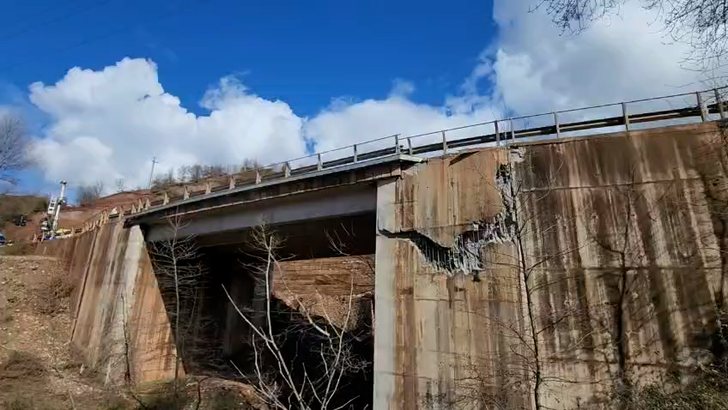
The collapse of the Dragostunja bridge on the Librazhd-Prrenjas axis is more than a local incident.
It is an alarm signal for the condition of a significant portion of the bridges in the national network, some of which have for years exhibited structural problems, damage from floods, landslides, or lack of periodic maintenance.

The irony is that since 2023, Albania has been implementing a $100 million program with the World Bank precisely to increase the sustainability of bridges.
The Building Resilient Bridges program is designed as a multi-phase approach (MPA), with a total funding of $100 million. The first phase, worth $55 million, began in 2023, while the second phase, worth $45 million, is expected to begin in 2027.
The objective is clear: increasing the resilience of bridges to climate change and natural disasters, as well as improving road asset management.
But while the program is being implemented, Dragostunja collapses.
A problem known for years
The World Bank document openly acknowledges that a significant portion of Albania’s bridges are at the end of their technical lifespan. According to assessments included in the project, over 30 bridges are considered at imminent risk of structural failure, while hundreds more have exceeded their design lifespan and have received only minimal maintenance over the years.
The national network includes 803 bridges, many of which were built to different standards – Soviet, Italian or Albanian – before harmonization with European Eurocodes.
This means that some of the structures were designed for loads and climatic conditions much lower than those they face today.
In this context, the case of Dragostunja is not an exception, but a symptom.
Climate and disasters are increasing pressure on bridges
Albania is ranked among the countries most exposed in Europe to floods, earthquakes and landslides. The analysis included in the project itself shows that the average annual losses from floods on the main road corridors are in the tens of millions of dollars, while the road infrastructure is among the most affected assets.
Floods and riverbed erosion damage bridge foundations and abutments. Landslides destabilize accesses. Increased rainfall intensity increases the risk of exceeding design hydraulic capacities. If these factors are not integrated into design and monitoring, any intervention remains temporary.
Dragostunja was hit precisely by a combination of geological and climatic factors, in a segment that had been experiencing massive ground movements for days. This raises the question even more: is the prevention system working?
Main problem: lack of systematic maintenance
One of the most important findings of the document is that bridges in the national network do not have a dedicated budget for periodic maintenance. Interventions are often carried out on an ad hoc basis, after extreme events, rather than on a multi-year planning basis.
The existing bridge management system (BMS) is largely an old database, without advanced modules for degradation analysis, risk or financial planning. This means that priorities are often set after damage, not before it.
Under these conditions, even a bridge that is repaired today may become problematic again in a few years, if protective elements such as drainage systems, riverbed protections, or lateral retaining structures are not monitored and maintained.
$100 million: transformative investment or reactive credit?
The first phase of the program aims to rehabilitate, reconstruct or build about 15 bridges, as well as build institutional capacities for better asset management. The second phase will continue with another 15 bridges and the full operationalization of the management system.
In theory, this approach is right: new concrete is not enough, a new management system is needed. But cases like Dragostunja show that the gap between the project and the reality on the ground remains large.
If the new management system (RAMS/BMS), climate resilience audits, and multi-year maintenance planning are not rigorously implemented, the $100 million risks covering only the most urgent part of the problem, not solving it.
Dragostunja as a test for reform
The collapse of Dragostunja should serve as a real test for the “Sustainable Bridges” program. The key questions are: was this bridge inventoried as at risk?
Was it part of the priority list?
Were there regular structural inspections?
Were the problems signaled earlier?
If the answers are positive, then we have a feedback problem. If they are negative, we have a monitoring problem.
In both cases, the issue is not simply the quality of a construction, but the functioning of an entire system.
Dragostunja is not an isolated episode. It is a reminder that infrastructure does not collapse overnight; it degrades over years.
And if management remains weaker than concrete, even multi-million dollar loans are not enough to keep it afloat. /ekofin