Is this police force professional and capable of handling violen...
/ 2026-10-16 18:54:07Focus


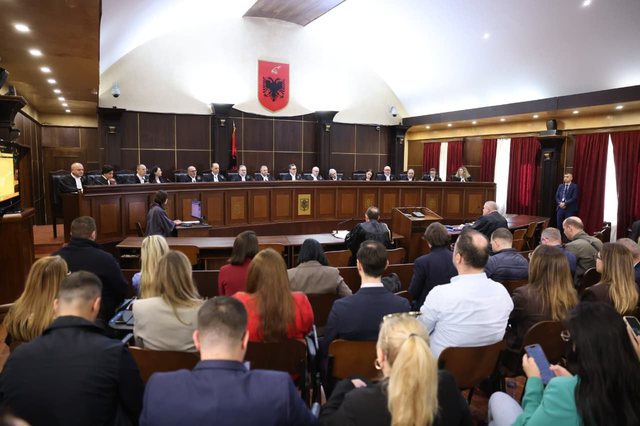
The Joint Panels of the Supreme Court met today to review the change in practice regarding the stance that should be taken regarding the measure of detention in prison, when it is decided on the basis of the dangerousness of the offense.
Shortly before the start of the meeting, prosecutor Arqile Koça requested that the session be held behind closed doors, arguing that the person in question is under investigation. On the other hand, lawyer Luan Hasnëziri emphasized that the issue is of public interest, but agreed that the specific part of the discussion should be held without the presence of the media.
Following these positions, the United Colleges withdrew for decision-making, deciding that the review would take place in two phases, where the first part would be in the presence of the media.
According to Top Channel journalist Anila Hoxha, there are three main points on which the 2011 decision on the Ilir Kumbaro case, which has served as guidance for judges, is expected to be reviewed.
The Supreme Court took its cue from Strasbourg's positions on the Thoma Gëllçi case, where it was emphasized that suspicion alone is not enough to justify arrest, especially when investigations continue indefinitely, as well as from two other cases and legal changes.
The hearing is expected to feature a presentation of the case by the President of the High Court, Sokol Sadushi, while positions will be presented by prosecutor Arqile Koça and lawyer Luan Hasnëziri, regarding the specific case of suspect Bektash Zeneli, arrested in flagrante delicto with 7.5 kilograms of cannabis.
Discussions inside the hall:
Prosecutor Arqile Koça: Today's case carries with it two main points, firstly with the unification of the practice and also with the specific issue, we request that the session be held behind closed doors, due to the problems that the case has. Regarding the unification of the practice, it should be open as much as possible, but regarding the issue, the media should not be present.
Lawyer Luan Hasneziri: I agree with the prosecutor that the discussion on the specific issue should take place behind closed doors.
The defendant is Bektash Zeneli, arrested in flagrante delicto with 7.5 kilograms of cannabis.
The joint panels of the Supreme Court, after returning from the deliberation room, assessed that it is necessary that for the part of the unification of practice, the court session have two phases: a first public part related to the unification of practice, while the phase related to the specific case will be behind closed doors.
First rapporteur, Ilir Panda: The report that has been made available to you is related to the fundamental right addressed by the Constitution. In this report, it results that in October 2025, the police in the Lezha area conducted a search in the apartment of this citizen, after a quantity of narcotics was found, and the prosecution requested the security measure of arrest in prison and the lawful arrest of the arrest. The first instance, the Lezha Court, has decided to accept the prosecution's request. Among other things, the court has also decided to implement the unifying decision of 2011 of the High Court, which served for the needs of determining security measures. Through the defense, an appeal was filed by the arrested person on appeal and then the Court of Appeals has imposed the security measure of house arrest.
Further, rapporteur Panda expressed "regarding the partial change of the unified judicial practice, with the reasoning that some decisions require special review and with this argument the case was transferred to the High Court for review. 1. Justification of the imposition of a coercive security measure. 2. The measure must also be in accordance with the margin of punishment that the offense has. 3. The measure is not applied when the defendant presents positive evidence.
The unifying decision of 2011 has been applied so far by all courts, but in this practice the united panels have concluded that the decision should be reviewed with regard to the security measures and the type of security measure chosen, especially that of imprisonment.