"We are drowning..." - From Lisbon, Milan to Tirana, "The Guardi...
/ 2026-10-18 23:13:32Focus


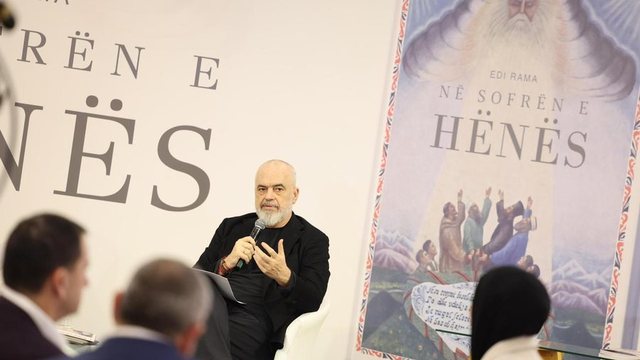
Prime Minister Edi Rama today promoted his newest book "At the Moon's Table".
Rama said that he received inspiration from some Muslim friends to write this book.
The head of government emphasized that the iftar table is a place that goes beyond those who fast.
He said that the conversations he had at iftar tables, in his capacity as prime minister, were summarized in this book. Rama noted that religions serve to connect people and cultures, adding that the Islamic faith has played an important role in promoting peace in our society.
"The book is a compilation of the iftar evenings that I have had the pleasure and privilege of organizing, in the function that I have, opening a tradition, as far as my function is concerned, that goes beyond those who fast. The Iftar meal is beyond those who fast. It was the impetus of some Muslim friends who fast, that I summarized these words in this book. I wanted to do the presentation in a modest way. The Iftar meal brings us together beyond the lines that separate us on the boulevard.
"It was the encouragement of Muslim friends that encouraged me to delve deeper into the culture of Islam. There is a treasure trove of cultures that come to us from religion, which should have our worship. Through my work, I have met esteemed professors of the Islamic religion. The foreword was written by the Foreign Minister of the United Arab Emirates ," said Rama.
Important figures from the Islamic faith, well-known authors and lecturers were present at the promotion of the head of government's book.
Speech by Prime Minister Edi Rama
First, I believe that the very composition of the guest list reflects my shyness to bring this book to light, which is in fact a compilation of the iftar evenings that I have had the pleasure and privilege of organizing in my function, opening a tradition in terms of my function that, in my opinion, goes beyond the table of those who fast, because for me, and increasingly so and as a result of this experience, the iftar table is beyond those who fast and is in a way a beautiful moment to bring together people who come not only from different walks of life, but also from different backgrounds of their beliefs.
It was the impetus of some Muslim friends who fast that I summarized these words in this book. And I said it before, today I wanted to do the presentation in a modest way. Arlinda had the book ready before the Book Fair, but I did not give her the green light to bring it to the fair because it would automatically create an undeserved attraction for all those other authors who have the fair as an important moment. For me, the last remaining word carver on the boulevard of Tirana is here with us today, Aurel Plasari, proof of the fact that the iftar table brings us together beyond the lines that separate us on the boulevard.
Meanwhile, I don't want to talk any longer. I have a lot of respect and I am grateful for those friends around me who practice this religion, but I am also grateful for the experience of these iftars that has enriched me to be honest and has encouraged me to delve a little deeper into the approach, the word, the culture of Islam. And to be honest, I believe that beyond that slogan that we often repeat of religious coexistence, there actually lies a treasure trove of cultures that come from religion here with us and that deserve our dedication, care, admiration, and respect, also because thanks to all of this that I said, people can be helped to see religion beyond prejudices and stereotypes that are the most dangerous thing, especially when talking about Islam.
It was a pleasure and to be honest, I felt pampered by the fate of the task that gave me the opportunity to meet the professor, Besnik. Besnik is a man who certainly follows the Islamic religion, but at the same time he lectures at the University of Tübingen. We met through the work of a very beautiful foundation that was established in Albania called Konak. They are a group that makes an effort to collect artifacts of Islamic culture and together we have a very beautiful project. It is their idea, but the project is also a joint one to establish a museum of Islamic art in Albania. Unfortunately, we do not have such a museum. All countries that have Islamic culture in their organization have such a museum, but also countries that do not have a genuine contemporary Islamic culture, but may have roots of Islamic culture in the past, have such museums and we are working on the project and it will be very beautiful because it will be built at the former famous Toptan palaces, near the Tirana Castle and adjacent to the Parliament and at the same time in that same oasis, another museum called the Besa Museum will be opened that will echo our relationship with the Jews and that will bring contemporary Jewish culture into our lives. So in a way, a mosaic is completed.
To return to the book, I am very grateful to the professor who agreed to write an afterword. The foreword of the book was written by one of the representatives of the crown of the United Arab Emirates, the Minister of Foreign Affairs of the Emirates, Sheikh Abdullah bin Zayed, and the afterword was written by the professor. So since he was forced to go through the entire collection of summarized words, I am passing the floor to the professor.
***
Prime Minister Edi Rama: Thank you professor! I wanted to complement it with a personal element that is connected precisely to the sequences of these iftars year after year, which as I said before, on the one hand have encouraged me to delve a little deeper into reading and understanding Islam, of course referring to the main book and to some extent the history of Islam in Albania, but on the other hand have also encouraged me to do this as a reaction to the stereotypical reaction of all those who very quickly equate either Islam or its rites, including iftar, with something that has lowered our culture, because we are Europeans or I don't know. While there is certainly an important contribution of Islamic culture in the roots of Europe, but what is most important today, I think for man in the conditions when the more knowledge extends and the more the wings of development extend to points unimaginable until recently and every day the development becomes very rapid, is the need to believe.
I saw a survey conducted not long ago on a global level regarding belief in God, and what surprised the organizers of that survey was that the more knowledge has increased, the more the need for belief in God has increased, and in the last decade, belief in God on a global level has experienced an abnormal increase compared to the usual trend that followed a very strong decrease in the 1960s.
Beyond direct belief, I think that religion in general and Islam in particular is a source of great cultural wisdom, a wisdom that is related to human limits, to the need for man to be aware of where his limits are and then to connect these limits with human dignity. And in the entire process and practice of Islam, including fasting, there is a wisdom that teaches and educates. Some time ago I was lucky enough to meet a very famous Muslim doctor, a practitioner who followed all the rites and explained to me one by one the rituals related to the effects on health, not the religious part, but health, all of them. Western prayer, kneeling, all of them, of course fasting has now become a global trend, fasting for health reasons and for reasons of the overload that has been created with cholesterol in the developed world, but I am talking about all the other rituals. So there is a great cultural wisdom in Islam that is an added value I believe for anyone who refers to it beyond faith, then that is a matter in my own personal perspective. As for the narrative that the professor said, I have not thought deeply about this aspect, but I believe that it is very important that we always do not forget that this harmony that we say, or coexistence, or religious brotherhood as Pope Francis baptized it, is something that must be taken into account and must be cultivated. Now is it true that we have managed to be comfortable with each other, this is a question mark, but I would be very happy if we have achieved this.
In the end, I believe that the tradition of iftar beyond the religious ritual is social education, it is social teaching, it is a social exercise because it is unique. We do not lack tables, we even have the most passionate discussions about the poor economic situation while eating chicken in abundance, but we cannot have it and humanity cannot have this opportunity that the tradition of iftar gives you where you are at the table, sharing bread, sharing the moment around the table, but you are not actually there inclined to enjoy the food, but you are primarily inclined to enjoy the fact that you are together with others. And of course, I am convinced that this for those who fast is stronger and healthier, we are talking about the soul. I have said it from the beginning at the first iftar, I invited some people who had never been used to it, some came, some did not come. One sent me a very harsh message against the fact that I was organizing an iftar at the Prime Minister's Office, that the Prime Minister's Office is secular and I don't know, etc., he strongly declared his atheism to me. I believe that iftar is also for atheists. The meal is also for atheists. They don't have to avoid the invitation simply and only because they are not Muslim or don't believe, on the contrary, if they don't believe in Allah, maybe Allah believes in them, that there may be a day for them or God, let's call it now, because they like to confuse me with these religious matters while I find them very simple, very clear, I am convinced that when they see any of this, many will say, why didn't I invite them while we have the big iftar in the coming days as we have done every year because it is not easy to enter this territory and even more so to pretend to wrap it in a book.
Thank you very much and once again, professor, thank you, respect. Thank you all!