Is this police force professional and capable of handling violen...
/ 2026-10-16 18:54:07Focus


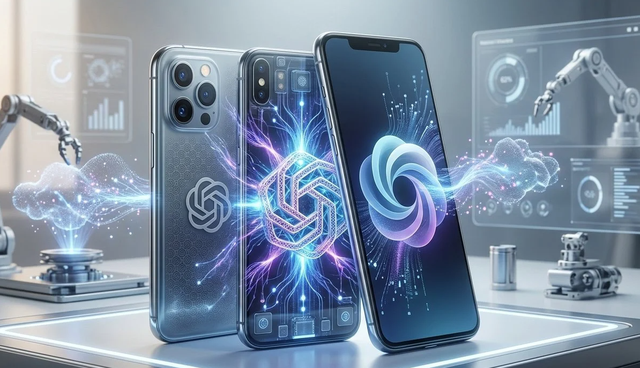
When OpenAI decided to buy hardware company io Products for about $6.5 billion, many read it as a casual expansion move. In reality, it may be much more than that: the most serious attempt yet to build the next personal technology platform, after the smartphone.
At the center of this project is Jony Ive, the man who designed the iPhone, iPod, and iMac, some of the objects that changed the way people interact with technology.
And the irony is strong: the architect of the iPhone is now working on a device that could challenge the logic of the iPhone itself.
What OpenAI is building is not a “phone” in the classic sense of the word. On the contrary, according to reports and signals that have emerged from the industry, it is a new device, built from the ground up for Artificial Intelligence. An object that does not have a screen at the center of the experience.
And this is the most radical point.
For nearly two decades, personal technology has been built on the screen: apps, icons, notifications, keyboards, swipes, touch. The entire architecture of the smartphone is based on the idea that one must see to command.
OpenAI is betting on the opposite: that in the age of AI, humans don't need to see to act.
Instead of a screen, the device is expected to operate through voice, sensors, and constant context. Practically, an always-on Artificial Intelligence that listens, understands, and acts.
This is the fundamental difference between this device and classic assistants like Siri or Google Assistant.
They respond. This one intends to act.
If you ask them to send an email, book a meeting, organize their calendar, search for information, or update a document, the logic is for the device to do it itself, not just suggest the steps.
Essentially, it's no longer "search." It's "execution."
This is why OpenAI is investing so heavily in hardware. Because if AI remains just an app inside the phone, the real control remains with the existing platforms: Apple, Google, and Microsoft.
App Store, operating system restrictions, permissions for the microphone, camera, or background processes – all of these are set by others.
By building its own hardware, OpenAI controls the entire chain: the hardware, the system, the AI models, and how they interact with the real world.
It's the same model that made Apple powerful: total control over the experience. In that sense, the move is strategic, not simply technological.
The history of AI devices has not been a successful one so far. The Humane AI Pin failed to convince the market. The Rabbit R1 made a splash, but quickly lost momentum.
The problem wasn't just the hardware. The problem was that Artificial Intelligence wasn't yet capable enough to justify a dedicated device.
Today, this has changed. Models like ChatGPT, Claude, or Gemini have reached a level of functionality that makes them practically usable in real life.
The question is no longer whether AI can help. The question is: what is the best physical object to use it with?
This is where Jony Ive comes in. His strength has never been just aesthetics. It's been the intuition to build objects that seem inevitable the moment you see them. That's what happened with the iPhone: he didn't invent the telephone, but he invented its modern form.
OpenAI is seeking to do the same thing with AI. Not to invent Artificial Intelligence, but to materialize it in a new form.
Reports suggest the device could be small, portable, perhaps wearable or carried in a pocket, with minimal physical interaction. Not an object you hold in your hand to look at, but an object that accompanies you.
And this change is philosophical.
Your smartphone demands your attention. This AI device aims to give you back your time!
If it works, the impact could be huge for the business world as well. Imagine a sales professional no longer having to jump between CRM, email, and meeting apps. AI can listen to the conversation, process the information, and update the system in real time.
Or a journalist who receives information, searches for sources, and organizes material without opening ten windows.
In this scenario, the device is not a communication tool. It is an operational partner.
However, the challenges are huge. Building a new device is not just a matter of design. It's manufacturing, distribution, ecosystem, and consumer trust. According to reports, Foxconn could be the manufacturing partner — the same giant that builds iPhones.
This shows that Ambition is not a niche product. It is a mass product. The most realistic timeframe for the market seems to be between 2026 and 2027.
But the biggest question isn't when it'll come out. The question is whether people are ready for a life behind the screen.
Because if the smartphone was the machine that connected us to the internet, OpenAI's device could be the object that connects us to Artificial Intelligence permanently.
And if that happens, then the next technological revolution won't be a better screen. It'll be the lack of one.