Is this police force professional and capable of handling violen...
/ 2026-10-16 18:54:07Focus


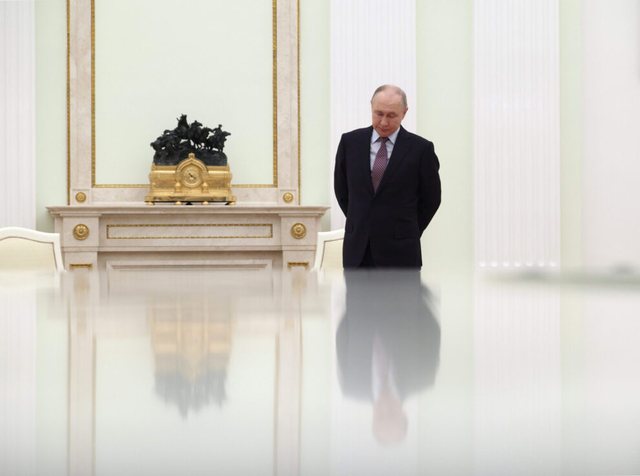
The Kremlin is preparing Russian public opinion for a "victory" that would essentially be an admission of the limits of failure in Ukraine.
This is according to an analysis published by Guillaume Lancereau, based on an internal document of the Russian presidential administration, discovered by the Russian investigative media Dos'e.
The document, drafted by the team of Sergei Kiriyenko, deputy director of Vladimir Putin's presidential administration, outlines the propaganda strategy that will be used if Moscow reaches a peace agreement with Ukraine.
According to the analysis, the Kremlin indirectly admits that the maximalist objectives of the beginning of the war are no longer realistic. The document states that Russia must “know when to stop,” as continuing the war of attrition could lead the country to economic and social collapse. It even uses the term “Pyrrhic victory,” to warn that military persistence may cost more than territorial gains.
In the scenario considered "most likely," Russia would hold Donetsk, Luhansk, and parts of the Kherson and Zaporizhzhia regions up to the current front line, while Russian troops would withdraw from Sumy and Kharkiv.
The document also shows that Russian propaganda is preparing to change the narrative of the war. The Kremlin aims to present the agreement to Russians as a “historic victory” for Vladimir Putin over the West and “globalism,” even though it acknowledges that there will be no capitulation of Ukraine or “taking of Kiev.” The text states that “taking Kiev was never a goal,” despite the slogan “Kiev in three days” becoming a symbol of the Russian invasion in 2022.
A large part of the document focuses on the management of public opinion. Kremlin strategists divide Russians into problematic categories: ultranationalists, veterans, military industry workers, and war-weary citizens.
For ultra-patriots, it is proposed to limit their voice in the media and "rationalize" the idea that this is the right moment to stop the war. For veterans, social projects, political integration and even recruitment for new missions in the "Africa Corps", the Russian formation operating in Africa, are envisaged.
Meanwhile, ordinary citizens are promised a "return to normal life": the opening of airports, the lifting of sanctions, the resumption of trade, and the restoration of economic stability.
The document also reveals the Russian elite's fear of the internal consequences of the war. The authors warn of economic, demographic and social risks in the event of a continuation of the conflict, including general mobilization, tax increases, inflation and further human losses.
Another section argues that the word "peace," criminalized in Russia during the war years, should be gradually rehabilitated. It even proposes the return of humor to political life and a "controlled thaw," similar to the Soviet period of the 1960s after Stalin.
According to the analysis, the document shows that the Kremlin does not operate on any deep ideology, but on a series of propaganda techniques and communication formulas that aim to convince every segment of society that the outcome of the war is victory.
However, it remains unclear whether Vladimir Putin himself is ready to accept such a compromise. According to the author, while Kremlin communicators are preparing the ground for a ceasefire, military leaders continue to promise Putin that they can occupy all of Donbas by 2026.