Protests, violence, curfews: From France to Albania, why Europe'...
/ 2026-10-20 23:47:20Focus


Arms production is reviving three cities in Europe, writes The Economist
The cobblestone city of Bourges is located on France's so-called "empty diagonal": a wide strip of farmland in the center of the country that residents quickly traverse on their journeys to other destinations.
In 1860, Napoleon III decided to build a cannon factory and military arsenal there, in a safe place far from France's fragile eastern borders.
With only 64,000 inhabitants, Bourges was in a difficult situation, as modern arms manufacturers were unable to sign contracts. “There was a long period of economic decline,” recalls Serge Richard, head of the local chamber of commerce.
Today, however, Bourges is on the verge of a remarkable renaissance. European governments are sharply increasing defense spending in the face of Russian aggression and American instability.
Cities that have been accustomed to industrial decline for years are now preparing for the opposite. Three cities in France, Germany and Poland illustrate the great potential this wave can bring, but also the challenges it carries.
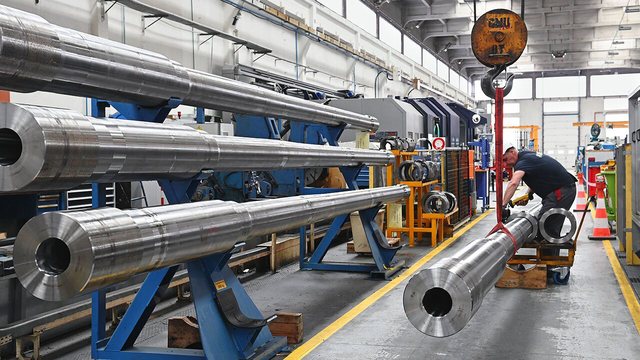
Bourges is preparing for an industrial boom. Two major European defense companies already have factories in the city: MBDA, a European company that produces missiles and missile systems, and KNDS, a Franco-German company that produces CAESAR howitzers and 155 mm shells.
Both companies are expected to invest 1 billion euros locally in the next five years.
On the outskirts of the city, MBDA is demolishing old buildings near existing facilities, with the aim of expanding capacities. On the other side of the city, KNDS has tripled production of CAESAR howitzers (medium-range heavy cannon), starting in 2022.
Together, these companies are expected to add 2,500 jobs over the next five years. The effect will be felt beyond Bourges, even in the dozens of small subcontractors that supply these giant companies, says François Cormier-Bouligeon, the local MP, who describes the expansion as “giant.”
In many ways this is a welcome development. The new jobs will be skilled and well-paid.
Bourges has already benefited from new orders for companies, thanks to the seven-year defense budget increase, an increase that began under the presidency of Emmanuel Macron in 2019.
Unemployment has fallen from 10.3% in 2015 to 6.7% in the third quarter of 2024, below the national average.
But this situation also brings challenges. One of them is planning services such as kindergartens, schools, housing, and doctors for the new arrivals.
Yann Galut, the mayor, has written to the mayors of 54 other French cities that depend on the defense industry, to coordinate a joint request for additional state aid.
To attract tourists, he has managed to have Bourges, with its Gothic cathedral, declared the "European Capital of Culture" for 2028.
Another issue of concern is the lack of a skilled workforce. Local residents need appropriate training programs and professional internships. Local business leaders report that they are already facing recruitment difficulties. Some residents express concern that housing prices will increase significantly.
These concerns are similar to those in Unterlüss, a green and quiet German town near Hanover, surrounded by the Lüsswald forest.
The regular sound of test firing has now become the soundtrack to life for locals at the largest production center of German defense giant Rheinmetall.
Heavy trucks ply the city streets; the traffic of workers coming to the factory clogs the city during rush hour. Rheinmetall will soon employ almost as many workers as the number of residents of Unterlüss, about 3,500.
As in Bourges, this is both a burden and a blessing.
Two types of development
Rheinmetall's ambitious expansion plan includes the construction of a new ammunition factory in Unterlüss, which will be added to existing facilities that produce self-propelled howitzers, as well as Lynx and Puma armored vehicles.
The use of these tools has increased significantly since the official opening of the factory last year, which was attended by the then German Chancellor, Olaf Scholz, and the Minister of Defense, Boris Pistorius.
Since then, the noise and traffic have increased even more. Dozens of transport carts move quickly through the work site.
"We are building the new factory at Rheinmetall speed," says Jan-Phillipp Weisswange, a company spokesman, drawing a clear contrast to the slow pace of construction in the rest of Germany.
The company is in the process of recruiting hundreds of qualified workers with good salaries.
Katharina Ebeling, the Christian Democratic mayor of Unterlüss, is investing 1.3 million euros this year to renovate the train station and make other improvements that will help the town cope with new challenges.
However, many residents are unhappy. In the last local elections, 35.7% of voters in the city voted for the far-right Alternative for Germany (AfD) party, a percentage much higher than the national average of 20.8%.
The town has very few shops, cafes or churches. Rheinmetall employees often commute daily from surrounding towns. As a result, local residents suffer from noise and pollution without directly benefiting.
As in Bourges, local subcontractors complain that the defense giant could poach their most skilled workers.
In neighboring Poland, the challenges are of a different nature. The country is increasing defense spending to 4.7% of GDP this year.
However, most military equipment is purchased from abroad. Wladyslaw Kosiniak-Kamysz, the defense minister, has stated that he wants half of the military equipment to be produced within Poland.
But the problem is that the Polish State Armaments Group (PGZ), a conglomerate of 50 companies, has in practice excluded most private companies and is itself unable to supply the Polish military with the most necessary equipment.
To support PGZ, the Polish government last year ordered 96 howitzers from one of the companies in this group.
In March, a contract was signed for the production of 111 Borsuk armored vehicles, the first to be developed and produced entirely in Poland.
For the southeastern town of Stalowa Wola, where Borsuku is produced, this could make a huge difference.
Founded 80 years ago, when a metal factory was built where a forest used to be, Stalowa Wola (“Steel Will”) is closely linked to the fate of its industries, says the mayor, Lucjusz Nadberezny.
After a wave of layoffs in the 1990s, the region's industrial base was revived by foreign investment in car parts factories.
However, the public finances of the city, which is located in one of Poland's poorest regions, remain strained.
With orders in the defense sector increasing, the city's steel plant plans to expand warehouses and triple production capacity by 2026, which is expected to bring a significant improvement.
Facing a "dividend" from increased defense spending is a huge benefit for European cities.
If defense spending continues to grow at the same pace as it has been so far, the European Commission predicts that this will add 0.5% to the EU's Gross Domestic Product by 2028.
But for the cities themselves, often located in areas affected by industrial decline, this new wave will need to be managed carefully to bring real benefits at the local level.
Conversely, disappointment could fuel increased support for extreme political groups./monitor.al