Is this police force professional and capable of handling violen...
/ 2026-10-16 18:54:07Focus


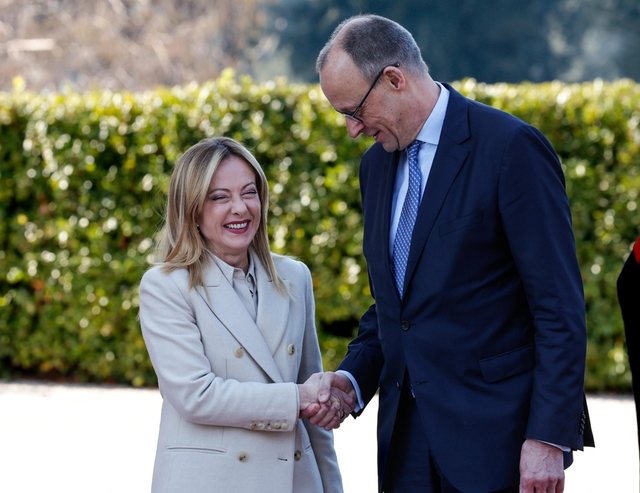
Germany is evaluating the possibility of joining the Gcap project, the sixth-generation fighter jet being developed by Italy, the UK and Japan. The signal came during a meeting between Italian Prime Minister Giorgia Meloni and German Chancellor Friedrich Merz, held at Villa Pamphili in Rome.
According to high-level Italian and German sources, Merz directly asked how Rome would view a possible German involvement in the Gcap project. There was no objection or refusal from Meloni, but a willingness to cooperate.
The largest military project in Europe
Gcap is considered the most important military project currently underway in Europe. It is described as a "system of systems", where the fighter jet will be integrated with drones, satellites and the so-called combat cloud, creating an air platform with highly advanced technology.
The GCAP project, a collaboration between Italy's Leonardo, Britain's BAE Systems and Japan's Mitsubishi, is a direct competitor to the FCAS project, strongly supported by France and Germany about ten years ago. FCAS aimed to be the European champion against American dominance, but according to many analyses, the project is close to failure.
During the intergovernmental summit in Rome, where Meloni declared that Italy and Germany “have never been so close,” Gcap was described by one participant as “the elephant in the room.” Publicly, however, not a word was said.
The FCA crisis and the role of Paris
Fcas was created in 2017 by the Dassault–Airbus consortium, which was joined by the Spanish company Indra in 2021. Since its inception, the project has been plagued by clashes over division of labor, subcontracting, and decision-making processes.
Recently, Airbus CEO Michael Schoellhorn declared that Dassault's approach "does not fit a European cooperation project," suggesting parting ways. On the other hand, the French group Dassault, which produces the Rafale jets, is convinced that it has the capacity to continue alone.
A senior German Foreign Ministry official said that Berlin must "properly close" this chapter with Paris, at an already difficult moment due to divergences on many other files.
According to German media, Merz has informed his ministers that there will not be a joint Franco-German fighter jet, but "two different aircraft."
The issue of funds and Italian interests
For Italy, Gcap is also a question of funding. According to a decree of January 2026, the cost of the project has increased from 6 billion euros to around 18.6 billion euros, due to increased costs. Part of the funds have been secured, but over 7.8 billion euros are still missing.
The entry of a new partner like Germany would help cover these costs and lower the price per unit, if Berlin were to order dozens or hundreds of aircraft.
On the other hand, in Rome the question is raised as to what Italy will ask for in return. The summit documents mention the possibility of cooperation for a new land platform (related to tanks), but there is also interest in the maritime sector, where Fincantieri is mentioned, as well as for satellites.
The last word belongs to London.
The final decision, however, lies with the UK. Gcap is based in Redding, on the BAE Systems site. London wants to participate in joint European arms purchases and access the European SAFE fund, but has so far been rejected.
The situation is also complicated by the British desire to include Saudi Arabia in the project. A delicate balancing act, which is part of the biggest redesign of European defense in decades and which will require diplomacy, ambition and high political skill./ Corriere della Sera