Protests highlight trauma crisis, operating rooms under reconstr...
/ 2026-10-15 18:35:16Focus


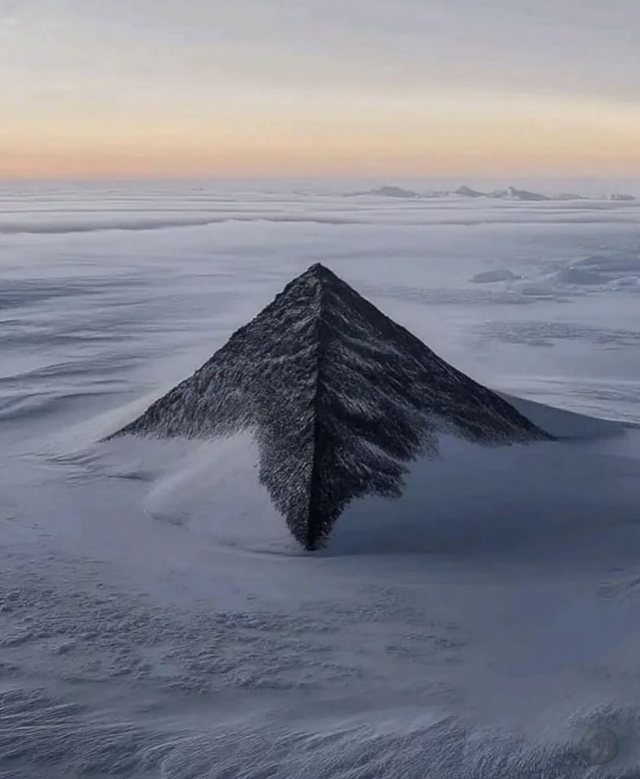
A mountain formation in Antarctica, often described as a "giant pyramid about 2 kilometers wide," has reignited debates over the existence of unknown structures on the icy continent, according to "Adventure Life."
However, experts and geological studies confirm that it is a completely natural phenomenon.
What exactly is a "pyramid"?
According to analyses published by scientific sources and international geologists, the structure is located in the Ellsworth Range and is a "nunatak" – a mountain peak that protrudes above layers of ice.
These formations are created over millions of years by glacial erosion; cycles of freezing and thawing; the action of wind and extreme temperatures.
These processes create steep faces and sharp angles that give the mountain a pyramidal shape.
Who has studied this phenomenon?
The formation has been discovered for decades and has been observed since British expeditions of the early 20th century.
Modern studies and interpretations have been conducted by geologists and international research institutions, including researchers such as Dr. Mitch Darcy from the German Center for Geosciences, who emphasizes that the shape is the result of natural processes.
The analyses are based on satellite images, field studies, and general knowledge of glacier geomorphology.
Why does it look like a pyramid?
The explanation is also related to the psychological phenomenon called "pareidolia" - the brain's tendency to see familiar shapes (like the Egyptian pyramids) in natural objects.
Conspiracy theories are dismissed
Claims that these structures were built by ancient civilizations or extraterrestrials are not supported by any scientific evidence.
Antarctica has been covered in ice for millions of years and there is no evidence of early human presence in this region.
The alleged "pyramid" in Antarctica is not a new discovery nor an artificial structure.
It is an example of the power of natural processes that, through erosion and extreme climate, create geometric shapes that may seem unusual – but are completely natural.