Is this police force professional and capable of handling violen...
/ 2026-10-16 18:54:07Focus



By Matt Wilson, BBC
A listening device hidden inside a work of art in 1945 was not discovered by US security services for seven years and is not the only example of art being manipulated for secret purposes.
Eighty years ago, during the final weeks of World War II, a group of Russian Boy Scouts presented the American ambassador in Moscow with a large, hand-carved U.S. seal at his official residence, Spaso House. The gift symbolized cooperation between Russia and the United States during the war, and U.S. Ambassador W. Averell Harriman hung it proudly in his home until 1952.
But unbeknownst to the ambassador and his security team, the seal contained a secret listening device, later dubbed “The Thing” by American security tech teams. It eavesdropped on diplomatic conversations, completely undetected, for seven years. By using an obvious work of art to infiltrate the enemy and gain a strategic advantage, the Soviets had pulled off the most ingenious maneuver since the Trojan Horse. But this is a true story, even if it sounds like spy fiction.
American technicians realized that the large engraved seal was an invisible "ear," eavesdropping on the ambassador's conversations behind the scenes.
How did “The Thing” work? John Little, a 79-year-old counter-espionage specialist, has long been fascinated by the device and even built a replica of it. A documentary about his remarkable work was released this year and, after a sold-out first showing in May, is set to be shown on September 27 at the National Museum of Computing, in Bletchley Park, Buckinghamshire.

He describes the technology of “The Thing” in musical terms, consisting of organ-like pipes and a membrane “like a drumhead, vibrating with the human voice.” But it was packaged in a tiny object that looked like a hatpin and had the advantage of going undetected by anti-eavesdropping controls because “it had no electronics, no batteries, and it didn’t get hot.”
The engineering of such an instrument was also extremely precise, “a cross between a Swiss watch and a micrometer.” Historian H. Keith Melton has claimed that, in its day, “The Thing” elevated the science of audio eavesdropping to a level previously thought impossible.
But its success as a listening device did not come from technical originality alone. It was effective because it exploited cultural attitudes toward beautiful objects. We tend to trust works of art and decorative objects as passive symbols of status, taste, or cultural interest. Russian intelligence turned this assumption into a weapon with the carved maple Great Seal.
And it is not the only example from the history of art that has been manipulated for espionage, deception, and military strategy. In addition to painting the Mona Lisa, Leonardo da Vinci also designed tanks and siege weapons, and Peter Paul Rubens acted as a spy during the Thirty Years' War. Artists from various nations during World War I and World War II designed camouflage and deception operations, and Anthony Blunt, a British art historian (and Keeper of the Royal Art Collection), was a Soviet spy throughout World War II and into the early Cold War.
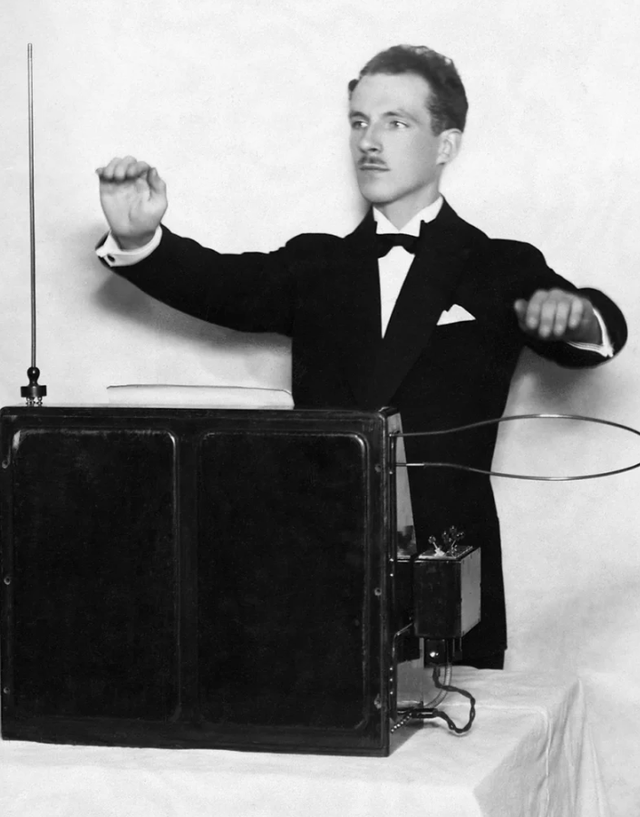
In the strange case of “The Thing,” musical history is also important. Its ingenious inventor, the Russian Lev Sergeyevich Theremin, better known as Léon Theremin, was also a gifted musician. He created the world’s first electronic instrument, known, according to its creator, as the Theremin. It could be played without touching anything, with hand movements in the air around its antennae controlling the notes. Its haunting sound became synonymous with the soundtracks of American science fiction films in the 1950s, perhaps most notably in The Day the Earth Stood Still (1951), which, ironically, is often cited as an allegory for Cold War paranoia.
After its discovery, “The Thing” was kept a state secret by American intelligence. But in May 1960, at the height of the nuclear arms race, an American U-2 spy plane was shot down over Russia. In the diplomatic turmoil that followed, U.S. State Department officials publicly displayed the Great Seal at a meeting of the UN Security Council to prove that Cold War espionage was not one-sided. According to John Little, the infiltration of an embassy residence was such an egregious breach of security “that it took the downing of a spy plane to bring ‘The Thing’ to light.” But its true technical prowess was never revealed to the general public.
Behind closed doors, the device was studied in detail by British counter-intelligence, who gave it the codename SATYR. Its details remained a state secret until former security officer Peter Wright revealed them in his memoir Spycatcher in 1987.
“The Thing” has fascinated historians because of its technical sophistication for its time and the way it influenced the game of espionage during the Cold War. But it also reveals a strange and darker history of high culture that unfolded outside the glitter of opera houses and art galleries, where classical musicians invented listening devices and hand-carved artworks served as instruments for military intelligence gathering.