Is this police force professional and capable of handling violen...
/ 2026-10-16 18:54:07Focus



On the morning of January 20, 2025, a local official in a municipality in the south of the country received a message from his superior on his phone. “You need to take your annual leave, we will be engaged in the campaign,” he instructed.
The employee, who chose to identify himself as Alban, requested annual leave a day later, but did not actually take leave.
Instead of his usual office work, Albani* went into the field to collect data on voters and their political affiliations in aid of the Socialist Party's electoral headquarters, which had already started the campaign engines for the May 11 parliamentary elections.
He describes his campaign work as "combing through the voter list."
"Our work was very clear, in the SP electoral offices we filtered all the voter lists. We analyzed every name and made the appropriate divisions, where on May 11 we were calm for every citizen who showed up at the voting center," said the local official on condition of anonymity.
He wasn't the only one.
Data obtained by BIRN through the Right to Information Act shows that thousands of public administration employees in central and local government received annual leave in the period January - April 2025; a period that coincides with the electoral campaign on the ground for the May 11 parliamentary elections.
Compared to the non-election year of 2024, the number of annual permits increased by almost 40% in most major municipalities and other central institutions – figures that, according to experts, reflect the extensive use of public servants in vote-gathering.
“State resources have been used continuously, but now they have returned to normality and this constitutes a major concern and a change from the elections of the years before 2009,” says Afrim Krasniqi, director of the Institute of Political Studies based in Tirana.
"The impact is statistical in votes and substantive in the quality of politics and parliament," he added.
Annual leave flow
During election years, public administration employees in Albania both experience and exert pressure to garner votes in favor of the ruling party. According to the OSCE-ODIHR report on the May 11 elections, Prime Minister Edi Rama’s Socialist Party gained unfair advantages from the extensive use of public resources as well as from pressure on voters, especially public administration employees.
Observation missions also received numerous reports alleging pressure on municipal employees by their superiors to support or participate in the Socialist Party campaign. Concerns were also raised about the influence of patronage networks across the country, used as leverage to secure votes in violation of international election standards.
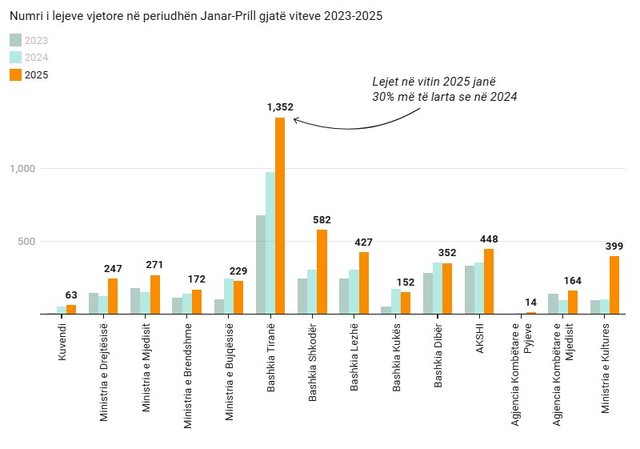
To document the involvement of the public administration in the pre-election period, BIRN requested through the Right to Information law statistical data from the country's main ministries and municipalities on the number of annual permits issued in the period January-April 2025 and compared it with the same period in 2023 and 2024.
Of the 20 central and local institutions that responded to the requests, in the period January-April 2025, 5673 employees had benefited from annual leave, or 40% more compared to the same period in 2024. The Municipality of Tirana leads with a 30 percent increase in annual leaves compared to the same period last year, followed by the Ministry of Innovation and Culture and the Ministry of Environment.
Data collected by BIRN also shows that within institutions, the number of annual leaves granted in the period January-April 2025 ranges from 5 percent to 33 percent of staff for certain ministries. Meanwhile, in some municipalities across the country, more than half of staff were on annual leave in the same period.
The institution with the fewest annual leaves turns out to be the Albanian Parliament, while the Prime Minister's Office refused to make the data available, claiming that it does not have these statistics.
Statistics on annual leaves confirm the Socialist Party's engagement in elections several months before the official campaign; where the upward trend begins in January and peaks in February and March 2025. In line with the statistics, administration employees told BIRN on condition of anonymity that they were forced to take annual leaves during these periods also due to their engagement with Albanians in the diaspora.
The head of the Association for Democratic Culture, Gerta Meta, told BIRN that the engagement of public administration employees has the potential to significantly impact the electoral process.
“Using the administration for campaigning distorts equality between contestants, creates pressure on employees and voters, and uses state resources for partisan purposes,” Meta told BIRN.
"The impact may have been significant, especially in areas where the public administration has a wide angle of contact with the community," she added.
Diaspora patronage
At the start of the electoral campaign, Prime Minister Edi Rama announced the electoral objective of obtaining 900,000 votes at home and abroad. Although it seemed difficult, the math was simplified to district division.
To achieve this objective, the political leaders of the regions turned their attention to the diaspora from the beginning of the registration process. In support of them, administrative employees organized working groups, which traveled mainly to Greece and Italy to engage Albanian emigrants in the voting.
In separate interviews, administration officials told BIRN that they used their annual leave to meet with Albanians in Greece and Italy. To cover the expenses, they said they received excess fuel stamps.
"They told me to get permission and go to Greece. You have to meet some of our people there," recalls Mandi*, another local government official.
"We went to Greece 3-4 times, for each trip they took 400 liters of fuel," he added, emphasizing that they sold the fuel tolls to provide money for their stay.
Another official involved in the diaspora vote told BIRN on condition of anonymity that he had traveled to Athens, Greece, with lists of voters and their contacts, provided by relatives in Albania.
He added that he had spent almost 3 weeks in Athens in January of this year, where he had participated in the establishment of electoral offices and meetings with potential voters.
"They set up offices in several areas and with the contacts provided by their family members in Albania, we were able to find them. We also went to their homes where we helped them register on the CEC platform," said the official identified as Genti*.
"It was a colossal job, we worked from morning until night," he stressed.
Depoliticization of the administration
The politicization of public administration and its commitment to filling the vote bank in favor of the ruling party is considered by election experts as a key problem that requires immediate solutions.
"This requires legal and practical means," suggests Rigels Xhemollari from the organization "Civic Stability."
According to him, interventions in electoral legislation are needed in order to increase sanctions for the misuse of public office as well as extend the period of prohibitions on the use of public resources in elections.
"The OSCE in its recommendations, but also the Civic Resistance, have been in sync that these recommendations are two immediate measures that must be taken," he emphasized.
Gerta Meta also agrees that the need for change is urgent and proposes increasing sanctions. But in a broader perspective, Meta believes that only the real depoliticization of public administration will eliminate such phenomena of influence on a free and fair electoral process.
"Real depoliticization of public administration through recruitment based on merit and not party affiliation; strengthening of institutional control by the CEC, the Ombudsman and audit bodies, as well as effective protection for whistleblowers who denounce political pressure or abuse of office," Meta told BIRN.
For political scientist Afrim Krasniqi, we are now dealing not only with an electoral administration problem, but with a political crisis that affects the country's democracy. He suggests that Albania does not need to look away, but simply follow Kosovo's example to improve its election standards.
"For example, in Kosovo, if a public administration official is involved in a legal violation, in addition to the financial and criminal measure, he loses the right to pursue a career in the profession for several years, so he receives a direct, measurable and immediate penalty," said Krasniqi.
He also suggests that in order to minimize abuses, legal responsibility needs to be extended to the heads of public institutions, since according to Krasniqi, they are the ones who guide the use of state resources, make appointments or dismissals of an electoral nature, or inflate the administration during elections.
"The holders neither pay nor are penalized, which shows that the system is deformed...," Krasniqi concluded./ reporter.al