


"We are drowning..." - From Lisbon, Milan to Tirana, "The Guardi...
/ 2026-10-18 23:13:32Focus


A powerful earthquake with a magnitude of 7.8 hit Turkey and Syria on Monday, causing the death of over 2,500 people.
Thousands more have been injured, while a large number of people have been trapped under the rubble of destroyed buildings.
Various governments and numerous international organizations have expressed willingness to assist search and rescue efforts.
The World Health Organization said it expects the death toll to be much higher. Turkey's Interior Ministry said the earthquake was followed by more than 20 aftershocks. At least one of them was magnitude 7.5.
Turkey is in one of the most active earthquake zones in the world.
In 1999, 17,000 people lost their lives when a 7.4-magnitude earthquake - the worst in decades - struck the northwest of the country.
In October 2022, a magnitude 7.0 earthquake struck the Aegean Sea, killing 116 people and injuring over 1,000. Apart from the two victims, all the dead were from the city of Izmir.
Why is Turkey a high seismic risk area?
Turkey is one of the most earthquake-prone countries in the world because it lies on the Anatolian plate between two major cracks in the earth's crust, explains the Italian science magazine, ' Focus '. The North Anatolian Rift (in yellow in photo 1, below) that crosses the country from west to east and the Eastern Anatolian Rift (in pink in photo 1) located in the southeastern region of the country. They originate from a single area known as the "Karliova Triple Junction", so named because it is the point of intersection between three plates: Anatolian, Eurasian and Arabian.
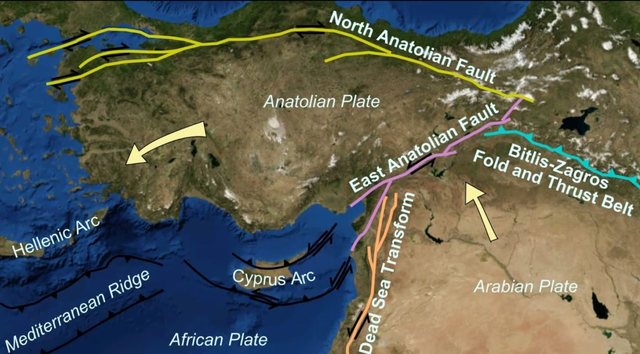
To understand why such violent earthquakes occur, see picture 2 (below). The red star indicates the area where the last earthquakes occurred in the Eastern Anatolian Rift. This fault is of the "slip" type, meaning that the two regions in contact slide horizontally relative to each other when an earthquake occurs.
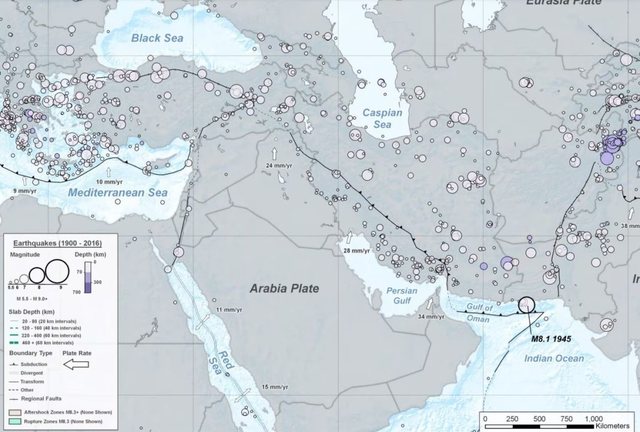
In this case, from the first data obtained, it seems that there was a slide of the northernmost fracture zone towards the south by about 2 meters. All this is due to the fact that the Arabian plate, which is located in the south, is moving towards the north-northeast at a speed of about 24 millimeters per year, and while in the north of the Persian Gulf it slides under Eurasia (where in photo 2 there are small triangles along a black line), along the eastern fault of Anatolia the plate creates a sliding movement.
Slip does not occur continuously, but only occurs when the forces involved accumulate in large amounts along the fault and at some point this suddenly releases them.


