"We are drowning..." - From Lisbon, Milan to Tirana, "The Guardi...
/ 2026-10-18 23:13:32Focus


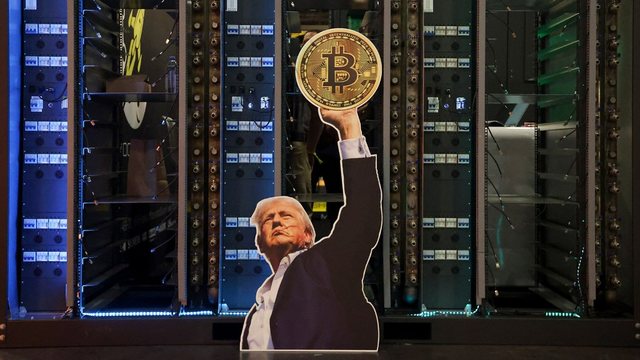
Donald Trump has made billions by listing crypto startup World Liberty Financial on the Nasdaq stock exchange, after he secured a favorable political framework.
US President Donald Trump and his family have been making billions in crypto ventures since returning to the White House, taking advantage of Trump's influence in a less regulated market. With Trump's sons running the venture, critics see a troubling mix of presidential power and personal pursuits.
From meme coins to stablecoins – digital currencies that are pegged to a fixed value – the financial gain is estimated to be over five billion dollars (4.25 billion euros). Critics draw attention to the president's unprecedented greed for profit in office.
Two ventures are fueling the Trump family's crypto profits: World Liberty Financial (WLF), a decentralized financial platform whose lending rules can be co-branded by users with the $WLFI token, and American Bitcoin Corp. (ABTC), a Nasdaq-listed Bitcoin exploration venture.
WLF is making millions from selling $WLFI tokens, which are tied to Trump's name, while ABTC, which is backed by his sons, owns significant amounts of Bitcoin. The price of the stock temporarily rose by about 110 percent after the IPO, settling at 16.5 percent above its initial price of $6.90. According to Reuters, Trump's company owns 60 percent of WLF and claims 75 percent of the proceeds from the sale of the coins.
Disturbing exercise of influence
Critics believe that the Republican president, with his dual role as a cryptocurrency beneficiary and political decision-maker, is undermining public trust by blurring the lines between government leadership and personal enrichment.
US lawyer and finance expert Ross Delston warns that crypto firms could offer a way for shady investors to gain political influence over Trump through digital coins.
"This is a new avenue that allows the president to take money from anyone, including people and countries that would be prohibited under US election campaign laws, or from people who have been convicted of criminal offenses or are under investigation," Delston told DW.
Trump relaxes rules on cryptocurrencies
Under Trump, longtime crypto promoter Paul Atkins became the head of the US Securities and Exchange Commission (SEC). One of the first executive orders signed by Trump in January was to ban all US authorities from creating or promoting a central bank digital currency (CBDC) – a government-issued crypto version of the dollar.
In March, he began creating a strategic crypto reserve by confiscating crypto assets. In the summer, Trump signed the Genius Act, the first federal legal framework for Stablecoins.
Grand banquets and political favors
The enthusiasm for cryptocurrencies has spread beyond politics to high-profile social events, particularly dinners and banquets for big digital investors hosted by the White House. The exclusive gatherings, with lavish menus and exclusive access to the president, are being criticized for mixing political power with private financial interests.
A prominent event was the Crypto Kings-Dinner in May 2025 at the Trump National Golf Club in Virginia, where Trump's $TRUMP Meme-Coin investors were invited, who had collectively invested $148 million.
At the event, 25 of Trump's top $TRUMP Meme-Coin investors were given private access to the president, while four of the largest co-shareholders were given luxury watches from Trump's collection. Justin Sun, a Chinese-born crypto billionaire and advisor to World Liberty Financial, was the most important guest, spending $18.5 million.
"This is likely another attempt by the government to link public office with private interests," Richard Briffault, a professor at Columbia Law School, told DW.
Regulatory authorities reserved, while critics call for action
US regulators have been reluctant to regulate cryptocurrencies. Washington has recently lifted some rules, such as the requirement to disclose the value of crypto assets on companies' balance sheets. This gives companies more room to maneuver to advance their businesses. While the SEC under former director Gary Gensler faced tough scrutiny and indictments, the measures under the second Trump administration have been largely ignored.
One of Trump's inner circle describes this development as "crypto capitalism with incentives." This branch is booming, but when it comes to ethics, transparency, and long-term stability, observers have raised many questions.
Alarming extent of layoffs in federal authorities
More and more headlines are being devoted to the firings of federal employees that the Trump administration has eyed, such as Reserve Bank Governor Lisa Cook, the director of the US Health Authority, CDC, Susan Monarez, or the head of the Labor Market Statistics Authority, Erika McEntire.
"The government has no qualms about firing people, including low-level employees, if they are not politically aligned with the government," says Columbia lawyer Richard Briffault. "There is no clearer signal than the firing of the director of the Bureau of Labor Statistics (Erika McEntarfer, d. Ed.). If they are willing, they are willing to fire anyone."
The climate of fear and retaliation has meant that regulators are not scrutinizing Trump's crypto projects critically - even when ethical issues are evident. Calls for tighter oversight are growing in Congress. Lawmakers are demanding clearer rules for digital currencies, more transparency for ventures like WLF, and conditions for employees with their own crypto holdings./ DW