Is this police force professional and capable of handling violen...
/ 2026-10-16 18:54:07Focus



By 2026, all municipalities are expected to be integrated into the new Fiscal Cadastre IT system, which will automatically calculate the building tax liability for both individuals and businesses.
This system will be used by municipalities to generate building tax invoices, which will contain detailed data on the residential area, the basic taxable value and the reference price per square meter. Detailed data on real estate will be entered by the municipalities and will be automatically processed by the municipalities in the system.
In the manual for using the Fiscal Cadastre information system, drafted by the General Directorate of Property Tax, the new model of the invoice for the building tax has also been published.
Unlike the current bill, the new bill will include more details for calculating the obligation paid by individuals and businesses.
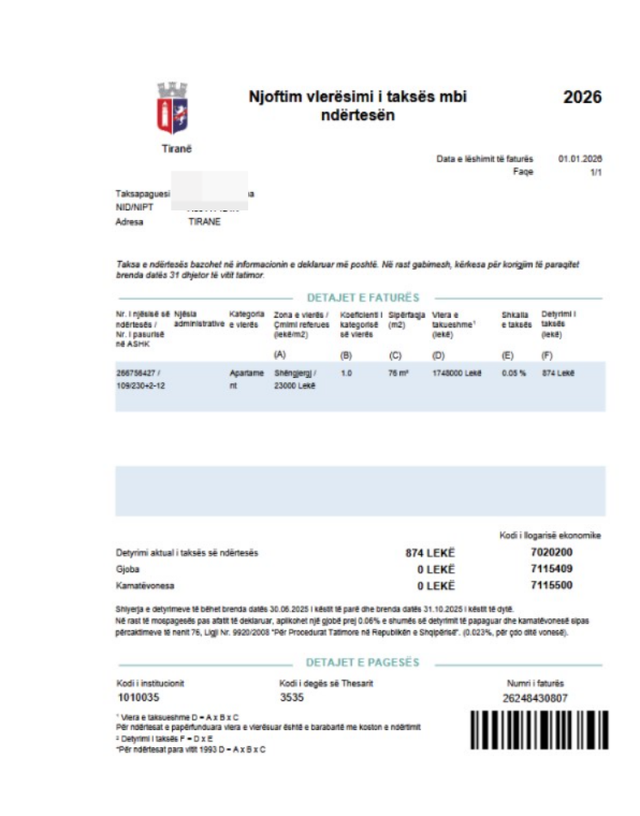
The new invoice will include data on the building unit number, the property number registered with the State Cadastre Agency, the reference price according to the cadastral zone where the property is located, the area of the apartment, the taxable value of the property (which is calculated from the reference price and area), as well as the building tax liability.
A concrete example of the invoice is that of the Shëngjergji area in Tirana, where for an apartment with an area of 76 square meters, with a reference price of 23,000 Lekë/m² and a tax rate of 0.05%, the taxpayer's liability is calculated at 874 Lekë for the year 2026. The invoice does not include fines or late payment interest, and the payment deadlines are clearly defined.
The invoice has the municipality's logo, data on the taxpayer and the building unit, the invoice number, the relevant account codes for payment, and the obligation to pay.
Currently, the building tax obligation for individuals appears on the water and drinking water bill and is paid monthly. For businesses, the obligation is paid in two installments. The payment deadline for the first installment is by June 30th and for the second installment by October 31st.
The data that will be entered into the system
The system is currently not yet fully integrated with all municipalities, but is expected to include all administrative units in the country within the year.
According to the manual, in the system, data is sorted by building unit number and users have the option to change their sorting according to various attributes such as: building unit number, property number in ASHK, area, value category, use in ASHK, municipality, administrative unit, street, cadastral zone, entrance, floor, door and active status.
The user manual explains that the system allows for taxpayer registration for building units that do not have taxpayer data, using the personal number for citizens, the business number for commercial entities, as well as the registration of foreign taxpayers.
The methodology for calculating the property value is based on the area, the average reference price, the coefficient for the value category and the privatization coefficient for residential properties. For units used for housing and without data on the area, the presumed area is used. The property value is determined as the highest among several different values such as the assessed value in bulk, the value in the IPRO, the sale price, the self-declared value and the construction price for unfinished buildings.
The tax base is multiplied by the tax rate approved by local self-government units according to categories: 0.05% for housing; 0.2% for economic activity; 30% of the rate for unfinished areas with a building permit.
Local units may adopt zonal subdivisions to adjust the rate within the limits of +/− 30%.
In cases where the property has more than one taxpayer, the obligation is divided into tax proportions for each of them.
The population and monitoring of data will be carried out by the General Directorate of Property Tax, ensuring an accurate and sustainable administration of the tax collection process.
By 2026, data for about 2.5 million real estate properties is expected to be recorded in the fiscal cadastre.
Meanwhile, the implementation of the new real estate tax, which was planned to come into effect in 2026, will be postponed for another two years and is expected to begin in 2028.
The Ministry of Finance has learned that a completely new draft law is being drafted, which will be approved in 2026, and will begin to be implemented together with the Fiscal Cadastre from 2028. The postponement comes after the consultations and preparations necessary to build a new taxation system, which will be based on the market value of real estate.