"We are drowning..." - From Lisbon, Milan to Tirana, "The Guardi...
/ 2026-10-18 23:13:32Focus


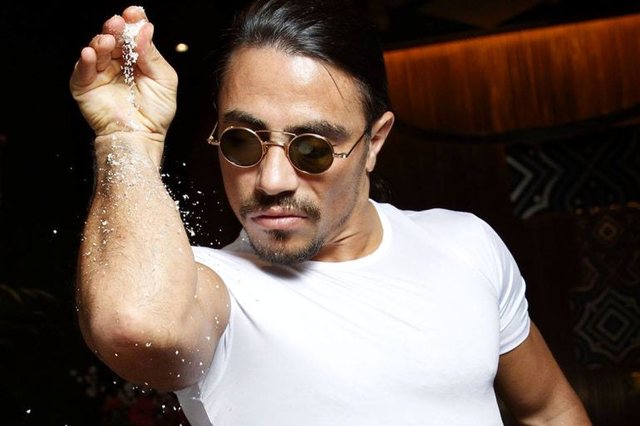
He turned a small amount of salt into a global brand and a £600 steak into a status symbol. But now, with a £5.5m loss in Britain and successive lockdowns in the US, Salt Bae's downfall signals the end of "showing off wealth" through food.
A man in sunglasses and a white short-sleeved shirt sprinkles salt, letting it slowly roll down his arm before landing on a steak, like “magic dust” for the rich. Even if you’ve never eaten at one of his restaurants, chances are you’ve imitated the gesture at your summer barbecue.
This man, Nusret Gokce, better known as Salt Bae, built a global steakhouse empire thanks to this video. His now-famous restaurant in Knightsbridge, London, opened in 2021 to much fanfare on social media, serving up £680 Wagyu striploin steaks and £50 gold leaf baklava to City footballers and golden boys.
New financial figures show that, despite a turnover of over £10m, the UK branch is recording a loss of £5.5m. In the US, only New York and Miami are being saved, while Beverly Hills, Dallas, Las Vegas, Boston and another New York venue have closed, burdening the group with “extraordinary expenses” of £6.6m. Officially it is “stabilising”, but for a brand that lived off the spectacle, the silence is eloquent.
When viral fame surpasses taste
However, the success was not about the food, but… the meme. The platforms that raised it today reward the simple and the everyday. Thus, the “bait” became a product, customers were locked in to “experience the meme”, not for the taste or recipe of its dishes.
According to the Independent, in Britain in 2025, with inflation approaching 3.8% and the “discretionary” spending target set at -9%, a £600 steak is not considered a “luxury” but an excess. The culture is shifting towards “quiet luxury”, that is, quality without fuss, and Gokce’s public profile, which shows video tours of ultra-luxurious mansions and “discounts” with four-figure bills, seems inappropriate.
From “appearance” to “belonging”
In contrast, the new trend in dining focuses on value and experience. Popular videos are about “where to eat for under £60” or “the best steak in London under £100”. Restaurants such as Hawksmoor are bringing back affordable lunch specials. It’s not that Britons have stopped eating out. They’re simply choosing places that offer comfort, authenticity and substance. For a country that has championed Sunday roasts and full English breakfasts, Salt Bae’s appearance seemed foreign.
London's Nusret was not aimed at Londoners. Knightsbridge means tourists, footballers and Gulf royalty, the same clientele as Miami, Dubai, Istanbul, Milan. According to the Agriculture and Horticulture Development Board (AHDB), consumption of meat, fish and poultry rose by 1.4% in January, while plant-based alternatives fell by 12.4% year-on-year.
Veganuary’s popularity has also waned, with just 5.6% of Britons taking part this year, a sign that the “vegetarian craze” is losing steam. But consumption has shifted direction. The issue is no longer about excess, but about quality: Consumers are looking for “real” food, rich in nutrients, not just protein. In this context, Salt Bae’s steak was the wrong form of luxury: flashy, inauthentic.
The irony is that Salt Bae's empire seemed untouchable, a global chain built not on Michelin stars but on the power of memes. In a decade when the fastest way to open a restaurant was to go viral, he seemed to have found the secret.
But the collapse of Salt Bae’s empire isn’t just business news. It marks the end of an era when food was a commodity, viral image was as important as quality, and gold leaf was considered a craft. Today, consumers are looking for the opposite: authentic, earthy, personal, slightly luxurious food. The Knightsbridge restaurant may survive, fed by tourists and the curious. But to the British palate, salt has lost its flavor.