Is this police force professional and capable of handling violen...
/ 2026-10-16 18:54:07Focus


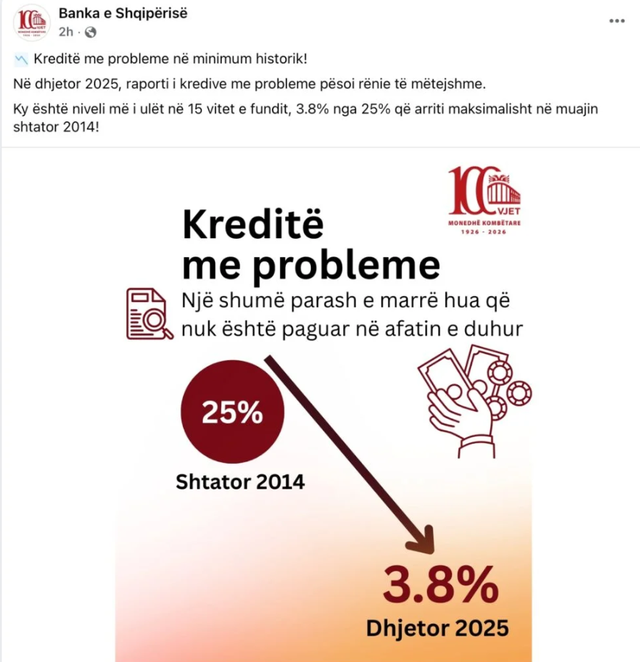
The Bank of Albania today publicly boasted of one of the most cited indicators of financial stability, the drastic decline in non-performing loans from around 25% in September 2014 to 3.8% in December 2025.
According to the institution, this is a great success that proves the health of the banking system and the strengthening of financial supervision in the country.
On paper, this assessment is accurate. The banking system today operates with high liquidity, record deposits, and banks that in some cases display "laziness" even to open new deposits.
From a strictly financial perspective, a low ratio of non-performing loans is a positive and desirable indicator.
But this is where the hypocrisy begins. The Bank of Albania chooses to show only the final result, while hiding the process that produced it, driven by the policies and inaction of the regulator itself. It was a brutal and devastating process for hundreds of thousands of Albanian families.
From 2014 to 2016, due to regulatory decisions to write off uncollectible loans after a certain period, banks (ProCredit Bank was the first to do so) began massive sales of non-performing loan portfolios. Their removal from the balance sheets automatically brought about a statistical improvement in financial indicators and the beginning of a rapid decline in non-performing loans.
But what was called a "balance sheet cleanup" for banks turned into a social tragedy for thousands of Albanian families.
Loan portfolios were purchased by debt collection companies, which then transformed into completely predatory structures.
Subsequent investigations and complaints revealed that companies such as Micro Credit Albania, Final, ADCA, Consulting Company, ZIG and similar ones systematically exerted pressure on debtors through incessant phone calls, threats, blackmail, seizures and appropriation of property.
Families who had received small loans years ago were faced with multiplied financial demands, without transparency, without legal clarifications, and often without any direct communication with banking institutions.
Apartments, land, warehouses, and other assets were transferred to these companies for amounts that made no economic sense, much less legal sense.
The scheme operated for years without any institutional intervention. In fact, similar to the current reign of IUTE Credit, Kredo.al and similar usurers, the scheme was tolerated by the Bank of Albania, as is happening now.
Public and investigative reports of criminal activity in the field of microcredit have been made since before the 2020 pandemic, involving a chain of companies and individuals operating openly in the center of Tirana, near state institutions, without being hindered by anyone.
From 2016 onwards, according to subsequent evidence and data, such companies had appropriated millions of euros in real estate belonging to hundreds of Albanian families, without any official inventory and without any social analysis by the responsible authorities.
The psychological and financial pressure on debtors reached extreme levels. Salary freezes, constant harassment in the workplace, involvement of family and relatives in the pressure for payment, daily anxiety and a constant sense of terror became a reality for many citizens.
The story of Mirela H, a mother of two who ended up without any income and under constant pressure due to an old loan, is just one of hundreds of similar stories that were never heard.
Such cases show how a loan taken out years ago, partially repaid, turned into a multiplied, unexplained and impossible-to-manage debt.
The culmination of this human drama was the tragic suicide of Pal Trashaj, which became a symbol of what many Albanian families experienced in silence. A human price that does not appear in any financial report and is not mentioned in any triumphalist statement.
Only after the public outburst of the scandal did the state begin to react, albeit belatedly.
Private bailiffs operating as bandits with the state seal, lawyers and real estate experts were reported to the prosecutor's office, while schemes of selling seals, manipulating auctions and transferring properties through fictitious procedures were discovered.
But the damage had already been done.
Today, the Bank of Albania talks about success, stability and historical indicators. What is not said is that this “success” was built on the economic and psychological destruction of thousands of Albanian families, on the loss of property and on a system that for years allowed credit predators to operate without restraint and fear of the law.
The reduction in non-performing loans is statistically real.
But the way it was achieved, and the price that Albanian society paid for this result, remain a grave moral and institutional stain, for which there is still neither full responsibility nor sincere reflection. / skyweb.al