Is this police force professional and capable of handling violen...
/ 2026-10-16 18:54:07Focus


There is something paradoxical about the way Albania deals with fuel prices. Every time the numbers increase, the same instruments appear: transparency board, warnings to operators, temporary tax reductions, etc. Yet each crisis continues to be felt and resembles the previous one. Every time prices increase, confidence falls and we return to the same question: Is this really all we can do?
In the European Union, but also in the region, the crisis manual is evolving. Kyriakos Mitsotakis has unveiled a system to cope with the fuel price crisis, which aims to mitigate costs for families, publishing the mechanism of how it will work. Italy continues to combine fiscal balancing with structured market surveillance. On the other hand, countries in the region such as Kosovo, Montenegro and North Macedonia have at various times intervened directly in prices, margins and supply conditions.
On the contrary, Albania has improvised. It has never planned to anticipate such crises.
Perhaps the time has come to move beyond the proactive style of governance and enter a phase of structural thinking. Not through left or right political ideologies, but through calibrated innovation, even if this movement is sometimes uncomfortable.
The state as a "competitor"
The idea that the state could enter the fuel import market may, at first glance, seem like a radical move and a signal of the establishment of a monopoly scheme. Politically it may seem absurd, but economically it makes sense: to fight the operators’ agreement on price and to stimulate some competition. In reality, it is a modern regulatory instrument, which translates into strategic participation, without dominating the market. As has been discussed in the past, Albania could create a small importing entity supported by the state or a public-private vehicle with a clearly limited market share. The purpose of this vehicle should not be profit, but to “reveal” the price. By periodically publishing a complete structure of the cost of fuel imports, from the international purchase price, to insurance, storage and the final margin, this entity would become a point of reference for each operator. This is the model applied by Italy in the past, where it shows that the presence of the state in the market, however limited, could serve as a stabilizing factor against distorted tendencies of competition. Such transparency for Albania, where suspicion about the price is high, would not necessarily lower the price, but it would make unjustified price changes more difficult.
Balkan fuel alliance
Albania’s second structural weakness is the scale at which it operates. Our country is small and fragmented in the global market, which limits its bargaining power and translates into higher costs per liter at the point of purchase. A coordinated mechanism for purchasing and/or stockpiling fuel with Kosovo, Montenegro and North Macedonia could make a fundamental difference to our position. Together they could aggregate demand, negotiate better terms by volume, optimize logistics and, most importantly, reduce the impact of surges in volatile times through shared reserves. Regional energy cooperation exists in other forms and is not new news. Expanding this cooperation to fuel procurement at this time would be the logical next step. For each of the economies in the region, price is determined by scale. Joint action would not eliminate global price shocks, but it would change the way these shocks are absorbed.
New law on the price formula
Even when prices have been lower, there remains a problem of lack of trust in how these prices are formed. In Albania, perceptions are that fuel prices are covered by a “dark curtain”, and darkness fuels speculation. A legal requirement to make pricing formulas transparent would directly address this problem. Major market operators could be required to link their prices to identifiable components, including international standards, taxes and margins, and logistics costs. This would not impose a fixed price, but a clear logic. Greece has strengthened monitoring mechanisms during periods of crisis, while North Macedonia has long used pricing models linked to international standards. Albania could adopt a similar approach, notably to that of Greece, by turning uncertainty into calculation and moving from suspicion to legitimate verification.
Fuel dividend
Taxation of fuel and its ingredient list per liter has been discussed frequently. At such times when the price increases, tax revenues increase and this is logical. This creates a situation where the state has greater fiscal benefits, while citizens bear higher costs. A fuel dividend would rebalance this relationship. First, this requires setting a baseline level of fuel-related tax revenues. Then redistributing any “surplus” collected during periods of high prices. So, if the government taxes above the price of 215 lek per liter, it should keep only the taxation of 170 lek per liter and redistribute the rest of the revenues in the form of a dividend. The distribution mechanism could be through discount cards for citizens, as Greece is applying. This countercyclical method could share the cost burden fairly between the state and citizens. On the other hand, Italy has experimented with fiscal easing, as we have, but Albania could go further, institutionalizing this principle. The goal would not be to subsidize consumption indiscriminately, but to ensure that the increase in public revenues does not come at the expense of citizens.
Free energy zone
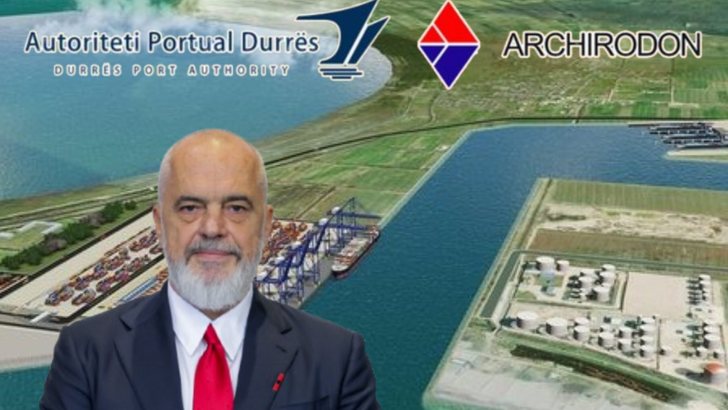
The price of fuel is not determined solely by the global market. A fundamental part of the price increases as a result of logistics costs. The fact that Albania relies on the Port of Durres makes it a key element in the price chain. The pronounced lack of efficiency of port operations, customs procedures, warehousing and internal transport, translate into additional costs, which are reflected in the price at the pump. One solution to reduce these costs is the construction of a free energy zone, dedicated to logistics in the Port of Durres to improve the efficiency of the entire supply chain. This would translate into faster cargo handling, more efficient customs processes, centralized warehousing and digital tracking systems, which would not immediately reduce operating costs, but would be cumulatively important in the case of this crisis. Countries like Greece are the best example to show how efficient logistics can support more stable and more responsive prices towards the consumer. Albania's advantage is not its favorable geographical position, but the way it is exploiting it.
"Government without Cars" as an example
During periods of rising fuel prices, the government could introduce a temporary initiative to reduce fuel consumption within the administration. This could include encouraging some sectors to work remotely, limited use of vehicles, and support for employees who group together to travel by vehicle. Of course, this does not have any direct impact on overall consumption, but the symbolic effect would be considerable. This model has been consistently advised by the International Energy Agency in periods when fuel prices have increased rapidly. By implementing this principle, Albania would send the message, especially to the main companies in the country, that adaptation starts with the state itself, reinforcing and supporting the measures taken and those it plans to take in the future.
Partial refining
This is not about bringing back refining capacity, nor as a nostalgic project. The point is that the refining revival project may not be economically viable, but a partial operation could be a possibility. Albania could explore flexible models such as modular refining or processing of reserves, developed through PPPs, where the primary risk is assumed by private capital. Greece still maintains a refining and storage infrastructure to help its sustainability. Meanwhile, Albania remains entirely dependent on imported refined products. Reducing this dependence, even partially, would directly affect the sustainability of fuel prices.
These proposals are not easy to achieve. Some of them require higher institutional capacities. Others need regional coordination and political will. The price of fuel in Albania is not just an economic issue. It is about sovereignty, transparency and planning by the system. Already, the region has been set in motion by changing approaches and adapting to the new reality. We do not yet know whether Albania will continue to react within such a limited framework, not taking into account new scenarios that have already begun to be applied by others.
What seems unrealistic today ends up being applied as a new reform tomorrow, especially when reality refuses to remain unpredictable.